
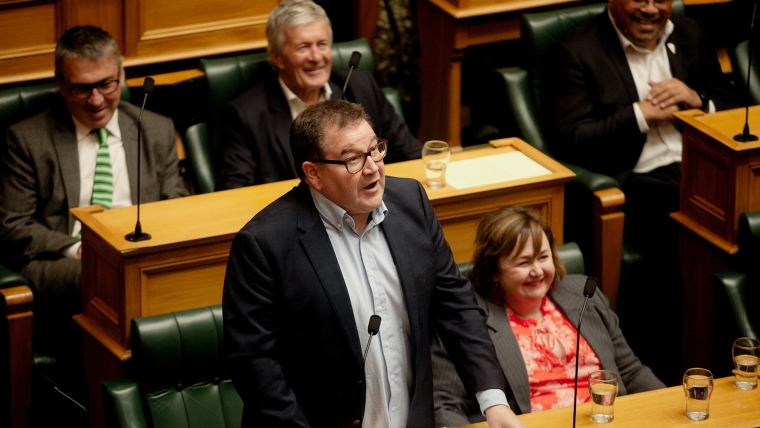
“Numbers don’t tell the full story,” Grant Robertson said to a near full house of his parliamentary colleagues from both sides of the house on Wednesday.
A quick headcount would’ve revealed a conspicuous absence of the entire New Zealand First caucus, but Prime Minister Christopher Luxon and his finance rival Nicola Willis were there.
Numbers may not be everything, but Roberton’s farewell missive, spanning three decades in politics, was full of numbers that have defined his career.
From his first start in the Beehive where his job was to “count to 61” for Helen Clark’s chief of staff, to the “nine long years” in opposition as the MP for Wellington Central — he was always counting.
He didn’t list the five failed Labour leaders and his own unsuccessful bids that came before Jacinda Ardern took them into Government, with a little help from Winston Peters.
“When Jacinda asked me to be the Minister of Finance, I told her it was on one condition – that I was Minister of Sport and Recreation as well,” he said in his speech.
“She said a few people had expressed interest in that role. I asked her how many of them she had asked to be Minister of Finance?”
His successor, Nicola Willis, laughed perhaps too enthusiastically as he described the antics of his colleagues while negotiating budget allowances in their portfolios. It’s a difficult job.
“I was going to ask the Parliamentary Library to calculate how many times I used the word “balance” as Minister. But I feared the computer server would explode,” he quipped.
Robertson's first two budgets were in surplus and he looked likely to carry on the fiscally responsible legacy of his mentor Michael Cullen.
New spending in those budgets—the Winter Energy Payment, free year of university, and more support for families—are mostly surviving the change in Government.
Anything less is austerity
Robertson defended the increase in Government spending as a percentage of the economy that had occurred under his watch as being a necessary correction from austerity.
“When we entered government in 2017, government spending was 27% of GDP. That’s not enough,” he said.
“It’s the reason why we had sewage running down the walls of hospitals, it's why nurses and doctors were so underpaid, it's why we saw a growth in homelessness and more kids in poverty”.
Labour’s spending peaked at above 34% of GDP during the pandemic and was forecast to slowly shift back towards 30% — though some were skeptical that prediction would play out.
“The long run average is a bit over 30%. Anything less is in my mind austerity. We are still dealing with the intergenerational damage from that approach in previous decades. We must not repeat the same mistakes”.
Robertson also argued New Zealand had received a good return from the higher spending in the form of more state homes, classrooms, apprentices, and front-line worker pay.
But it was the enormous wave of spending unleashed in the face of the pandemic that will always be the biggest part of Robertson’s legacy.
Pandemic stimulus
He recalled the Cabinet meeting in which they agreed to shut the borders in early 2020.
“I tried to lighten the moment by noting that I knew when we went into coalition with New Zealand First our immigration policies might change, but I didn’t think it would go quite this far. Jacinda didn’t laugh.”
Economic forecasts at the time were suggesting bond markets could dry up, business would fail en masse, and unemployment would climb to 13.5%.
“The government’s approach to the virus was to go hard and early. In the finance space this translated to focusing on cashflow and confidence,” he said.
The wage subsidy was designed to keep people in their jobs, save businesses, and be available almost immediately. It ended up costing roughly $19 billion.
Other schemes were set up to support specific parts of the economy: cashflow loans for small business, finance guarantees for larger ones, and the covid-19 income relief payment.
It all worked. Unemployment stayed below 5.5% and international rating agencies actually upgraded New Zealand’s credit worthiness.
“These great results of course pale into insignificance in the face of the one statistic that matter: the number of lives saved. On that measure New Zealand stood head and shoulders above others, with lower death rates than in normal years,” Robertson said.
Unfinished business
Robertson spoke about his legislative achievement modernising the Reserve Bank — most of which will survive despite the Coalition Government removing the employment mandate.
And he also called attention to the Depositor Compensation Scheme which the central bank is busily working on implementing to go live next year.
“New Zealand has been an outlier with not having a formal protection scheme for depositors when a financial institution goes belly up,” he said.
“Our strong prudential framework makes this a rare occurrence, but the worst can happen (think South Canterbury Finance) we need to give account holders and investors confidence that their money is safe”.
However, there was one big job he didn’t get done: reforming the tax system which leans too heavily on income and spending — while largely leaving capital alone.
“New Zealand’s tax system is unfair and unbalanced. We are almost alone in the OECD in terms of not properly taxing assets and wealth in some form,” he argued.
“It is not my place any longer to say specifically what the answer is here, but I do know that the answers are out there. And this is not a message for my party alone. The truth is that we need some political consensus about this to ensure we get it right and it sticks”.
The IMF agrees but Willis doesn't. After the speech she shook his hand and asked him to sign an infamous political cartoon by The Post's satirist Sharon Murdoch.
It depicts Willis looking over the precipice of a metaphorical fiscal hole and asking for the plan to fill it, as Robertson pushes her in.
We welcome your comments below. If you are not already registered, please register to comment
Remember we welcome robust, respectful and insightful debate. We don't welcome abusive or defamatory comments and will de-register those repeatedly making such comments. Our current comment policy is here.