
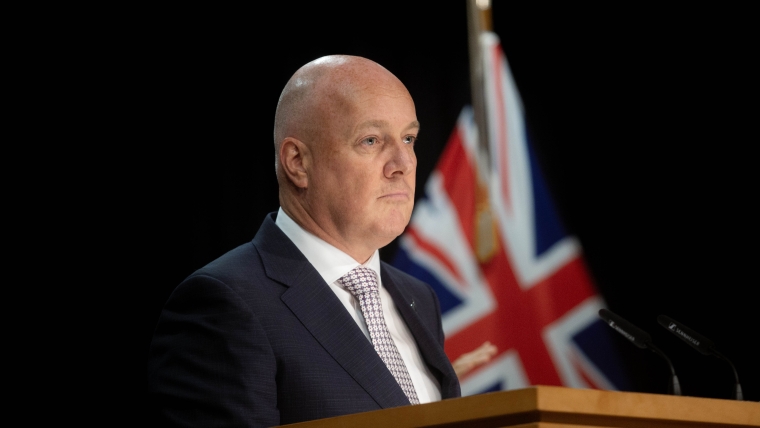
Prime Minister Christopher Luxon has announced nine goals for the public sector to achieve over the next six years.
He said New Zealand had been going backwards in recent years and these public service targets would help turn things around.
The list includes 95% of patients being processed through hospital emergency rooms within six hours, and spending less than four months on the waitlist for elective treatments.
A 15% reduction in youth reoffending and 20,000 fewer victims of violence. School attendance should be lifted until 80% of students are present for 90% of the term.
There should be a 75% reduction in the number of households in emergency housing and net greenhouse gas emissions should be on track for the 2050 net zero target.
There are no explicit economic targets other than reducing the number of people on the Jobseeker Support Benefit by 50,000 or approximately 25%.
This target is a nominal number which will ignore population growth and the ongoing decrease in employment after several years of a historically strong labour market.
Luxon said the average adult on a benefit was staying there for 13 years on average.
This is not true of the Jobseeker benefit, which includes people ready for full-time work and those who have some sort of disability. People are on Jobseeker for an average of three years.
A better measure of how long people were spending on that benefit before exiting would be the median number, which was just under two years. But many go back on it at some point.
What the Prime Minister was referring to was 2022 modelling which estimated the amount of time current beneficiaries will spend on any of the main benefits, excluding superannuation.
Those currently receiving the work ready Jobseeker benefit were forecast to spend an average of 13 years receiving some kind of government support before turning 65 and retiring.
The median person was predicted to be spending roughly nine years on a main benefit in the 2022 forecasts, up from seven years in 2019.
Main benefits refers to the youth benefit, both kinds of Jobseeker, sole parent support, and supported living, but it excludes superannuation and other government transfers.
The number of work-ready Jobseekers was increasing prior to the pandemic as the exit rate fell from about 17% to 14% after Labour took office in 2017.
Forecasts by Taylor Fry expected the exit rate to stabilise in 2025, after pandemic and inflation related volatility, albeit at a structurally lower level than in the decade to 2019.
Lower exit rates and a higher future unemployment rate were the main drivers of the extra years Jobseekers were predicted to spend on some kind of benefit.
A model is a simplified version of reality that simulates future outcomes based on historical data. They are useful for policy making but are rarely perfect predictions of the future.
Surging social investment
Luxon said the 50,000 reduction target was “ambitious” and had been chosen in discussion with the Minister for Social Development and relevant chief executives.
The goals set out on Monday were supposed to be “provocations” for conversation that will occur between the Prime Minister, ministers, and agencies at Strategy Committee meetings.
This is a new Cabinet sub-committee Luxon will chair to track progress on these targets and make decisions about where to direct resources.
He suggested more money could be targeted at helping Jobseekers into work using the social investment framework pioneered by Bill English in the previous National Government.
“When you think about [how much] we’re going to spend in the next six years supporting people on welfare, we’re better off taking some of that money and surging it, and do social investment properly, so that we can get people set up for success,” he said.
Luxon said he wanted social investment to be the basis of his government’s social policies.
Economic policies would be based on enhancing productivity and environmental policies would be focused on reducing emissions.
Social investment is based on three principles: taking a customer focus to services, making decisions based on long-term returns not upfront costs, and using data to refine settings.
Luxon’s list of nine targets is:
- Shorter stays in emergency departments: 95 per cent of patients to be admitted, discharged, or transferred from an emergency department within six hours.
- Shorter wait times for (elective) treatment: 95 per cent of people wait less than four months for elective treatment.
- Reduced child and youth offending: 15 per cent reduction in the total number of children and young people with serious and persistent offending behaviour.
- Reduced violent crime: 20,000 fewer people who are victims of an assault, robbery, or sexual assault.
- Fewer people on the Jobseeker Support Benefit: 50,000 fewer people on Jobseeker Support Benefit.
- Increased student attendance: 80 per cent of students are present for more than 90 per cent of the term.
- More students at expected curriculum levels: 80 per cent of Year 8 students at or above the expected curriculum level for their age in reading, writing and maths by December 2030.
- Fewer people in emergency housing: 75 per cent reduction of households in emergency housing.
- Reduced net greenhouse gas emissions: On track to meet New Zealand’s 2050 net zero climate change targets, with total net emissions of no more than 290 megatonnes from 2022 to 2025 and 305 megatonnes from 2026 to 2030.
We welcome your comments below. If you are not already registered, please register to comment
Remember we welcome robust, respectful and insightful debate. We don't welcome abusive or defamatory comments and will de-register those repeatedly making such comments. Our current comment policy is here.