
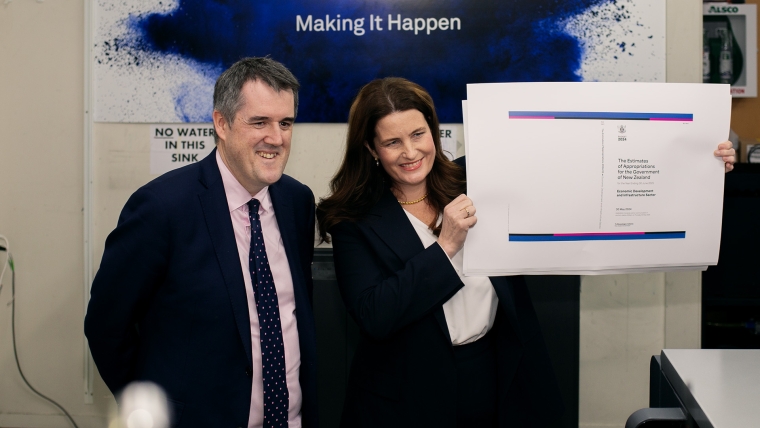
Finance minister Nicola Willis says she expects the outcome of policy work aimed at closing tax loopholes for not-for-profit businesses to be announced in the budget next May.
The government included a review of tax rules for charities and not-for-profit entities in its work programme. It will explore whether charities which run commercial businesses should have to pay tax on profits retained within the business.
Some examples of charities which operate commercial businesses include Weet-Bix maker Sanitarium, early childhood education company BestStart, and South Island iwi Ngāi Tahu.
This policy work, as well as a new requirement that infrastructure projects look for a user-pays model before seeking Crown funding, meant Willis was unable to promise no new taxes in the next two budgets.
During a Finance and Expenditure Committee hearing on Tuesday, opposition MPs repeatedly asked the minister if she could rule out revenue raising measures this term.
Willis said the government would rely on a package of spending, savings, and new revenues to stay within the annual operating allowance of just $2.4 billion.
“In the last budget, we did use revenue measures. We increased immigration levies for users… we also increased some fees in some areas, and removed commercial depreciation”.
“I intend to continue to take that umbrella approach which lets us stick to our operating allowances, while also giving us some new sources of revenue,” she said, offering up toll roads as an example of new revenue.
Earlier in the week, Infrastructure Minister Chris Bishop announced the cost of new projects should be covered by users wherever possible. This might mean congestion charges on motorways, road tolls on highways, water levies for new pipes, and targeted rates for residential developments.
These are in place of general taxes and don’t necessarily mean households will pay less overall costs for public services and infrastructure. It may even lead to higher tax-like costs for those who live in areas in need of upgrades, while those in well served areas save money.
User-pays models also make it easier for private developers to finance and operate public infrastructure. This saves the Government from having to rack up debt but can increase the overall cost of the project, as the private sector faces a higher cost of capital.
On the flipside, having that commercial pressure can mean projects are better managed and stay on budget — at least in theory.
In a press release, Labour’s finance spokesperson Barbara Edmonds said the Government needed to be more upfront with New Zealanders about how much “more expensive life will become”.
“Nicola Willis cannot pay for everything she has promised with cuts alone, but refuses to say what new revenue measures she will bring in. She must be upfront with Kiwis about what her sneaky taxes will be,” she said.
Speaking to reporters after the hearing, Willis said these toll roads and the possibility of charity tax reform meant she couldn’t promise no new taxes this term.
“I think it would be wrong to give a definitive no to that, when the truth is I will be looking at revenue from tolls. There could be tweaks to the charity tax regime. What I can rule out is a wealth tax or a capital gains tax,” she said.
On the weekend, the Labour Party membership voted to continue working on a tax proposal which could provide extra revenue to support Crown borrowing and fund social services.
Labour needs lessons
Opposition committee members became frustrated during the meeting, which is part of a new process called Scrutiny Week, and complained Willis was giving overly-long replies to simple questions and using them to attack the previous Government.
Asked about this, Willis told reporters she had to deal with the fallout of “six years of economic mismanagement” every day and Labour needed to learn from its mistakes.
“And so, when I hear people tell me that, it's all going to be simple and we'll just have more debt, and more tax, and it'll all be fine, I feel I need to remind them of those lessons”.
In the hearing, she agreed the economy would grow more quickly if she loosened her fiscal policy. “But we just did that, and the pain at the other end is not worth it,” she said.
We welcome your comments below. If you are not already registered, please register to comment
Remember we welcome robust, respectful and insightful debate. We don't welcome abusive or defamatory comments and will de-register those repeatedly making such comments. Our current comment policy is here.