
By Chris Trotter*
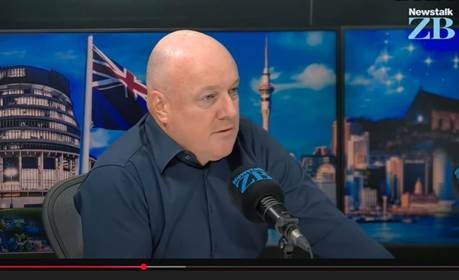
Christopher Luxon’s exchange with Mike Hosking was revealing in a way the Prime Minister almost certainly did not intend. The extraordinary Newstalk-ZB interview has since gone viral and occasioned much incredulous head-shaking among the voting public.
All Hosking did was ask Luxon if he would have sacked his twice-errant minister, Andrew Bayley, had he not pre-emptively resigned all his portfolios. The obvious one-word answer was: “Yes.” Simple, decisive, and bound to reflect well upon Luxon as a political leader. The one-word response that would have allowed Hosking to move on a lot sooner to other topics.
But Luxon couldn’t do it. The easy serve that Hosking had lobbed across the net was not returned. It was too much for the ordinarily supportive radio host. Utterly bemused, Hosking persisted, as did Luxon. The PM’s formulaic prevarication continued – as unfathomable as it was excruciating.
The near universal public response was: Why? Why can’t the Prime Minister give a straightforward answer to a straightforward question? Why can he not abandon the tortured syntax of corporate-speak in favour of plain English? Or, more seriously, from the point of view of a government struggling to secure a second term: What’s wrong with this guy?
What indeed?
Perhaps the best place to go looking for an explanation is in the brief tenure of David Shearer. (Labour MP for Mt Albert 2009-2016, Leader of the Opposition 2011-2013.)
Shearer had arrived in the Labour Party caucus with a fantastic back-story. Not, like John Key and Luxon, from the world of business, but from the world of administrating and delivering international assistance to people in desperate need. Caring and heroic: Shearer seemed tailor-made for the job of leading Labour back to power.
If only he had been able give straightforward answers to straightforward questions.
Meeting Shearer away from the cameras and the microphones, his problem with effective communication was easily explained. He could not say what he really thought about the important issues confronting his country because, had he done so, his party would have disowned him.
Shearer had welcomed the reforms of the Fourth Labour Government and clearly held the prime mover of those reforms, Roger Douglas, in high esteem. Unusually for a United Nations bureaucrat, Shearer had prized the efficiency and effectiveness of private-sector providers. On social issues his instincts were not altogether aligned with those of his “progressive” comrades.
In short, the man behind the back-story – the real David Shearer – could not speak plainly and forthrightly from his heart. Not without raising a political storm in his own ranks and across Labour’s support-base.
The reason Shearer’s communication was so clunky, so lacking in authenticity, was because he was forever having to convert all the responses he wanted to deliver into the responses the Labour Party needed him to deliver. Only very rarely did the content of the two responses, his and theirs, coincide.
When that happened, or, when the circumstances required him to use a teleprompter, Shearer was a very effective speaker. Most of the time, however, his communications were as tortured as Luxon’s, and, almost certainly, for the same reason.
Before answering a question, especially in front of reporters, or on-air, Shearer appeared to be anxiously reviewing his own thoughts and, if he suspected they might get him and/or Labour in trouble, substituting the policy responses thrashed out with his advisers.
This careful regurgitation of pre-arranged talking-points prevented Shearer from making any kind of lasting impression on the voters. New Zealanders never got to meet the person who could stare down men with guns, and deliver food to the starving.
Labour wanted heroism, sure, but heroism stripped of actual heroics. They did not appear to understand that while people may laugh at a ventriloquist’s dummy, they are much less likely to vote for one.
What is National afraid Luxon might say. Which ideas and aspirations have Luxon’s advisers persuaded him to keep out of sight?
The first big “negative” Luxon was persuaded to drop was his propensity to openly manifest his Christian faith – especially as it impinged upon the vexed issue of abortion. He was tutored by his National Party advisers to present his Christianity as an entirely private matter. Accordingly, Luxon reassured New Zealand’s largely secular electorate that he would never allow his faith to intrude upon or influence important policy debates.
There were other negatives, too. Telling a British Conservative Party audience how much he admired the austerity measures of George Osborne – David Cameron’s penny-pinching Chancellor of the Exchequer. His pilgrimage to the Institute of Economic Affairs, the London-based think-tank widely credited with supplying the hapless Liz Truss with policy advice that came close to crashing the UK economy. Explaining to a startled cocky how New Zealand had “lost its mojo”. Announcing his personal disdain for “bottom-feeders”.
National’s concerns about Luxon, like Labour’s concerns about Shearer, are likely generated by the fear that he is a great deal more conservative than it would ever be politically prudent to share with the voters.
Most New Zealanders are not so uncomfortable with abortion that they would sanction its prohibition. Austerity is not a popular economic strategy. Very few Kiwis are hankering for the extreme free-market policies peddled by the Institute of Economic Affairs. (Although David Seymour is a fan.) Nor are they all that keen on politicians who lament their compatriots’ loss of “mojo” (whatever that may be) or refer to those helping the poor as “bottom-feeders”.
National’s image of Luxon, the image they want the public to keep in focus, is of a high-flying, former corporate CEO, with all the skills needed to get New Zealand “back on track”.
The National Party’s Luxon promotes economic policies that are mainstream and much-needed – a far cry from the reckless policy-settings of his predecessors. His Finance Minister, Nicola Willis, is not a fan of Osbornian austerity. (No matter how closely her policies might resemble it.)
Extremism forms no part of the National Party Luxon’s political credo. On the contrary, he’s a politician entirely comfortable in the centre ground. No one’s ever going to catch their Christopher Luxon behaving like Donald Trump!
Certainly, no one is ever going to catch Luxon communicating like Trump. There is absolutely nothing free-wheeling, free-associating, browbeating, or suddenly terrifying about the New Zealand prime minister’s speaking-style.
Luxon’s speech is that of a man unswervingly loyal to his cheat-sheet; a man determined never to stray from the agreed talking-points; a man who doesn’t care if he sounds unspontaneous and inauthentic; a man who favours impenetrable corporate jargon over plain speaking; a man who, last week (25/2/25) point-blank refused to let Mike Hosking make him sound like a firm and decisive leader.
All of which raises the deeply disturbing question: If that is the sort of man Christopher Luxon is happy for the world to see; then, what, exactly, is the nature of the man he is willing to endure so much public ridicule to keep hidden?
*Chris Trotter has been writing and commenting professionally about New Zealand politics for more than 30 years. He writes a weekly column for interest.co.nz. His work may also be found at http://bowalleyroad.blogspot.com.
We welcome your comments below. If you are not already registered, please register to comment
Remember we welcome robust, respectful and insightful debate. We don't welcome abusive or defamatory comments and will de-register those repeatedly making such comments. Our current comment policy is here.