
How do you pay for a multi-billion-dollar harbour crossing without chewing into funding for hospitals, schools and other social infrastructure? The Infrastructure Commission’s answer begins with a number: $9.
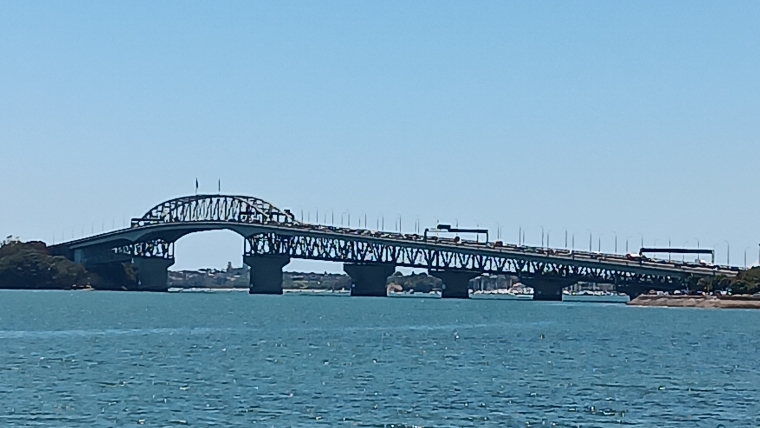
The Infrastructure Commission has put that price on the table for the current and future Auckland harbour crossings, saying its proposal reflects the maximum sustainable toll to help fund the multi-billion-dollar project.
Infrastructure Commission chief executive Geoff Cooper said the figure represents the revenue-maximising charge to raise up to $7 billion to $9 billion, and is intended to spark a broader debate about how New Zealand pays for its most expensive infrastructure.
“How have we got the $9? The question we're asking here and that we have been asking for several years now is, can tolls pay for new roading infrastructure? And for a great many of the roads that we are contemplating, the answer to that question is unequivocally no," Cooper said.
“Tolls do not cover a significant proportion of the capital and ongoing, renewal and replacement requirements of the roads.”
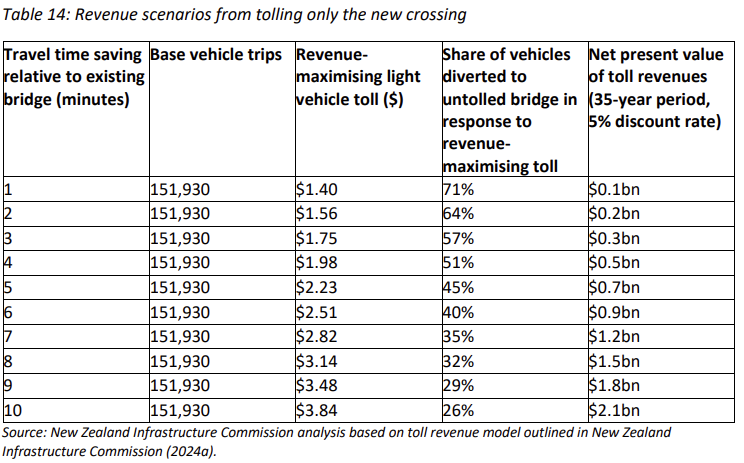
Cooper said $9 was the estimate of the most amount of revenue that you could collect to then fund the capital cost of a new crossing.
“If you charged a little bit less than $9, the revenue would fall, and if you charge more than $9, people would substitute away from the bridge, maybe they wouldn't make a trip and your revenue would fall.”
Inflation adjusted
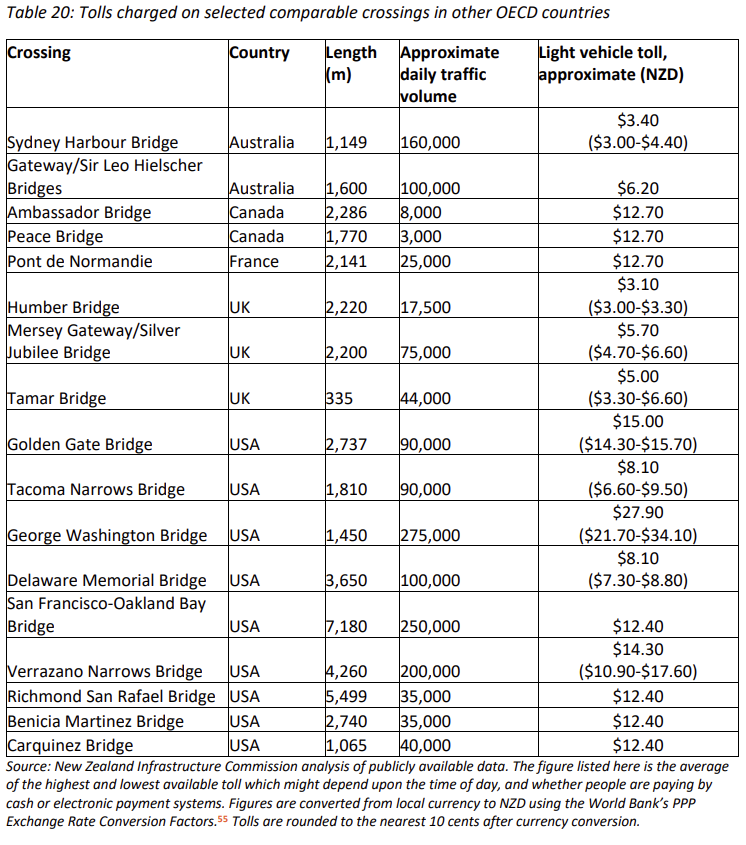
Cooper said coincidentally the $9 figure was the inflation adjusted number from the harbour toll in the 1960s.
“It tells you that we have paid this kind of toll to build this kind of project in the past. We don't make any assumptions about the acceptability of that toll, but you can observe that it's something we have paid before.”
Cooper said they put the number out “because it helps folks understand what a reasonable capital envelope for the project could be, and that capital envelope is somewhere between $7b to $9b".
There was a choice for ministers on what the toll should ultimately be, he said, or if there should in fact be a toll, or if it could be done alongside other broad based funding instruments, such as a Funding and Financing Act (IFF) levy, “as in what Wellington has done with its sludge minimisation plant”.
“You could say, $9 too much, and you can conclude that actually the project needs to get smaller than $7b to $9b… Our view would be, that's exactly the right discussion to be having," Cooper.
“We're trying to use the revenue maximising tool to help people understand a project envelope that would give confidence to a decision maker, to write it down in a budget such that they didn't crowd out a tonne of other investments or have to go down a funding path that required non-users to contribute to the toll.”
Cooper said the motivation for offering tolling revenue advice was to spark conversation about safeguarding funds for social infrastructure such as hospitals and schools.
“With the Auckland Harbour Bridge, this is our most expensive infrastructure project on the horizon and what is unique about this project is that it has… a very narrow, if not no, path to funding through conventional funding tools.”
'We don't even know what we're building yet'
During a Q+A in Auckland on Thursday, Transport Minister Chris Bishop was asked about the toll proposal.
“I want to stress we're a wee way away from a decision, we don't even know what we're building yet.
“I get people want certainty. But also when you're spending like 15 billion bucks of government money on a new bridge or tunnel - not saying one or the other. People would want us to take a proper process around it, I don’t think that’s unreasonable.”
“We're not shagging spiders here. We're like creating a massive multi generational infrastructure project for New Zealand for the next 50 years of New Zealand. So let's get it right.”
Finance Minister Nicola Willis on RNZ called the toll proposal a “completely hypothetical scenario in the Infrastructure Commission's plan”.
“It's not something that the government has given consideration to."
24 Comments
If people don't want to pay a toll that would pay for the project, then it shouldn't go ahead. Everyone wants a $20 billion project in their backyard if its free, but paying for a $20 billion project is another thing...
They'd rather it in the form of inflation or taxation, then it'd seem free.
Human nature is funny like that. People would rather pay someone $50 an hr to take 10hrs to do something, than $80 an hr for someone to do it in 5hrs.
The bit that no media seems to have picked up on is that even if every vehicle (including buses and trucks) crossing paid $9 each way, the revenue wouldn't even cover the interest bill of the debt to build the bridge.
- Approx 65 million vehicle trips each year
- Approx $585m Revenue
- Estimates for new crossings range from $15 billion to $45 billion
- With NZ Government bonds at 5%, the revenue will from the toll will cover somewhere between 25% - 75% of the interest costs, and none of the capital.
This is true for every toll road. Is it user pays or not?
User subsidized I guess.
The government will socialize some of the costs, and the users pick up the remainder.
Happens fairly frequently with council expenses also.
Similar maths with the Northern Gateway toll which collects around $16m a year. Doesn't touch the sides of the debt and interest, not even sure it would cover the road maintenance and cost of the toll collection system! Of course they should raise the tolls but they don't feel they can. And they are way lower than $9 a trip.
And anything PPP related the cost shoots through the roof.
Remember Waterview tunnel and Transmission Gully aren't tolled because they knew it would divert so many users that they wouldn't get enough benefits from the roads to build them in the first place.
Weird that Infrastructure Commission didn't use these NZ examples.
“I want to stress we're a wee way away from a decision, we don't even know what we're building yet."
But we have a plan...apparently
The problem when governments plan these days
They do endless enquiry in the pursuit of getting it right, as they are accountable to the electorate.
But, as well all should know
Perfection gets in the way of good.
Not so much perfection gets in the way of good but more a case of naming something that it isnt
https://www.beehive.govt.nz/release/national-infrastructure-plan-delive…
It's still a consideration.
The government, with all its scale and purchasing power, would still spend 25%-30% more building a house than GJ Gardiner, of similar quality. Part of that is servicing the oversight and approval requirements of government.
So something about government approach needs to change, or they should just get someone else to do things. I would prefer the former.
All of which does not address the fact we do not, repeat do not, have an infrastructure plan.
A plan would identify (and quantify) need
It would appraise methods of meeting that need
It would state the capabilities and capacities required to implement the selected method(s)
It would cost that method
It would outline how those costs were to be met
It would have timeframes.
We arnt even at step one....we have a document telling us we need to start the process.
If you wanted a nationwide plan then that would take even longer.
But yes you have outlined the nature of the problem. Very long process to come up with a plan.
In Vietnam, they'll work out they need one, and in 2-3 years there's vehicles driving through it.
"If you wanted a nationwide plan then that would take even longer."
What sort of plan other than national do you think parliament (government) should be working on?
You could have a rough national roadmap but the rollout timeframe would be decades, with many changes possible. So within that you'd be triaging or prioritizing things.
Yes it would....thats the purpose. Of course there will be revisions, but at least you will have something to revise, instead of blindly jumping from disaster to disaster a la LNG terminals or ferry contract cancellations.
We are blind and havnt even quantified simple things like population and demography...yes we have projections, but no targets.
How often do they line up?
End of the day, there's a percentage of it that's crapshoot.
Over time they can align...Id suggest its not terribly smart to replace a 25 year old graduate with a 45 year old uber driver.
Planning.
Any 3, 5 or 10 year plan, I've thrown in the bin after about 12 months.
Good for you...I have no idea how many people your processes impact but it may be worth noting the government has a responsibility to its citizens so I would suggest that your processes are not necessarily exemplar.
Neither is thinking you can effectively pull off a carefully executed plan that combines population and infrastructure management.
Lol....and yet they claim (erroneously) that they have.....for you cant do one without the other.
Nevermind, you can always continue to leave it to 'the market' and carry on failing.
While the Tokyo government was designing post war Tokyo.
That's exactly what happened.
But then they don't have so many rules. Gotta have rules.
The point is well made that we need to talk about what actually needs to be built.
Then the question then becomes how we can get maximum value for money to avoid as much cost as possible.
The reality is that we have a terrible history for getting value in public procurement and project execution: how do we change that before we start down any path?
No mention of left-digit bias? Bit too convenient that they've just happened to land on this number known for playing on human psychology, why not just go 9.99?
Suppose that top tax bracket, a palatable 39% happens to be just the right amount to equitably spilt the bills too?
It will always cost more to build houses, apartment blocks than a major franchise builder. It's the % more that is in question. Govts do not have a project manager for one or two houses. They don't have the capability in the first place and secondly it's always easier to provide an oberarching project manager for multiple builds in one area. I followed two particular builds in New Plymouth. The one two "houses" They are likely an upstairs downstairs apartments, x2 on a section which had previously been state houses. The project manager is a company that does not build residential houses. They build commercial buildings. I stop to chat to people on the work site to get an insight to what's going on. The question is not that the govt can build the same as GJ or any other franchise builder but by how much. I don't know if Housing NZ has any in house architects but there's an additional cost if external architects are used. I'd suggest the govt would not be able to build for anything less than 15% more than a franchise builder and 20% is more realistic.
We welcome your comments below. If you are not already registered, please register to comment
Remember we welcome robust, respectful and insightful debate. We don't welcome abusive or defamatory comments and will de-register those repeatedly making such comments. Our current comment policy is here.