
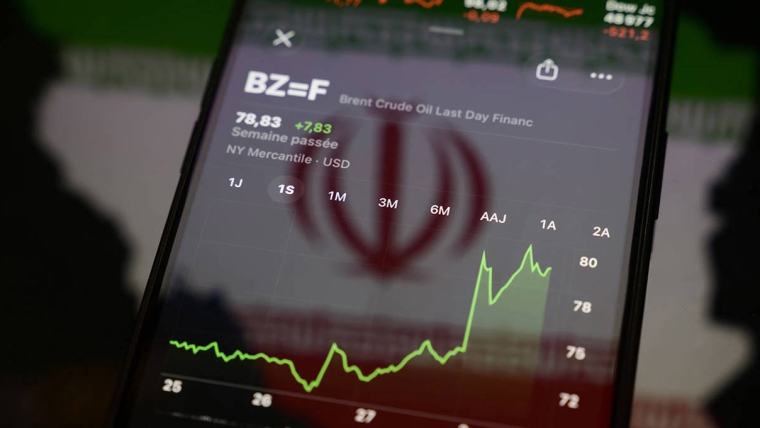
There is a moment in every supply shock when the market’s fear of inflation gives way to anxiety about economic growth. This shift is one of the most important—and dangerous—signals for policymakers because markets, central banks, and governments move at different speeds, and sometimes in different directions.
The market always rotates first. Since equity and credit markets are forward-looking, they price in the growth implications of a shock before it shows up in the data. Early in the shock, as markets price in higher inflation and margin compression (lower corporate profitability), equity prices fall as oil prices shoot up. Later, equity prices resume their decline even as oil prices decline. This typically means that the market is moving from pricing higher inflation to pricing recession.
The flattening or inversion of the yield curve then confirms the rotation: long rates fall as the market prices a recession, but short rates hold steady because the central bank has not yet cut its policy rate.
Central banks tend to rotate second—and usually reluctantly. They are institutionally biased toward guarding against inflation, especially after the 2021–23 episode. No central banker wants to commit the “Arthur Burns error” (named for the US Federal Reserve chair during the first 1970s oil shock) of declaring a supply shock transitory and allowing inflation expectations to de-anchor. But this vigilance creates its own kind of risk. The central bank continues to focus on cost-push inflation (because fertilizer and food price pressures take a while to work their way through the system), but the market has already moved on to pricing below-potential growth.
The result is a period when the central bank appears hawkish relative to the market, which can tighten financial conditions further through higher short-end yields and a stronger currency, deepening the recession. It is the 1974 pattern in reverse: whereas Burns eased too early and allowed expectations to de-anchor, the current risk is that central banks hold rates where they are too long and allow the demand destruction to overshoot.
Then there are fiscal authorities, who tend to rotate last. Politically, fiscal support during a shock is easy to deploy but difficult to withdraw. Because fuel subsidies, energy-bill caps, and food-price interventions create constituencies that resist their removal, the government’s fear of inflation is subordinated to its fear of visible household pain. Fiscal support, therefore, outlives the economic rationale for it.
To be sure, this outcome is not irrational, because the food- and utility-price effects working their way through the system will still hit households after the crude oil price has fallen. But it does create a fiscal overhang that complicates the central bank’s own policy path. If fiscal support persists, the market may interpret the combination as fiscal dominance (when the central bank accommodates higher government spending).
The divergence between the financial, monetary, and fiscal clocks is where policy errors are born. The most dangerous configuration is when the market has rotated to fearing lower growth, the central bank is still fighting inflation, and the government is still running emergency fiscal support. If the market sees policy tightening into a recession combined with a fiscal expansion that cannot be financed, it may conclude that the policy mix is incoherent.
There are risks of this now. We have recently witnessed a negative feedback loop between gilts (government bonds) and sterling in the United Kingdom; widening periphery spreads (the difference between yields on sovereign debt) in the eurozone; and a further weakening of the yen in Japan. The United States has been the least exposed because the market, the Fed, and fiscal authorities tend to rotate in closer synchronization. Moreover, a K-shaped demand-destruction channel in the US provides a natural coordination mechanism: When lower-income households’ spending collapses, it shows up in real-time spending data that markets, central banks, and fiscal authorities can see simultaneously.
The signals to watch now are the correlation between oil and equity prices and the slope of the yield curve. When crude prices and equities fall together, and the yield curve flattens or inverts, that means the market has rotated to fearing lower growth. At that point, the central bank’s priority must shift from protecting the inflation anchor to preventing demand destruction from overshooting; and fiscal authorities should pivot from addressing costs to supporting demand. In other words, the nature of the transfer should change from “absorbing the energy tax” to “preventing a consumption collapse,” and central banks should at least prepare for easing.
Getting this rotation right—matching the policy response to the market’s evolving fear—is the hardest judgment call to make. During the 1970s oil shocks, central banks got it wrong in both directions: they were too easy in 1974, and too tight in 1981. What is needed now is not a formula but a framework, one that names the signposts (the crude-equity correlation flip, the yield-curve inversion, and the collapse in real-time spending data) explicitly enough that policymakers can make the necessary turns in time. That is the only way to avoid excessive demand destruction and an unnecessary debate about the inflation anchor when a recession has already been priced in.
*Gene Frieda is a senior visiting fellow at the London School of Economics. Copyright 2026 Project Syndicate. Used with permission.
We welcome your comments below. If you are not already registered, please register to comment
Remember we welcome robust, respectful and insightful debate. We don't welcome abusive or defamatory comments and will de-register those repeatedly making such comments. Our current comment policy is here.