
sign up log in
Want to go ad-free? Find out how, here.

Public Service transformation: Government departments to reduce, sinking lid on budgets, more AI use, target of 8.7K fewer public servants

Public Policy / news
Public Service transformation: Government departments to reduce, sinking lid on budgets, more AI use, target of 8.7K fewer public servants
[updated]
Willis and Luxon
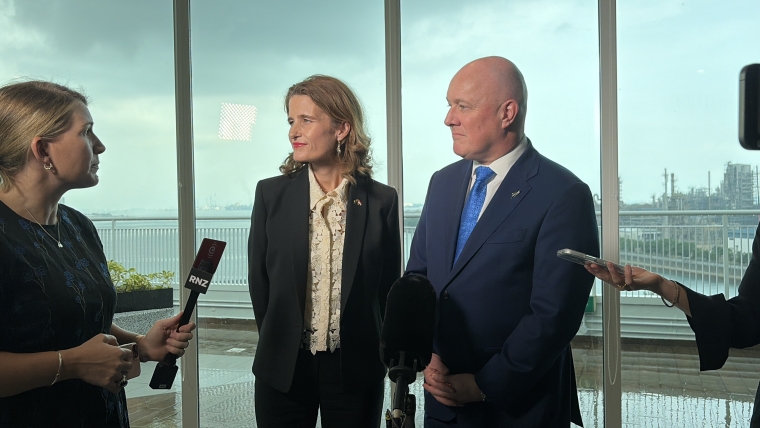
Nicola Willis and Christopher Luxon in Singapore.

The number of Government departments will reduce, $2.4 billion will be redeployed elsewhere, sinking lids will be placed on budgets and an in-principle target will be set for the number public servants in the Government’s public service reform over coming years.

That workforce target would remove almost 9,000 workers from the public service by mid-2029. 

From Auckland's North Shore, Finance Minister Nicola Willis announced the sinking lid on most agencies’ operating budgets aimed to “drive progress” on streamlining the number of government agencies and entities, digitising customer-facing and back-office government functions, and restoring public service numbers to "historical norms."

She expected that to result in savings of $2.4b over four years, which would go into health, education, infrastructure and defence and police.

Increased use of AI

Willis said over the next three to five years the number of agencies would be "significantly" reduced - with agencies asked to come up with proposals to “logically merge their existing activities around citizen-facing functions, using common technology platforms.”

“The overhaul will reduce the number of government departments, increase the use of AI [artificial intellingence] and other digital tools, and deliver significant savings,” she said.

Public Service Minister Paul Goldsmith said between 2017 and 2023 the size of the public service expanded from 47,000 to more than 65,000.

“That growth rate was nearly three times faster than the overall labour force, while back-office and support functions grew significantly faster than frontline service delivery roles," Goldsmith said.

“As part of the programme, the Government will restore public service numbers to the historic norm by mid-2029. That will be an in-principle target of about 55,000 public servants."

“Reductions will be achieved progressively over several years through digitisation, mergers, simplification of systems and processes and natural attrition,” he said.

Willis said the 55,000 target is about 8,700 fewer workers than in December 2025. 

The agencies exempt from baseline savings were the NZ Defence Force, police, Oranga Tamariki, Corrections, Ministry of Health, Ministry of Justice, Ministry of Education (except tertiary functions), GCSB and SIS, Education Review Office, Crown Law, Ministry of Defence and the Serious Fraud Office.
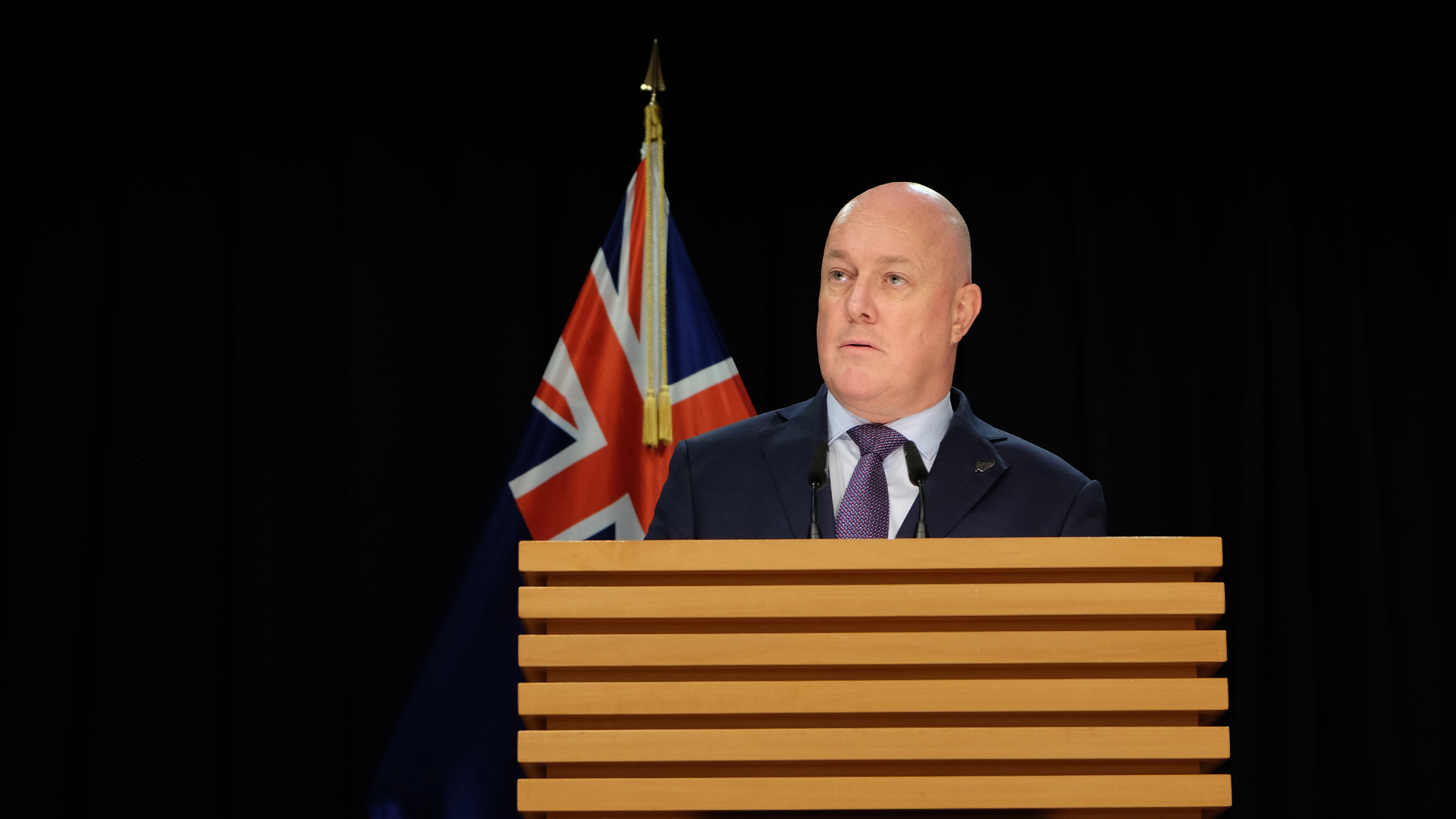
Prime Minister Christopher Luxon. Image source: Mandy Te

'Extensive and significant'

Ahead of Willis' Tuesday afternoon speech, Prime Minister Christopher Luxon said the pre-Budget announcement on the public service would include some of the most extensive and significant reforms agencies have seen in decades.

"What we're doing here is we're saying, look, the public service has been organised in a certain way over the last 30 to 40 years, it's right and appropriate we take a good look at that and say, could we better organise?" Luxon told reporters on Tuesday morning.

"The second thing is that there's an opportunity to really leverage technology, all with the primary goal of being able to deliver more effective public services and be much more efficient with taxpayers' dollars, and ultimately also building out a public service where the best and the very brightest actually want to come and work here..."

"We've got some very serious reforms that we've got to get underway. It's pretty exciting work," he said.

Luxon said he suspected there would be job losses - some through attrition and others "over a period of time".

"The public service is not a make-work function. It's not here just to maintain jobs and maintain a position of how it was always run since 1995 in the same way," he said.

Asked if it would be some of the most extensive and significant reforms to the public service in the next few decades, Luxon said, "I do and I think it’s long overdue".

"What's tended to happen is successive governments have come in and they've just added to what we already do, rather than... step back and ask the question, is this a cluster of activity that actually should be working more together?"

"Is there a need for us to have all these backroom functions when we could do that much more efficiently?"

He expected the plan to make savings, but added the primary objective was a more effective and efficient public service.

Labour public service spokesperson Camilla Belich said it seemed as though in the "last budget women paid for Nicola Willis's budget, and this time public servants and their families are going to be paying for the government's budget".

We welcome your comments below. If you are not already registered, please register to comment

Remember we welcome robust, respectful and insightful debate. We don't welcome abusive or defamatory comments and will de-register those repeatedly making such comments. Our current comment policy is here.

21 Comments

Ideological claptrap

When is someone going to overlay these fiddlings-at-the-margins, with reality:

https://axismundi001.substack.com/p/the-metabolic-theory-of-civilisation

These folk have come in too late, with no understanding. Perhaps we could examine that divergence, Interest.co? 

Up
1

I don't see why you need 100 policy analysts writing opinions to each other.

2-3 hard decision makers would be quicker and arguably make better decisions.

Also why develop 'policy' when there is negibible implementation skill.

Up
2

AI is great at this stuff

Up
0

So we are going to contract out the public service...likely to the tech bros.

More currency heading offshore.

Up
3

Appears that way. They reckon customer-facing and back-office systems will be digitised, with AI embedded “as a basic expectation for all public entities” with the aim to make services “easier and more affordable” for people to interact with.

Given that the govt decision makers will have no idea where to start, no experienced leadership in AI implementation, and that the MIT “State of AI in Business 2025” report found that only about 5% of enterprise generative AI trials produced measurable financial benefits with the remaining 95% either stalled or showing no clear ROI, I don't see how this is possible. 

 https://mlq.ai/media/quarterly_decks/v0.1_State_of_AI_in_Business_2025_…

I imagine the consulting firms are going to make out like bandits again. That is not improvement. 


Up
0

building out a public service where the best and the very brightest actually want to come and work here.

Yeah, cause people really love working for organisations that have major restructurings every 12 months.

Up
3

Jacinda's Labour ran on transformational change and National are basically doing nothing. So yeah if they are going to do nothing then they will need less public services. 

Up
0

Jacinda's Labour ran on transformational change 

I think it would be a big mistake to go back to that social experiment JJ. As it relates to public service, as an example, an ambassador high-tailed it out of the country where she was assigned as border lockdowns beckoned during the Covid period and worked from home back on full pay in Aotearoa. That was OK under the system back then, but it's not what we need from a credible public service. Similarly the appointment of Goff and Mallard in diplomatic roles shows just how ridiculous the Kindness period was. 

Up
1

Are you saying the current austerity period is better? People who criticise the previous government seem to be blind at how bad this one has made things! 

Up
0

Spending for the sake of spending is a suboptimal solution. It's not about qty of spend but everything to do with the quality of spend.

Up
0

Within the organisation of it all there will be a thin red line of capables  that will be doing the doing and fixing and to be cynical about it, will likely be the first to go. 

Up
1

"building out a public service where the best and the very brightest actually want to come and work here..."

Like S'pore? We need to be realistic. The S'pore civil service combines competent technocratic agencies, cross‑agency collaboration, and continuous learning so that ideas can actually be implemented. And their civil service is recognised as efficient and incorruptible - it ranks at the top of the Blavatnik School of Government’s Public Service Performance Index for effectiveness and innovation.

Up
0

While this initiative may reduce the numbers of public servants, what extra initiative is there to assess what gets done and how they do it.

What drive is there to create effective and efficient competence rather than BAU?

Having dealt with several departments and government procurement processes, that really is a pressing need. 

Up
0

Wellington service businesses and property holders are royally screwed........just a lot more so, than the rest of NZ, over the next few years.


Wgtn property market, set to be down a REAL 60 to 70% by 2030.

Up
1

Wellington service businesses and property holders are royally screwed........just a lot more so, than the rest of NZ, over the next few years.

Unlike Canberra where the real estate agents have a spring in their step and debauchery is rampant across the hospitality sector most nights of the week.  

Up
1

Yeah the Aussies are a bunch of idiots, look how much better our government are doing…

Up
0

Governments of all varieties struggle to see that some of their costs are also sources of revenue. For example, when they built the CRL, they say it cost $6 billion, but they would have got a hell of a lot of that back through tax, gst, increased economic activity, etc. Likewise when they make cuts like this, it will cost them in tax revenue and reduced economic activity. Increasing the unemployment rate decreases the government’s tax revenue and grinds the economy to a halt. 
As usual we are counter cyclical in our choice of government. We need a borrow and spend government right now, and a cost cutting debt reduction government when things are going well and the unemployment rate is low. The last one to get it right was Michael Cullen. 

Up
1

Disagree here. Nothing wrong with building out infrastructure, but you're exhibiting the policy wonk behavior that needs to end. 

For ex, the cycle bridge fiasco. Some people got handsomely paid, kitchen renos happened and tradies got jobs from this, office space rented, income taxes paid.

But the public ultimately got nothing in return. That is the kind of govt ineptitude that we have to stamp out.  

Up
0

How is a cycle bridge any different to these RONs that we obviously can’t afford yet National are persuing? Most of them probably have a worse business case. 
A cycle bridge could be bloody useful if fuel goes up more, a $20 billion 4 lane motorway to  a small city in northland not so great. 

Up
0

Useful for what? 

Think big-picture.

So many folk think shallowly; all else being equal being the usual failure. 

Who is going to be going where, for what? 

Answer that, first. 

Up
1

Fewer public servants to create red tape and transferring the savings into health, education, infrastructure and police sounds fantastic !

Up
0