
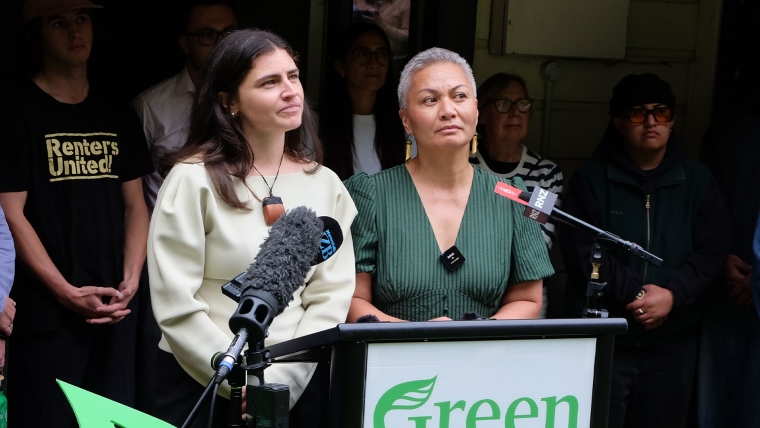
The Green Party has launched its election campaign slogan and released its manifesto, which outlines the party’s position on a wide range of issues including rejecting the proposed local government rates cap and reforming the public finance system.
Speaking at the party’s annual general meeting in South Auckland on Sunday, co-leader Marama Davidson told the audience that the manifesto was based on the Green Party’s principles and was developed with its wider party membership.
“This isn’t cooked up by a few people in a backroom doing deals with corporate lobbyists. It sets out our party’s broad and bold vision for how government could work for the best interests of everyone, for future generations and for the planet,” Davidson said.
The Greens' election campaign slogan for 2026 is: “For all of us.”
"Affordable lives, healthy nature and honest politics – for all of us," Davidson said.
Earlier on Sunday, the Greens proposed a one-year pause on consenting new AI data centres so regulation can be developed.
Green Party co-leader Chlöe Swarbrick said “if we are going to let these things be built, we should at least understand who is benefitting and ensure we protect our natural resources and communities”.
The party has already released policies on tax, water and energy. On the party’s policies on tax, water and energy, Davidson said: “When we begin negotiations to form government, our priorities will be our headline policies. These are the issues Aotearoa needs action on now and in the next three years.”
“There are more to come. The manifesto sets out our positions across a broader range of topics so people can see what we stand for.”
Reform to public finance system, rejecting local govt rates cap proposal
As part of its manifesto, the Green Party has called for the voting age to be lowered to 16, to extend the right to vote to all people in custody and to restore enrolment up to election day.
The Greens also want a reform of the public finance system to “ensure that the fiscal management approach supports New Zealand’s long-term resilience, the productive capacity of our economy, and ensures the health and well-being of everyone".
On things like global affairs and trade, the Green Party suggested implementing a Trade For All agenda, which includes “democratic scrutiny of trade agreements, and enforceable recognition of our Te Tiriti o Waitangi obligations, workers’ rights, human rights and climate commitments”.
In its local government section, one of the things the Greens have called for is to reject the proposed rates cap. Instead the party wants to “enable a range of new funding and financing tools, such as a bed levy, congestion charging and GST from rates and growth”.
Climate action
On climate action, one of the things the Green Party wants to do is make the government’s Budget process consistent with limiting global warming to 1.5C, gross emissions reduction targets and international commitments as a way to strengthen the Zero Carbon Act.
The Greens also want to allow the Climate Change Commission to directly set unit supply in the Emissions Trading Scheme (ETS) in line with emissions budgets and align the government’s Budget process with the National Adaptation Plan and Emissions Reduction Plans.
The Green Party has also put forward a proposal to introduce a price on agricultural emissions to make sure methane reduction targets are met, with financial and technical support for on-farm emissions reduction.
The party also wants to reform the ETS by “phasing out the free allocation of units, removing and forestry offsetting so the system functions as a genuine ‘cap-and-trade’ system” and redirect funding from the reformed ETS to an "improved Government Investment in Decarbonising Industry Fund".
In terms of climate adaptation, the Greens want an expansion of the Natural Hazards Commission’s role to include cover for climate-related weather events and to ensure the organisation plays a key role in managing community adaptation and retreat.
The Greens also want to establish a dedicated fund for central and local government to implement climate adaptation and resilience measures, including funding for partnerships with tangata whenua and community organisations.
Pause on AI data centres not a ban on data infrastructure, Greens say
On pausing new AI data centres, Swarbrick said "right now, AI data centres can be consented behind closed doors, with no community input".
"Experience overseas has seen these projects turn local water supply to sludge and suck huge amounts of energy, driving up prices for regular people.”
"Some may argue these AI data centres could build their own renewable energy, or that they’re increasingly using closed-loop water cooling systems,” she said.
“That may well be the case, but our current rules don’t require any of those things. New Zealanders haven’t even had the opportunity to discuss and decide whether they want them."
She said having a one-year pause gives NZ time to get it right and this was not a ban on data infrastructure.
"It's a pause on the most resource-intensive developments while New Zealanders get a say on what conditions they should meet,” Swarbrick said.
“We need to write the rules before the concrete is poured.”
The Green Party's full 2026 manifesto can be read here.
We welcome your comments below. If you are not already registered, please register to comment
Remember we welcome robust, respectful and insightful debate. We don't welcome abusive or defamatory comments and will de-register those repeatedly making such comments. Our current comment policy is here.