
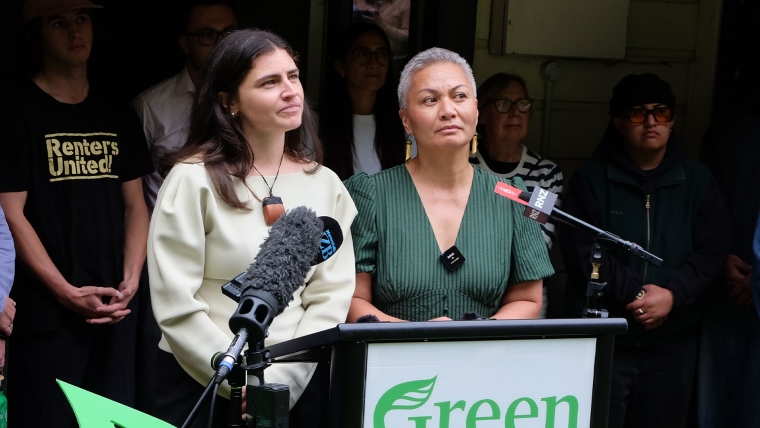
The Green Party has announced a new suite of tax policies including making the first $10,000 people earn each year tax free, which the party says will give 96% of New Zealanders a tax cut.
The Green Party released its election year tax policy called A tax policy for all of us: Contributing fairly to society on Sunday, saying its plan; "will make sure the super-rich and big corporations contribute their share, reduce tax on salaried and waged workers, and fund the critical social services we all rely on.”
Alongside creating a tax-free threshold of $10,000 for those on an income under $160,000, it would also set tax brackets between $10,000 and $160,000 thresholds, including a 45% threshold for incomes that are $160,000 and over.
Corporate tax rate, big tech tax and bank levy
The Greens also want to:
- Return the corporate tax rate to 33% for the 0.7% biggest corporations like energy companies, banks and supermarkets - this would apply to companies with an annual turnover of over $30 million
- Keep the corporate tax rate at 28% for small and medium enterprises to level the playing field for local businesses
- Introduce a bank levy of 0.06% on the liabilities of banks who have more than $100 billion in liabilities [ANZ NZ, ASB, BNZ and Westpac NZ]
- Enforce a 5% withholding tax rate on the profits that big tech companies like Google, Microsoft, Facebook, Uber, Visa and Mastercard send offshore
- Reverse the Coalition Government’s interest deductibility on residential investment property for landlords and changes to the brightline test
“Big corporations that set up shop in Aotearoa are profiting from society while often making little contribution to it, while New Zealanders struggle to keep up with costs for life’s essentials, like food and electricity," the Green Party says.
When it came to the corporate tax rate, the policy points out how in the early 1980s, it was 48%. Currently at 28%, the Green Party says reducing the corporate tax rate has not led to “any measurable, meaningful improvement for working New Zealanders.”
“It reduces the collective pool of resource that pays for things we all use and need.”
Bank levy 'to address the fiscal risks of highly leveraged banks to the economy'
Of its proposed bank levy, the Green Party says: “The purpose of this is to address the fiscal risks of highly leveraged banks to the economy in Aotearoa, the high profitability of the big banks, and level the playing field for smaller competitors such as Kiwibank.”
Of big tech companies the Green Party says they use service fees and license fees to reduce their taxable profits paid in NZ by shifting profits offshore.
"These fees are often, in substance, royalties that are supposed to be subjected to withholding taxes."
A withholding tax would also apply to companies like Netflix and credit card companies, such as Visa and Mastercard, who use a service company model where the local subsidiary operates as a marketing and support service to an overseas group company, with the sales booked offshore, the Greens say.
"This enforcement action would apply to all companies who misclassify royalties as service fees and license fees, not just the big tech companies listed as examples.”
The Greens would fund Inland Revenue to implement transparency work to crack down on multinational tax evasion.
Taxing 'the super-rich' and an inheritance tax
The Green Party has put forward a 2.5% tax on the net assets of "the super-rich" above $10 million, things like properties, companies or shares, with an exemption on family homes.
“For an individual with net assets above $10m, or $20m for a couple, minus mortgages and other debt, a 2.5% annual tax will apply on those assets.”
The Green Party says this means the richest 0.3% of New Zealanders would contribute more to "solving the big challenges we face together".
Māori land under Te Ture Whenua Māori Act would be exempt, and so would the assets of Post-Settlement Governance Entities, such as land returned under a Treaty Settlement or vested in a Treaty Settlement Entity.
Assets belonging to charities, Non-governmental organisations, clubs and other entities would not be part of anyone’s individual taxable wealth, the tax policy document says.
“Wealth held in trusts will be apportioned to an individual’s taxable wealth, based on their interest in the trust. For discretionary trusts, the settlor of the trust will be liable for the trust’s net wealth," the Greens say.
“For fixed-interest trusts, the net wealth of the trust will be apportioned to each beneficiary’s tax liability per their interest in the trust.”
The Greens are also proposing to implement a Capital Acquisitions Tax of 33% on inheritance and gifts received worth over $1 million - family farms , small gifts and family homes are not included in this.
“The person receiving the inheritance or gift will pay the tax, not the estate or person passing it on. It would apply to approximately 1100 people a year.”
The Greens say their tax policy will increase net revenue by $5.15 billion in 2027/28, rising to $5.73 billion by 2030/31.
‘The big rip-off ends here’
Greens co-leader Chlöe Swarbrick says the party was “proud to announce a tax policy that will tackle inequality and corporate greed to rebuild our country and put more money in the pockets of 96% of New Zealanders”.
“People aren’t dumb. They know that while their cost of living has gone through the roof, corporate profits have skyrocketed and the wealthiest 150 rich listers now own more than half of the country. The big rip-off ends here,” Swarbrick says.
Greens co-leader Marama Davidson says some people are making record profits yet the cost of living has jumped for ordinary people.
She says the country’s hospitals, schools, public transport and environment “are all starved of funding.”
“These are critical social services that all New Zealanders need, including the super-rich.”
“Essential services like healthcare, education, and infrastructure could be funded if the super-rich and mega-corporates like the supermarkets duopoly, banks, and power companies contribute fairly to the society they profit from,” Davidson says.
Note: The Greens initially said on Sunday that their tax policy would increase net revenue by $5.35 billion in 2027/28, rising to $5.94 billion by 2030/31. These figures have been updated and corrected on Monday due to the Greens' own error.
We welcome your comments below. If you are not already registered, please register to comment
Remember we welcome robust, respectful and insightful debate. We don't welcome abusive or defamatory comments and will de-register those repeatedly making such comments. Our current comment policy is here.