
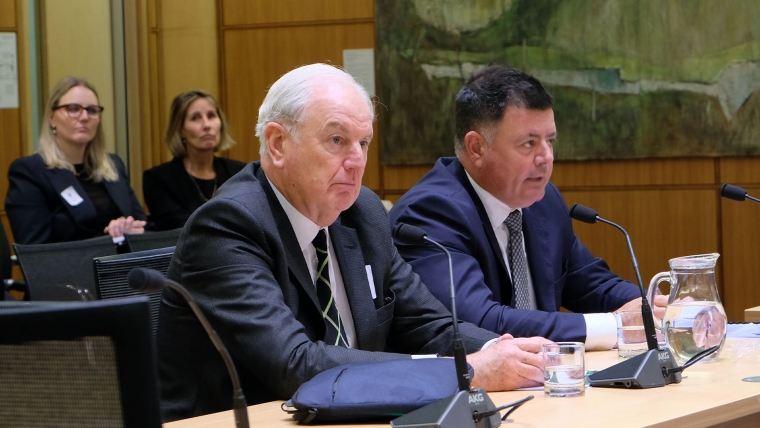
The Chairman of Kiwi Group Capital Limited (KGC), Kiwibank’s parent company, says work on alternative growth scenarios and capital to fund them, is at an early stage.
“The important thing is that we start with a blank sheet of paper and look at all the potential options for capital,” KGC Chairman David McLean told reporters on Wednesday.
Many of the decisions would be made above their pay grade by Ministers who are shareholders, he said.
McLean’s comments came after he and Kiwibank CEO Steve Jurkovich spoke at a meeting of Parliament’s Finance and Expenditure Committee, giving a briefing on the 2024/2025 annual review of KGC.
Kiwibank is back in the spotlight after documents on Kiwibank’s long-term growth and competitiveness were proactively released last Friday. This included a letter from Minister for State Owned Enterprises Simeon Brown outlining additional specific expectations for the company.
“We expect KGC to undertake work on alternative growth scenarios for Kiwibank along with the capital required for these. We also expect you to engage with the Treasury on these scenarios, and the implications they would have for the Crown,” Brown wrote.
Brown's letter of expectations was sent in March - months after Kiwibank announced a proposed $500 million capital raise was off the table. The capital raise had been recommended by the Commerce Commission and endorsed by the Government to help it better compete with the big four Australian-owned banks.
The bank cited changes to the Reserve Bank’s capital requirements and said Kiwibank’s successful $400 million Tier 2 capital raise at an attractive price meant that it could continue its “strong growth without the need for additional equity”.
‘Driven by the Government’s appetite to allow it’
McLean said Reserve Bank regulatory capital changes had given them more time.
“It allows us to spend a bit more time planning and analysing and [to] look through particular cycles.”
Asked if they would put a monetary target on any future capital raises, McLean said: “It’s driven by a number of factors. It’s driven by what our need is at a particular time, which changes with time.”
It was also driven by the market’s willingness, capacity or demand to invest, he said.
“And it’s driven by the Government’s appetite to allow it. So it’s really quite a complicated matrix of decision making.”
‘Always need to be planning’
At the Finance and Expenditure Select Committee meeting, National MP Dan Bidois asked about potential alternative pathways in the absence of capital structure.
McLean said: “We need Kiwibank to have a bigger impact in the market. It has to be a bigger share in the market.”
“When it’s 7.5% or something market share, the big banks can afford to ignore it. If it was 15%, it would be very hard to ignore and we could have much more effect in the market. To do that, you need two things: you need capability and you need ongoing sources of capital.”
McLean said capability was going to be addressed by people and technology.
“The fact that it’s seen as a bit of a challenger and disruptor, Kiwibank now has a really attractive employment proposition and is hiring the best people in the market, which is good. The technology transformation project, which is replacing the core IT, will give it a capability that is a generation ahead of the big banks.”
“If you’re growing, you need ongoing sources of capital. And banks need to plan this out for several years. You don’t want to be running short and having to come to the market.”
McLean said the effect of the RBNZ’s regulatory capital changes “gave Kiwibank about $500 million more capital headroom, which translates to something like $20 billion of mortgage lending, if you did it all in mortgage lending”.
That has made a huge difference to Kiwibank’s outlook, McLean said.
“So for the next two or three years or more, depending on how fast the economy grows and how fast we grow within it, we’re okay from the capital point of view but we always need to be planning and looking ahead, and saying ‘in three to five years’ time, we’re going to need more' so we need to be working well ahead of time to plan for that.”
Asked about what made the biggest difference from the Reserve Bank’s changes, Jurkovich said in the near term, the risk-weighted assets nearly levelled the playing field after more than two decades of being disadvantaged compared to the big players.
This was very welcome, he said.
'We didn't have to pay for it'
Jurkovich also pointed to the step-ups, saying; “we were planning capital planning with the step-ups, that obviously meant that we had to be really careful about what the capital planning was”.
“Having those moderated meant that two levers really strengthened the position … It was the equivalent of $500 million being injected, but of course, we didn’t have to go and raise it and didn’t have to pay for it. So there’s a benefit from that as well,” Jurkovich said.
"And I think it reflects the fact that for a long time, it didn't make any sense that we were carrying 60% more capital for a loan compared to ANZ."
Asked if this also gave other banks more ability to lend, he said not really.
“They’re in the same position that they were in before because their internal models had given them the advantage. So it chops the advantage of someone like ANZ from being 50% ahead of us to being 10% ahead.”
Jurkovich said Kiwibank needed to keep growing, be bigger and more influential.
“It’s always been the mission to be bigger, to challenge harder. And even if we don’t win the customer, if you get a better deal, then we’ve achieved what we were founded for, which is to make you better off.”
Partial sale? Politicians weigh in
When asked during Question Time in Parliament if Finance Minister Nicola Willis could rule out selling all or part of Kiwibank, she said; "we will not be doing that in this term".
Speaking to reporters after, Willis said she wanted Kiwibank to grow and be a bigger competitor that could take on the Australian banks.
To get bigger, it needs more capital, she said. "As we look to the future, I am interested in helping Kiwibank grow. My ambitions may require them to source new capital."
"In terms of our plans to grow Kiwibank, the National Party will have a policy at the election on how we seek to achieve that," Willis said.
Labour leader Chris Hipkins said: “We’re not going to be supporting the privatisation of Kiwibank full stop.”
He said Labour would set out its own policy on Kiwibank in the fullness of time.
New Zealand First leader Winston Peters told RNZ he would not entertain a partial sale
When asked by reporters whether he would support the partial sale of Kiwibank, ACT leader David Seymour said "I think the question is, what benefit does the taxpayer get from owning it?"
He said it hadn't brought down bank fees or introduced the competition that was promised.
“So why is the taxpayer risking their money in order to keep something afloat, that 25 years on, hasn’t made the difference it promised.”
Greens co-leader Chlöe Swarbrick said: “Ultimately, there are different ways that we can go about that capital raising, the likes of Government putting its hands back on the wheel of this economy and making the requisite investment.”
Asked where the Government would get that money from, Swarbrick said: “There definitely is money there when they find that something is a priority.”
We welcome your comments below. If you are not already registered, please register to comment
Remember we welcome robust, respectful and insightful debate. We don't welcome abusive or defamatory comments and will de-register those repeatedly making such comments. Our current comment policy is here.