

Pathways for reforming the New Zealand Emissions Trading Scheme (ETS) are available and feasible, but the window to act is closing and deferring policy change beyond 2030 could forgo $11 billion to $12 billion in auction revenue through to 2035, a group of researchers say.
“Our concern is that within a few years, we’re going to reach a stage where the NZ ETS really doesn’t serve anyone’s interests. It’s not going to work for high emitters, for low emitters, for foresters, for iwi and Māori, for taxpayers, for future generations - and if it doesn’t work for them, then it doesn’t work for government,” Catherine Leining, policy fellow at economics organisation Motu Research, said in a webinar on Thursday morning.
Alongside Leining, Motu Research analyst Ikerne Aguirre, Kapiti Climate director Kristen Green and Victoria University of Wellington associate professor Julia Talbot-Jones, produced a working paper called ‘Scoping NZ ETS and removals pathways for better climate and nature outcomes.’
Publicly released on Thursday, the researchers said through their working paper, they were interested in finding solutions that would work better than the status quo for everyone.
Leining made clear that she and other researchers were not presenting an implementation plan, proposal or recommended pathway at this time. “We’re hoping that this work will lead to deeper research and to dialogue.”
ETS ‘must evolve to deliver on NZ’s climate targets’
The ETS prices emissions by requiring certain sectors of the economy to have "surrender obligations" for the greenhouse gases they release into the atmosphere. These sectors include forestry, liquid fossil fuels, stationary energy, industrial processes, synthetic greenhouse gases, and waste.
The ETS was initially set up to help NZ meet its 2050 net emissions target and international obligations under the Paris Agreement. Changes to climate change law removed a provision which stated the ETS unit volumes and price control regulations must "accord with" Nationally Determined Contributions (NDC) under the Paris Agreement.
In the working paper, the researchers said the ETS was based on outdated assumptions “and must evolve to deliver on New Zealand’s climate targets and send clear long-term investment signals to emitters and foresters."
“By the mid-2030s, the Government will progressively lose control over unit supply and prices, placing market stability and climate targets at risk. The substitution of forestry removals for feasible emissions reductions is delaying decarbonisation and creating intergenerational risks.”
Alongside this, the paper said "deferring policy change beyond 2030 could forgo around $11 billion to $12 billion in auction revenue through 2035".
Calls for ETS reform are not new, with Parliamentary Commissioner for the Environment Simon Upton saying in August that it was a question of ‘when’ not ‘if’ reform happens.
A Removals Investment Mechanism
The researchers said a complementary Removals Investment Mechanism (RIM) alongside ETS reforms could improve outcomes.
“Under current settings, a single price signal cannot deliver both the decarbonisation and removals New Zealand needs in the long term. A RIM would combine government- and market-driven incentives with policies and regulations to value removals for their climate and wider benefits, such as biodiversity and resilience.
“A RIM could be used alongside any NZ ETS pathway to boost and diversify investment in forestry and other removals without displacing emissions reductions. This would help with meeting current climate targets - and more ambitious future targets in response to temperature overshoot.”
Scenarios were modelled for alternative ETS pathways - this included how the status quo, a pathway with constrained removals in the ETS, and a pathway with no removals in the ETS could impact emissions prices, climate targets, afforestation and fiscal outcomes with and without a RIM.
The paper said the RIM could operate independently from a NZ ETS, trading only in gross emissions or in conjunction with an ETS trading in both gross emissions and removals.
The role of the RIM would increase with greater constraints on removals in the NZ ETS and the role of supporting policies would increase alongside greater reliance on "least-cost" forestry removals to achieve climate targets, the paper said.
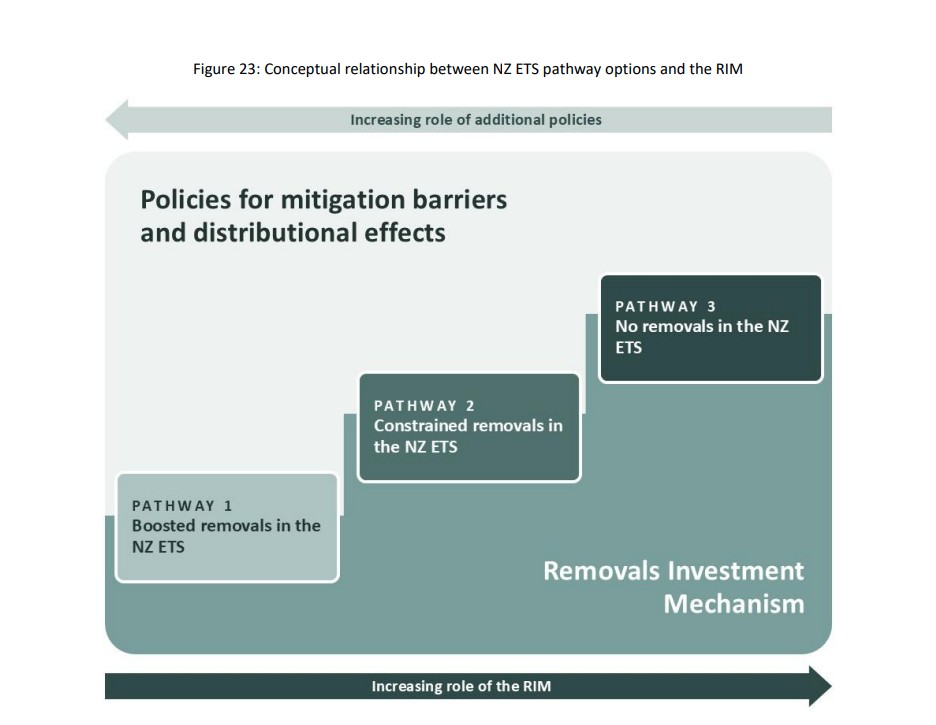
“Depending on design, a RIM could be used to help maintain government control over climate targets and NZ ETS market stability, send clearer investment signals for emitters and foresters, generate net revenue for the Crown, and improve outcomes for climate and nature.”
“It could be designed in ways that maintain or increase the value of existing and new removals investments relative to the status quo NZ ETS. The RIM modelled in this paper is a hypothetical illustration for demonstrating proof of concept, not a proposal or recommendation, and additional approaches should be considered," the paper said.
Policy development should start now, researchers say
Leining said the window to act was closing and the policy development process needs to start now as it was slow and took time.
“We need inclusive processes and well-signaled outcomes that maintain investment value and market confidence.”
The working paper said to avoid market disruption, government decision-making on introducing a RIM would need to be staged carefully and be "shaped and informed by inclusive processes with full regards to the rights, interests, and aspirations of iwi and Māori; and concluded well in advance of implementation.”
“Process guardrails would be essential to build confidence in policy change and ensure a just transition for NZ ETS participants, iwi and Māori, broader stakeholders, and communities.”
Policy development should start now, the paper said. “Given the lead time required, the process of policy development should begin as soon as possible, while the Government still holds the lever of auctioning and before misdirected investment decisions driven by the status quo NZ ETS lock in adverse outcomes for decades."
"A collective effort is required to build on the findings of this paper and design an integrated policy framework for the NZ ETS and removals that will deliver what is needed in the decades ahead," the working paper said.
A world that no longer exists
Speaking to webinar attendees, Leining said: “Our emissions trading system was designed for a world that no longer exists."
"And we need to upgrade it for the challenges that lie ahead, so that it sends the investment signals we need, so that we don't end up with an economy that's beautifully suited for a world that no longer exists and a land sector that's beautifully suited for a world that no longer exists.”
We welcome your comments below. If you are not already registered, please register to comment
Remember we welcome robust, respectful and insightful debate. We don't welcome abusive or defamatory comments and will de-register those repeatedly making such comments. Our current comment policy is here.