
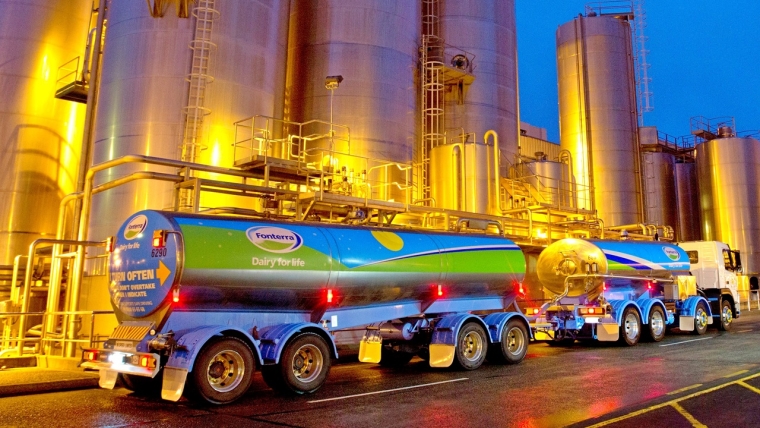
Dairy co-operative Fonterra has hiked its forecast milk price to farmers for the current season to an effective $9 per kilogram of milk solids, which will be the second largest payout ever if achieved.
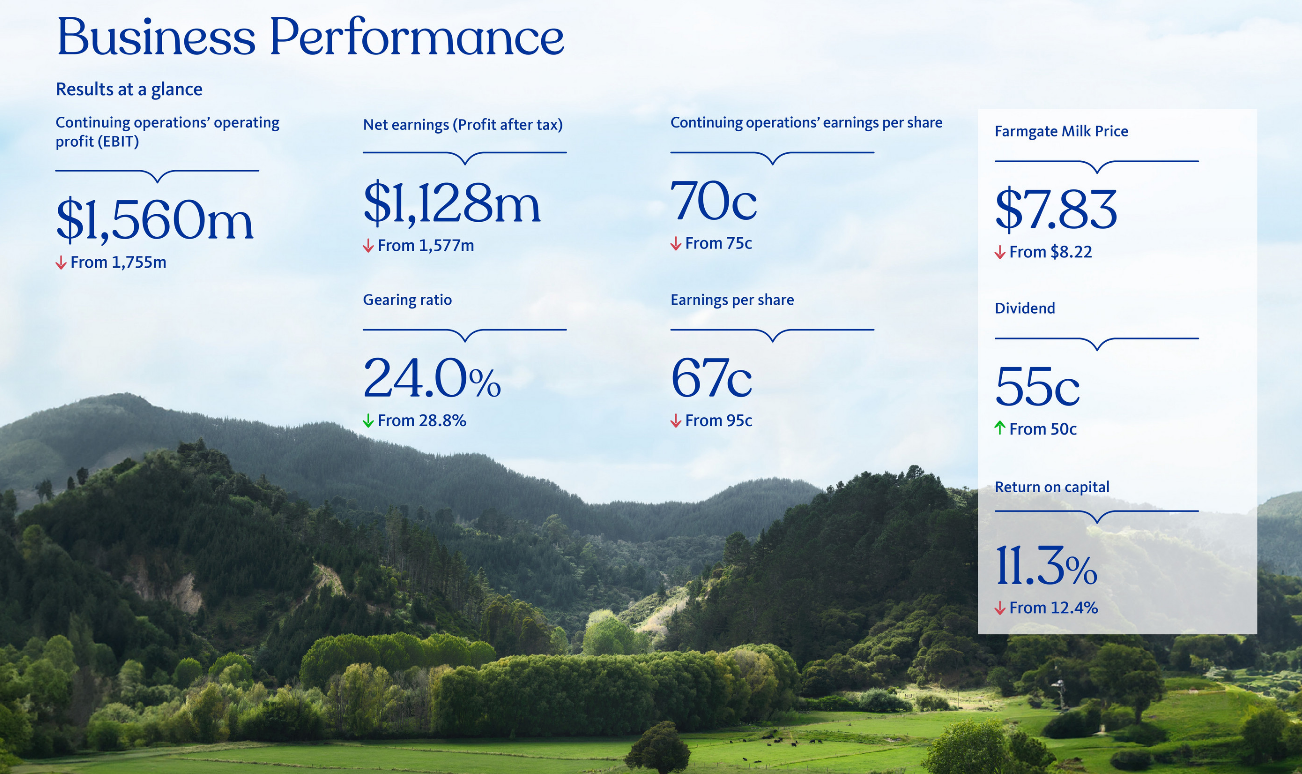
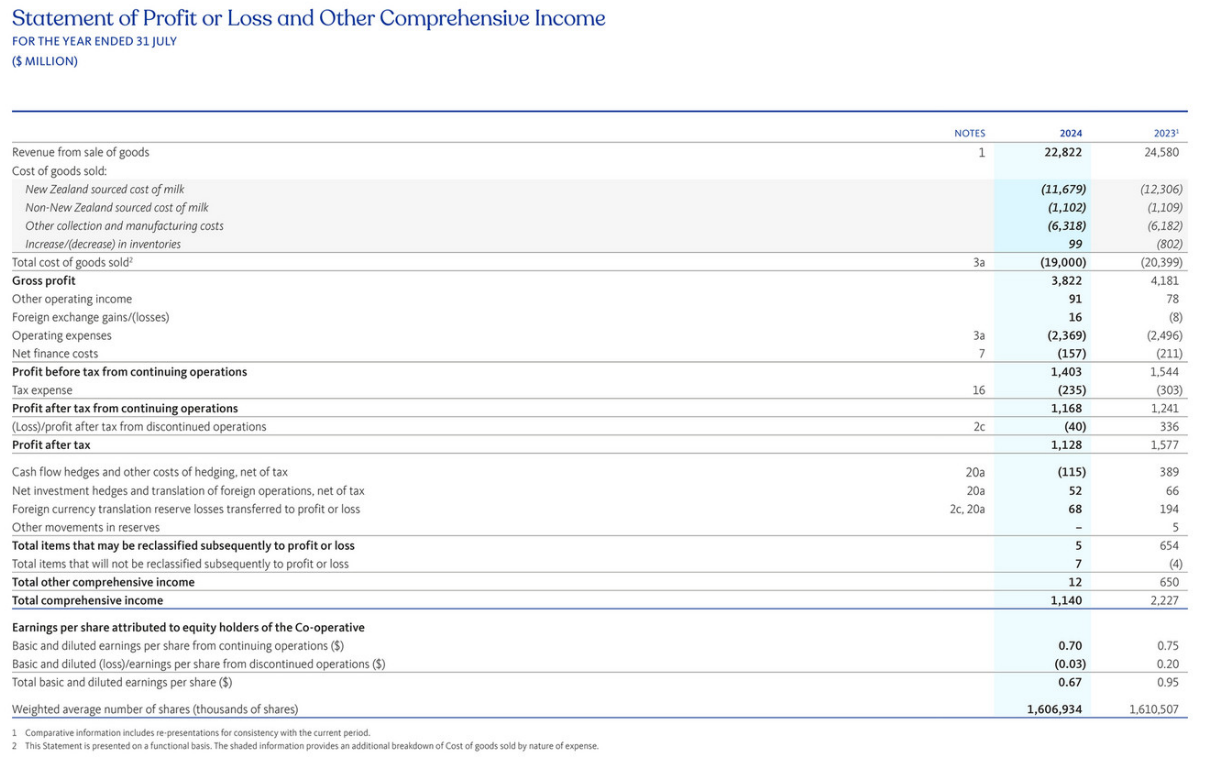
The 50c rise in milk price forecast comes as the company announced a reduced after tax profit for the year ending July 2024 of $1.128 billion, down from the record $1.577 billion in 2023. The prior year's figure included over $300 million from subsequentlly discontinued (sold) operations.
Revenues were $22.822 billion, down from $24.58 billion in 2023.
In terms of continuing operations, the after-tax profit was $1.168 billion compared with $1.241 billion in 2023. Total borrowings were $3.388 billion compared with $3.9416 billion in 2023.
The co-op announced a total dividend for the 2024 year of 55c, which was up on 50c from last year.
The dividend in the latest year included the already paid interim dividend of 15c, a final dividend of 25c and a special dividend of 15c.
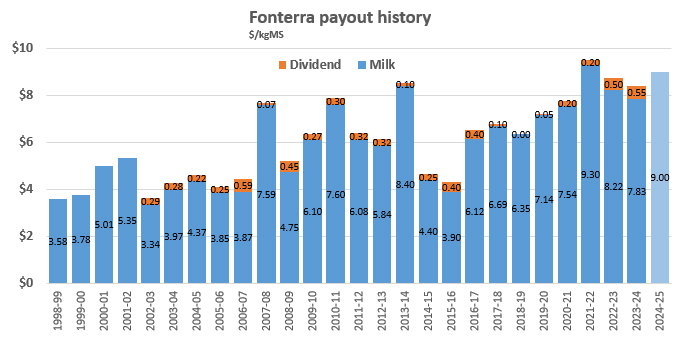
The final milk price for the year just past has been set at $7.83, meaning farmers are getting a full payout of $8.38 for the 2024 financial year.
When giving guidance on the expected milk price Fonterra forecasts a range. In terms of the milk price forecast for the season currently under way, Fonterra’s new forecast range is $8.25-$9.75 per kgMS. This gives a 'mid-point' of $9.
Fonterra chief executive Miles Hurrell says the lift in this season’s forecast Farmgate Milk Price follows further recent strengthening in global dairy trade prices and constrained milk supply in key producing regions.
"I’m pleased to be announcing an increase in this season’s forecast Farmgate Milk Price, which I’m sure will be welcome news for farmers, particularly when combined with the 55 cent total dividend for FY24 also announced by the co-op today," Hurrell said.
The full year profit in 2024 represented earnings per share of 70c.
However, the company's signalling lower earnings per share for the 2024-25 year in a range of 40c-60c per share and is citing the fact that "after several years of strong earnings performance, the co-op exhausted its tax losses in FY24 and will now be paying tax".
The co-op says this change will reduce its reported earnings per share in future years, as Fonterra will have paid the tax on the cash to be distributed. Imputation credits will now be available.
In the annual report Fonterra reported that Hurrell was paid $5,924,782 in the 2024 year, up from $4,607,582 last year. The fixed component of his remuneration rose to $2,459,310 from $2,367,501 in 2023.
The co-op said as of July 31, 2024 it directly employed 16,441 people. The remuneration part of the report states that during the year 11,381 employees, of whom 8,821 were based in NZ, were paid in excess of $100,000. The 2023 annual report showed that the comparative figure then was 10,356 employees (7,865 in NZ) that were paid in excess of $100,000.
Back in May 2024, Fonterra surprisingly announced that it was putting a number of its consumer businesses on the block, including household-name brands such as Anchor and Mainland. It gave a timeframe for a sale of 12-18 months.
In a brief update on this, Hurrell said over the last few months, the co-op had appointed advisors to assist with assessing divestment options for the consumer businesses "and this work is ongoing".
The co-op remained "committed to a pathway that would maximise value of these businesses for our farmer shareholders and unit holders".
He said alongside this, Fonterra had "revised our strategy to have a sharper focus on the Co-op’s strengths and where we can best create value".
"We will be sharing this revised strategy, as well as the outcomes shareholders and unit holders can expect from the co-op, next week."
Fonterra chairman Peter McBride said during the 2024 financial year the co-op received "unsolicited interest" in parts of the consumer businesses.
"The world has changed. We have entered a new era of global competition, not cooperation," he said.
"It’s a more expensive, competitive and volatile world where customer expectations are evolving, and New Zealand milk and capital are becoming scarcer.
"Having a co-op that is aligned to our comparative advantage is fundamental. The strategic review has clarified the parts of the business that generate the greatest returns for farmers today, and highlighted where we see further headroom for growth," McBride said.
We welcome your comments below. If you are not already registered, please register to comment
Remember we welcome robust, respectful and insightful debate. We don't welcome abusive or defamatory comments and will de-register those repeatedly making such comments. Our current comment policy is here.