
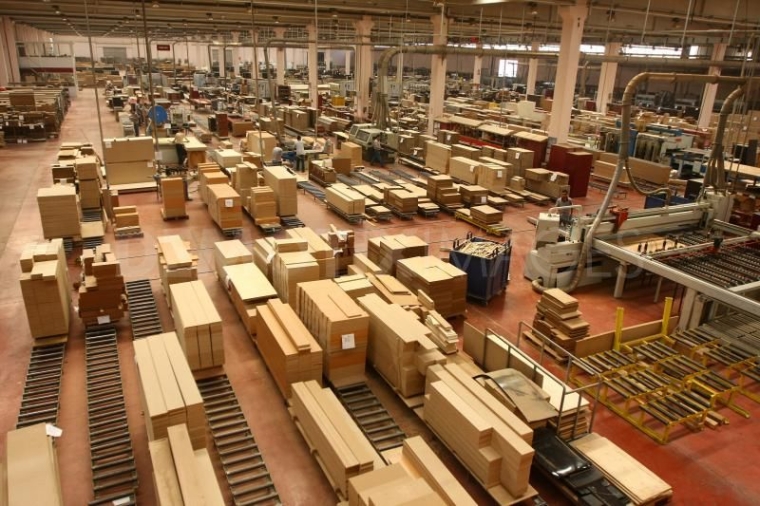
May At Wharf Gate (AWG) prices for export logs at New Zealand ports remained unchanged from April.
Softer market conditions in China and rising shipping costs continue to pressure exporter margins, with parts of the export supply chain absorbing some of these costs to maintain AWG pricing and fulfil vessel commitments.
In China, softwood log inventories remain relatively stable, reflecting balanced supply and demand conditions. However, weakening furniture sales are beginning to reduce demand for traditionally sought-after higher-value pruned and appearance-grade logs.
Domestically, sawn timber demand remains firmer than at the same time last year despite the introduction of fuel surcharges across many timber product categories. Reduced domestic processing capacity following mill closures over the past year has also helped tighten supply and improve market balance.
The PF Olsen Log Price Index remains at $122, which is $2 above both the two-year and five-year averages.
Domestic Log Market
Domestic log processors have introduced a 3–4% fuel surcharge on sawn timber across most product segments. The surcharge is being reviewed monthly and is expected to remain in place while fuel costs remain elevated.
Demand has remained relatively resilient despite these higher prices. However, the industry remains cautious heading into winter, when construction activity and timber demand traditionally soften.
Supply has tightened considerably following several mill closures over the past year, removing more than 400,000 m³ of annual production capacity from the domestic market. This reduction in supply has improved the market balance for suppliers.
Sawmillers report that current demand conditions are firmer than at the same time last year, particularly for structural timber and packaging grades. Nevertheless, the sector remains sensitive to any slowdown in residential construction activity or further increases in operating costs.
China
CFR prices for A-grade logs from New Zealand are currently in the range of USD 126–127 per JASm³ for the larger exporters. Most exporters have accepted price reductions of approximately USD 2 per JASm³ in recent weeks as market conditions have softened.
Softwood log inventories in China have remained relatively stable in the 2.4–2.7 million m³ range. Softwood log imports totalled 2.204 million m³ in April, an increase of 0.9% from March. Total hardwood and softwood log imports reached 2.98 million m³, up 7.9% month-on-month and 1.7% higher than April last year.
As noted in last month’s report, this period typically sees elevated export volumes from New Zealand due to a full schedule of working days in March and favourable harvesting conditions prior to the onset of autumn weather. Daily log offtake in China remains steady at approximately 55,000–60,000 m³ per day. Softwood sawn timber imports continue to weaken significantly. April imports fell 32.8% year-on-year to 967,000 m³, while cumulative annual imports were down 12.5% year-on-year.
China’s Caixin Manufacturing Purchasing Managers’ Index (PMI) rose strongly to 52.2 in April, indicating improving manufacturing activity. The index is based on a survey of more than 500 purchasing managers from large manufacturing companies, with readings above 50 indicating expansion in business activity.
However, conditions within the furniture manufacturing sector remain subdued. Manufacturers continue to report weak demand and elevated inventory levels. As a result, exporters are struggling to maintain the traditional premiums for furniture-grade logs such as pruned logs and A40 grades. According to China’s National Bureau of Statistics, retail furniture sales in April totalled CNY 13.4 billion, down 10.4% year-on-year, while cumulative sales from January to April were down 1.4%.
China’s construction sector also continues to underperform. Retail sales of construction and decoration materials in April were CNY 10.1 billion, down 13.8% year-on-year, while cumulative sales for January to April declined 7.1% year-on-year.
Overall, China’s log market remains relatively balanced in the short term due to stable daily offtake and inventory levels. However, ongoing weakness in the construction and furniture sectors continues to limit pricing upside and pressure demand for higher-value log grades.
India
The Indian Government has revived several COVID-era measures, including encouraging remote working and virtual meetings, discouraging non-essential overseas travel and overseas gold purchases, and promoting locally manufactured goods. These measures are aimed at moderating domestic consumption and reducing pressure on what are being referred to locally as the “three F’s” — fuel, fertiliser, and foreign exchange.
Concerns around fuel availability and foreign exchange reserves have increased following the escalation of conflict in the Middle East. There is growing public concern that the Government may introduce further measures to reduce petrol and diesel consumption if supply pressures intensify.
Foreign portfolio investors have reportedly sold approximately USD 24.4 billion of Indian equities and bonds since the onset of the Middle East conflict. The Reserve Bank of India (RBI) has intervened heavily in currency markets to support the Indian rupee, with foreign exchange reserves estimated to be around USD 40 billion lower than pre-conflict levels as at 15 May. The weaker Indian rupee is increasing the landed cost of imported logs and placing additional pressure on sawmill margins.
Sawn timber prices in Gandhidham have softened, falling by approximately INR 20 per CFT over the past month. However, sawn timber produced from New Zealand radiata pine has held its value better than competing species, declining by only around INR 10 per CFT.
Current green sawn timber prices (INR per CFT) are approximately:
- USA Southern Yellow Pine / NZ Radiata Pine: 661
- South American Pine: 621
Demand for pallets and timber packaging used for export goods remains weak. Labour shortages are also affecting sawmill operations as many workers travel home to celebrate Bakrid (Eid al-Adha).
Kandla Port received approximately 25% fewer pine log arrivals in May. June log shipments are currently priced at around USD 158 per m³ CFR CQD Kandla, with 159-day LC terms, for New Zealand pine logs. This is broadly unchanged from April arrival pricing.
Underlying long-term demand fundamentals remain positive due to India’s ongoing infrastructure and housing requirements, although short-term market conditions remain subdued.
Ocean Freight
Ocean freight costs (USD/JASm3) for logs from New Zealand are in the mid-40s to China and 70s to India. The Baltic Dry Index is shown below.
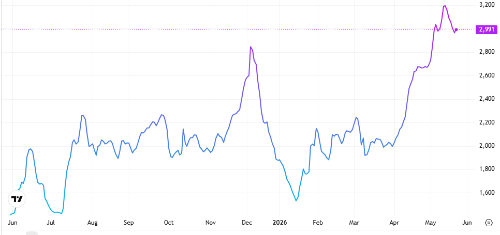
Baltic Dry Index (BDI)
Source: TradingEconomics.com
Exchange Rates
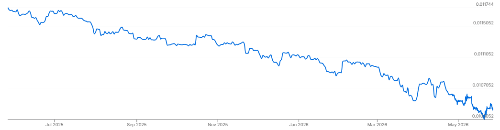
The NZD has weakened against the USD by 0.61.% over the last month. While not significant, every little bit helps when determining AWG prices with higher shipping costs and struggling CFR prices. The CNY strengthened 0.71% against the USD and the INR weakened by 1.68% against the USD over the last month. Graphs below are courtesy of XE.
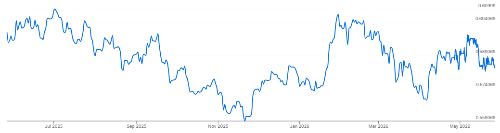
NZD:USD
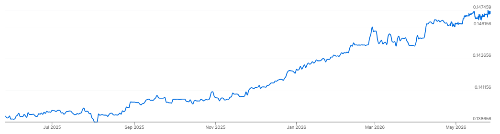
CNY:USD
INR:USD
PF Olsen Log Price Index - May 2026
The PF Olsen Log Price Index remains at $122, which is $2 above both the two-year and five-year averages.
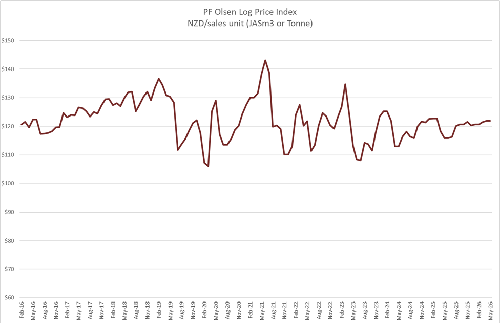
Basis of Index: This Index is based on prices in the table below weighted in proportions that represent
a broad average of log grades produced from a typical pruned forest with an
approximate mix of 40% domestic and 60% export supply.
Indicative Average Current Log Prices – May 2026
| Log Grade | $/tonne at mill | $/JAS m3 at wharf | ||||||||||
| May-26 | Apr-26 | Mar-26 | Feb-26 | Jan-26 | Dec-25 | May-26 | Apr-26 | Mar-26 | Feb-26 | Jan-26 | Dec-25 | |
| Pruned (P40) | 175-200 | 175-200 | 175-202 | 175-200 | 175-200 | 175-202 | 196 | 196 | 196 | 194 | 194 | 194 |
| Structural (S30) | 123-145 | 123-145 | 120-145 | 120-145 | 120-145 | 120-145 | ||||||
| Structural (S20) | 95-100 | 95-100 | 93-100 | 93-100 | 93-100 | 93-100 | ||||||
| Export A | 125 | 125 | 125 | 123 | 123 | 126 | ||||||
| Export K | 117 | 117 | 116 | 114 | 114 | 117 | ||||||
| Export KI | 107 | 107 | 107 | 105 | 105 | 108 | ||||||
| Export KIS | 98 | 98 | 98 | 96 | 96 | 99 | ||||||
| Pulp | 46 | 46 | 51 | 46 | 46 | 51 | ||||||
Note: Actual prices will vary according to regional supply/demand balances, varying cost structures and grade variation. These prices should be used as a guide only.
A longer series of these prices is available here.
Log Prices
Select chart tabs
This article is reproduced from PF Olsen's Wood Matters, with permission.
We welcome your comments below. If you are not already registered, please register to comment
Remember we welcome robust, respectful and insightful debate. We don't welcome abusive or defamatory comments and will de-register those repeatedly making such comments. Our current comment policy is here.