
Fonterra chief executive Richard Allen says the way people consume dairy is changing and the dairy co-operative needs to adapt accordingly.
At a media briefing following the release of Fonterra’s latest annual results, Allen said Fonterra was seeing global changes in dairy consumption.
“And when I say changing, effectively more and more consumers want the different components of milk. So they either want the fat to make their food taste good or they want the protein to make their food nutritious, and we see great opportunities across both,” he said.
“Ingredients are largely focused in and around the opportunity with proteins and our foodservice business is largely focused around the opportunities with fats.”
Fonterra’s ingredient business delivered the co-op $1.293 billion in operating profit in the July 31 year, supported by strong global protein demand, favourable pricing and product mix decisions, according to Allen.
The foodservice division reported $547 million in operating profit, which Allen said was driven largely by volume and pricing growth across all product categories and markets.
Fonterra’s total group reported operating profit was $3.4 billion, up from $1.7 billion last year, and includes the Mainland divestment benefit of $1.2 billion. Profit after tax came to $2.6 billion in the financial year ending July 31, an 142% increase on the $1.07 billion in the previous period.
During the July year, Fonterra’s return on capital was 14.2%, above its target range of 10-12%, which the co-op said showed the value of its focused business-to-business strategy.
Fonterra chief financial officer Andrew Murray said Fonterra is maintaining its return on capital benchmark of 10% to 12% and noted that the co-op’s future return on capital will probably find itself “coming down a little bit.”
“We're in a position just now where we've actually had a relatively favourable year. Pricing is high, particularly around those protein products. So we're in a good part of the cycle,” he said.
Fonterra’s results were helped by the strong performance in its foodservice and ingredients divisions as well as the divestment of its consumer and associated businesses to French dairy giant Lactalis for $4.220 billion earlier this year.
Allen said the sale of Mainland was a significant change for the cooperative.
“You know, we've got a big job to do to really execute what is now our focus strategy around business-to-business (B2B),” he said.
“There's a big job in setting up the relationship with Lactalis, and that's going really well. A big job to be done in completing the separation of both businesses.”
Murray said all that was left to finish when it came to passing the Mainland reins to Lactalis was disconnecting the IT systems, which Fonterra wants to complete by May 2027.
Fonterra chairman Peter McBride said the co-op’s farmers were using the payout from the Mainland deal for reinvestment purposes. — Fonterra proceeded with a $2 per share capital return from a total of $3.2 billion after the Mainland sale.
“So for many people, it starts with debt reduction and then it goes to start considering investment beyond that. There's been a lot of succession planning going on,” he said.
“This is the biggest shift in, I think, rural New Zealand, and dairy in particular, in terms of a generational change in the ability to do that, so that's quite powerful.”
Playing the El Niño cards
Allen said that with almost two months into the 2027 financial year behind the co-op, Fonterra is planning for another season of strong milk supply while also preparing for potential El Niño impacts. El Niño is a natural climate pattern involving unusual warming of the central and eastern tropical Pacific Ocean and can increase the likelihood of hotter temperatures and drought, which can impact milk supply. Global impacts are currently expected from a major El Nino.
McBride said that while the co-op and its farmers were as prepared as it could be for El Niño, they would have to “play the cards that are dealt to you on the day.”
“Last autumn, we had a really strong autumn season and there's a lot of stored feed that was grown on farm,” he said.
“So, you know, farmers are pretty good at adapting to these challenges. It's just the severity and the length of it that's an unknown.”
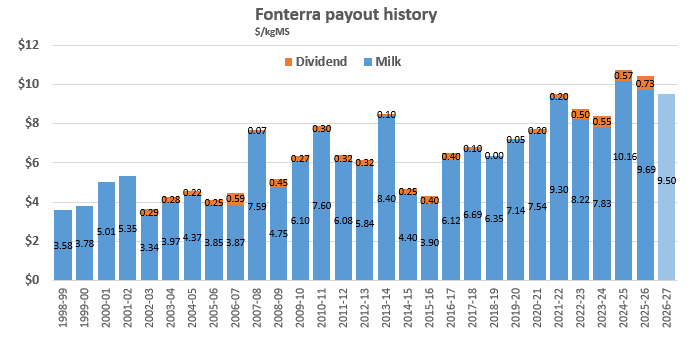
Fonterra’s current farmgate milk price forecast for the 2026/27 season that started in June 2026 is $9.50 per kilogram of milk solids (kgMS).
The co-op is paying a final dividend for the 2026 financial year of 33 cents per share, bringing the total to 73 cents, up from 57 cents in the previous year. This includes the 24-cent interim dividend and the 16-cent special Mainland dividend paid in April.
We welcome your comments below. If you are not already registered, please register to comment
Remember we welcome robust, respectful and insightful debate. We don't welcome abusive or defamatory comments and will de-register those repeatedly making such comments. Our current comment policy is here.