
Interest.co.nz is unpacking how AI will change your everyday life - the risks, the opportunities, and what to actually expect. Our new series brings you the policymakers, experts and industry leaders from New Zealand and overseas.
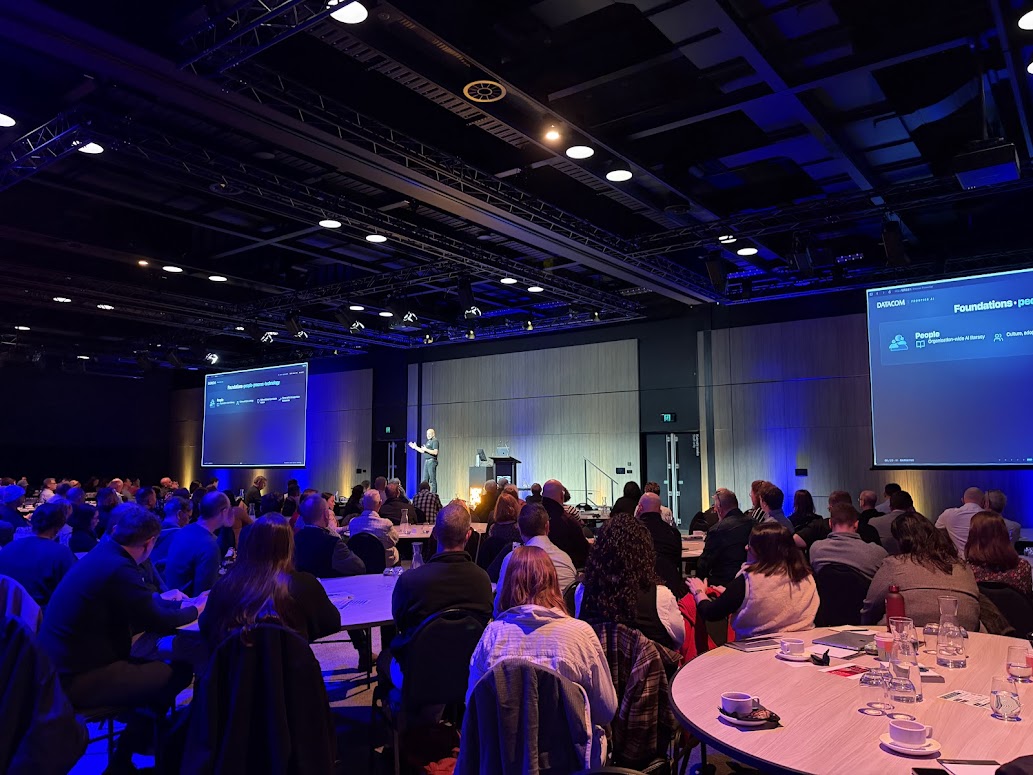
The lights are dim. The Tākina Events Centre in Wellington is packed out and seats are at a premium. The speakers are donned with mics and pacing the stage like it's the latest iPhone launch.
AI is still baffling to me and I’m secretly googling the jargon that everyone seems to already know (my AI dictionary is linked here). So I wasn't sure what to expect walking into the 2026 Great New Zealand AI Roadshow, hosted by AI New Zealand.
But after the roadshow, I had the basics broken down, a better understanding of how AI might impact me as a worker and the regulatory gaps explained in a way that a normal person can understand.
The crowd appeared to be a range of people - young, older, men and women, from both the private and public sectors. It certainly wasn’t the intimidating, brainy tech fest I had suspected it would be.
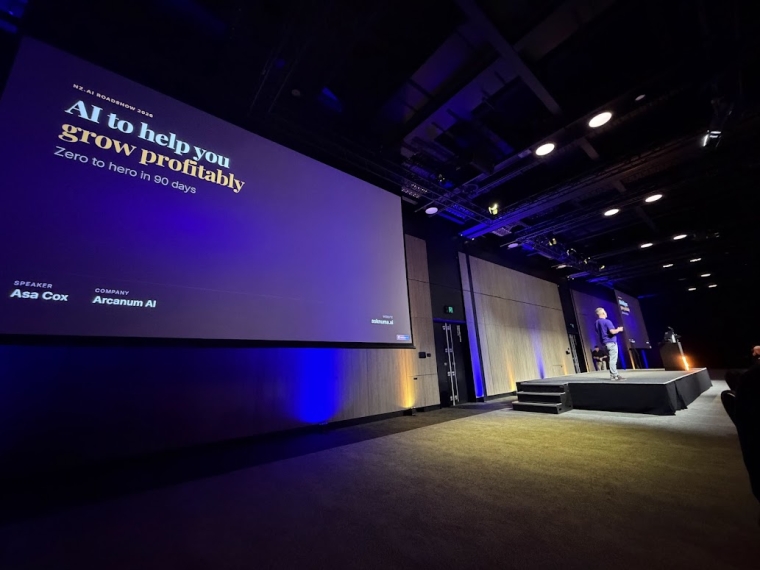
What stood out to me the most was a segment from Asa Cox of Arcanum, during his presentation on AI profitability.
He said in his 10 years trying to get organisations to embrace and adopt AI, eight times out of 10 it was not the technology; it was the humans who got in the way, through a lack of planning or some fear, or a lack of organisational design.
"There needs to be somebody in your organisation that very clearly can articulate, why do you want to do AI? Why do you want to embrace it? Why do you want to use it?
"Because if you don't communicate that clearly, I can tell you from the hundreds of companies we've worked with, there will be people that go, 'I'm just worried about losing my job, because that's all I know from the press... that means the writing is on the wall - stuff that - I'm going to block it as much as I can'.
"Or it's going to be, it's cheating, the bosses haven't told me that I'm allowed to use AI, so therefore, if I do use it, and I get caught out, then it's going to be cheating."
Cox said time was needed to get the value from AI.
"This is a transformational technology. It will unlock value, it will unlock time. This is an investment, a personal development investment, an organisational development investment. For some companies, this is an existential threat or an existential opportunity. Do not take it lightly."
Implementing cybersecurity alongside AI
“If you’re thinking of AI, and you’re not thinking about cyber security, then you’re not thinking about AI,” Richard Kenyon of Datacom told the audience.
Kenyon spoke about implementing AI into organisations and encouraged people to think of what "you would like to do that you can't do today because you don't have enough capacity and you don't have enough capital and you have enough time".
Ben Schollitt from cybersecurity company Check Point had a presentation titled Your Data Isn't Leaking, It's Being Handed Over.
Schollitt showed us three ways AI creates a new attack surface - through employees (“one bad paste can leak your crown jewels”), applications (a single prompt can hijack your Gen AI application) and through agents (can take unsafe actions autonomously).
“Whether it's an AI chatbot... or if we start playing around with agents as well, and agentic workloads, we're going to unlock a lot of value for New Zealand businesses, but what that's also going to do is increase risk,” he said.
“Things like data leakage, AI-specific threats like prompt injection and uncontrolled autonomy, so allowing agents to go do things that you said, just go do whatever order you need, and then it ends up doing more than it should have.”
Schollitt told us while 78% of organisations use AI, almost 70% of enterprises have AI-powered data leaks as a top security concern, but almost half are operating without AI-specific security controls.
For more on AI, see our series, Unpacking AI.
'If you don't have an AI plan now, you're already AI exposed'
Simon Martin of law firm Hudson Gavin Martin took us through the key legal issues with AI.
Martin said the three core categories of output risk included accuracy (such as hallucinations and misinformation, fair trading act breaches and professional conduct breaches), IP risk (like output infringement and ownership uncertainty) and privacy and confidentiality breaches (via uploading confidential information to an external AI tool).
“The reality is that if you don't have an AI plan now, you're already AI exposed. The risk is that if you don't use AI, other people within your organisation, suppliers to you, are already using AI,” Martin said.
“If you don't think about these things, if you don't recognise these risks and have something in place in relation to it, then the problem is that you don't have anything to really hold them to account to, you don't have anything that gives them the guidance around what is acceptable and what is not acceptable.”
He described the legal framework of AI in New Zealand as a “relatively light touch”.
"We don't have any specific AI regulation in New Zealand at the moment, so we are dealing with regular laws… there are some enormous challenges in relation to Privacy Act issues, because data is at the core of everything.”
'Just jump in'
Tech company founder Serge van Dam spoke about AI for boards and directors. He said while AI can feel intimidating, he encouraged the audience to jump in.
"It can be a travel itinerary, it can be comparing bicycles if you're into bike riding, it can be building a website with the FIFA World Cup draw on it, but just jump in.
"Honestly, the consequences of not getting stuck in are perilous, not just for you as professionals, especially those in governance, but the organisations that you're representing, because obviously... leadership is pretty critical.
"If your board is tepid, timid, and unwilling to jump in, then it's understandable that your teams, who are executing and trying to be more productive, move faster, are going to feel the same way."
We welcome your comments below. If you are not already registered, please register to comment
Remember we welcome robust, respectful and insightful debate. We don't welcome abusive or defamatory comments and will de-register those repeatedly making such comments. Our current comment policy is here.