
Kiwibank expects to be able to keep recycling all its profits into fresh capital to back its growth in market share against the big four Australian owned banks. It now has more certainty about its future growth plans after the potential for a sale or partial sale to a non-Government player has been ruled out, and the need to pay dividends has been removed from its immediate future.
The state-controlled bank's ultimate owner, the Government, announced Monday it would consolidate its ownership into a single completely-Crown controlled vehicle through the Crown 'buying' the 20-year old bank off its three current owners, the also-state-controlled NZ Post, ACC and NZ Super Fund.
The consolidation was forced by the NZ Super Fund offering to buy some or all of the stake held by NZ Post, which the Government opposed because NZ Super Fund wanted to retain the right to exit the stake at some point by selling to a non-Crown and non-Government company. See the full detail of the deal here.
The Crown will pay $527 million for NZ Super's 25% stake, which it paid NZ Post $263m for in 2016. NZ Super invested a further $61.75m in 2017. The acquisitions of stakes by NZ Super and ACC (23%) allowed a payment of a $200m dividend at the time back to the Government, which at that time was a National-led Government more focused on receiving dividends from state-owned firms and using them to repay debt. Engineering the sale of the NZ Super and ACC stakes effectively allowed the-then National-led Government to extract capital from Kiwibank and keep expecting dividends, given fresh capital would have to be injected by NZ Super and ACC.
An era of profit retention continues on
In the end, the change of Government in late 2017 saw Kiwibank allowed to hold on to its profits and plough them back into Kiwibank's equity and tier one capital position, which it has used to keep backing its growth of loans and market share. Kiwibank has collectively reported $537m in post-tax profits in the four years to June 30, 2022, which allowed the bank to grow its net equity by $715m to $2.202b over that time.
That allowed Kiwibank to grow its assets to $31.55b from $20.72b as June 30, 2018, as well comply with tougher Reserve Bank capital reserve requirements. Kiwibank's minimum common equity tier one capital requirement is due to rise from 4.5% to 11.5% by 2028. It was at 10.5% at June 30, down from 10.9% a year earlier, Kiwibank said in its latest disclosure statement it expected to meet the increased regulatory capital requirements "through a combination of growth in retained earnings and the issuance of qualifying capital instruments over the transition period."
But any move to restart paying dividends would have restricted Kiwibank's growth appetite in the years ahead, especially without the somewhat independent providers of fresh capital on its shareholder register in ACC and NZ Super Fund.
'No dividends required'
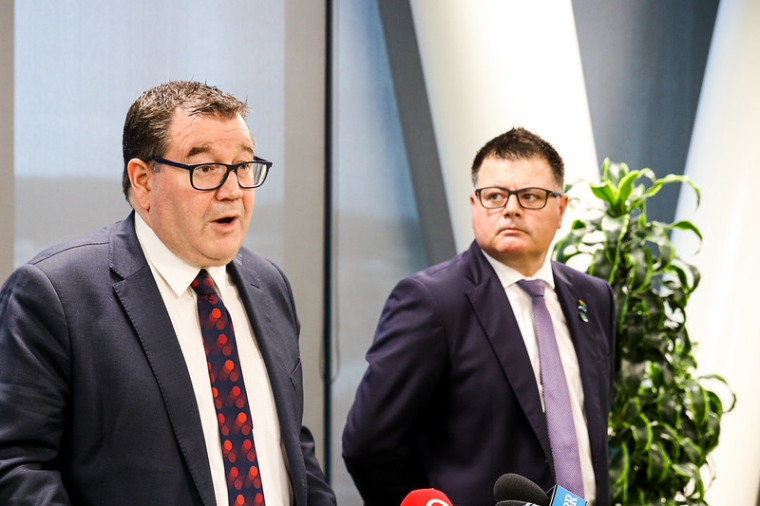
Finance Minister Grant Robertson and Kiwibank CEO Steve Jurkovich said they would retain the current policy of not paying dividends, other than for preferred capital instruments. Jurkovich was also confident about Kiwibank continuing to grow and aim to win market share off the big four Australian-owned banks in consumer, mortgage and small-to-medium business banking.
Asked if Kiwibank's dividend policy would change, Robertson said: "As it stands, nothing's changing in terms of where we are now. And we want to give some certainty and stability to Steve and to the New Zealand Home Loans team. So we're not looking to change anything."
"What we are looking to do is make sure that Kiwibank can continue, as Steve has indicated, to operate under its own steam. And if, from time to time, there is a need for further investment, the government would look at that," Robertson said.
Jurkovich said it was unlikely Kiwibank would recommend a dividend while it was still growing, and while the regulatory requirement for more capital was in place.
"So for us growing capital requirements in the regulatory environment plus our investment in technology, it seems really unlikely that we'd be recommending a payment out of the dividend, but we'll cross that bridge when we come to it," he said.
Robertson also reaffirmed the Government would support Kiwibank to compete against the big four.
"We understand the importance of investing more capital into this business. I think New Zealanders having a fully New Zealand-owned bank that they know and trust and that the profits of which all stay in New Zealand that is competitive with the Big Four is a really important thing for New Zealand," Robertson said.
"And so as a government, we have to then be prepared to do what is needed to make sure it can play that role," he said.
Jurkovich said Kiwibank had no plans to ask for extra capital, but had successfully been able to grow market share and meet higher capital requirements from retained profits.
"We've had a self-funding capital plan regardless of the change in ownership. I wouldn't as a chief executive ever want to put the bank in a position where we need to go and ask for capital. That's something within our control. We've had a capital plan that sees us meet the rising regulatory requirements over time. So those things are within our control," he said.
"Now, like any bank, if we can grow a bit faster and the returns are there, certainly we would ask for capital, but we're not a position where we are asking for capital, just to be clear."
We welcome your comments below. If you are not already registered, please register to comment
Remember we welcome robust, respectful and insightful debate. We don't welcome abusive or defamatory comments and will de-register those repeatedly making such comments. Our current comment policy is here.