
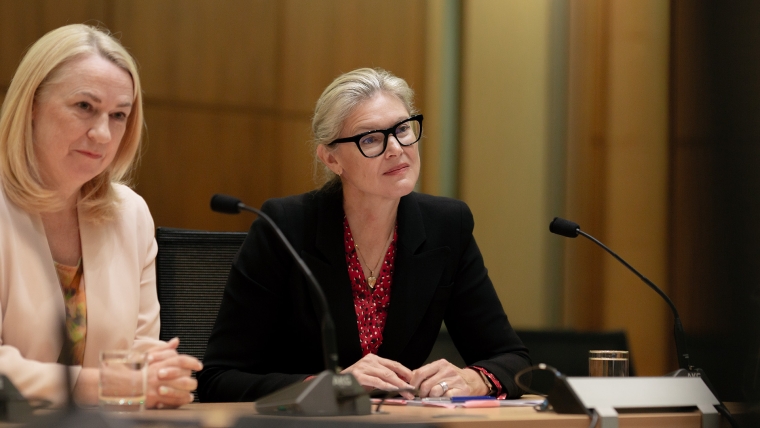
Against the backdrop of NZ First's "Woke Bank Bill" and MPs talking about the potential for a windfall bank profit tax, the Government ought to be wary of the message this sends overseas at a time "New Zealand really needs" international investors, ASB CEO Vittoria Shortt says.
On Monday NZ First announced plans for the Financial Markets Amendment Bill, a members' bill, aiming to prevent financial institutions from refusing services based on political views, ESG (environmental, social and governance) considerations, or industry type.
Government MPs in the ongoing select committee banking inquiry have also raised the possibility of introducing a profit tax or levy on the big banks, which Finance Minister Nicola Willis hasn't ruled out.
Separately the Government announced on the weekend it's "modernising" visa settings to incentivise migrants to invest in New Zealand.
And Prime Minister Christopher Luxon and Infrastructure Minister Chris Bishop say about 100 "of the world’s high-profile investors, business leaders, and construction companies" are expected to visit NZ in March for a global investment summit. They say their government is "relentlessly focused on accelerating the growth New Zealand needs to lift our incomes, strengthen our businesses, and create opportunities for all Kiwis."
Speaking to interest.co.nz after ASB posted a 2% rise in interim profit to $763 million on Wednesday, Shortt says NZ has a 2050 net zero carbon emissions target and the Government has reconfirmed its commitment to this. Banks' role, therefore, is supporting customers and their transition.
"[Then] the Government's signalling, or at least one party's signalling, that they want to direct investment. I think there are a lot of unintended consequences that need to be considered, and particularly what message is that going to send to international investors at a time when New Zealand really needs international investors to support our growth aspirations?" Shortt asks.
In terms of a potential windfall tax or levy, she again says; "I think the important thing for me is what signal is the New Zealand Government sending around windfall tax? Again ... at a time when New Zealand really needs international investors, you know, what signal is this going to send?"
'Support them with that transition'
Shortt says ASB doesn't have lending exposure to the mining or oil and gas sectors, which she attributes to its history as Auckland Savings Bank.
"Given our history, we just haven't developed the skills and expertise for that sector."
It does, however, have lending exposure to fuel retailers.
"We do lend to fuel retailers and those fuel retailers are working through and acting on their transition pathway. So ... the rate of adoption of EVs, and they're thinking about how that rate of adoption could change. They're thinking about their role in alternative fuels," says Shortt.
"So our job is to support them with that transition. That's the way we think about our role."
Shortt says ASB's unlikely to even lend to mining for minerals that could be used in the green transition to decarbonise the economy.
"I think for me the question is less about [what] would we be happy to fund. It's a whole lot more about do we have the skills, the expertise and the capability? And I believe that lending to mining activities does require specialist skills, and we just haven't built those skills," says Shortt.
"We've identified areas that we think we do have skills in that we have built capability in and we think are going to make a really important contribution. It's not the only areas, of course, but trade, infrastructure, productivity, financial resilience and housing, [are] five things that we think are really important for the future and that's where we can really participate."
Asked about emissions challenges facing the agricultural sector, where ASB is a lender, Shortt says they're not alone.
"So does everybody [face challenges]. I think that there are lots of questions around if we wanted to focus on climate. There are questions for housing, there are questions for dairying, there are questions for mining. I'm not sure I know of a sector that isn't thinking through all of the implications. So, you know, it's part of understanding every sector, I guess I would say," Shortt says.
We welcome your comments below. If you are not already registered, please register to comment
Remember we welcome robust, respectful and insightful debate. We don't welcome abusive or defamatory comments and will de-register those repeatedly making such comments. Our current comment policy is here.