
Heartland Group Holdings still plans to double down on expanding its reverse mortgage market share and snapping up more customers over the coming year if its proposed merger with TSB gets the green light.
Speaking to interest.co.nz on Thursday following Heartland’s annual results, CEO Andrew Dixson said Heartland’s reverse mortgages would remain a key focus for the group under the proposed TSB-Heartland entity.
Heartland is currently in the middle of trying to get a deal over the line with TSB, after signing an agreement in June with TSB's parent, the Toi Foundation, to buy TSB for $620 million.
“The reverse mortgage product won't change. We will continue offering it as we currently do today," Dixson said.
“So we will retain our specialist focus in terms of the products that Heartland Bank currently offers across New Zealand and Australia. However, you know, our offerings will be enhanced by the addition of TSB’s capabilities.”
Heartland has banking operations in New Zealand and Australia and specialises in reverse mortgages. It reported a net profit after tax (NPAT) of $93.2 million in the 2026 financial year, up $54 million from the prior year with strong growth in its reverse mortgages book on both sides of the Tasman.
Reverse mortgages are equity release devices for home-owning retirees and act as a way to cash up some of the equity in a freehold home. Unlike standard mortgages, regular repayments are not required as the debt is repaid from the proceeds received from the property in a future sale.
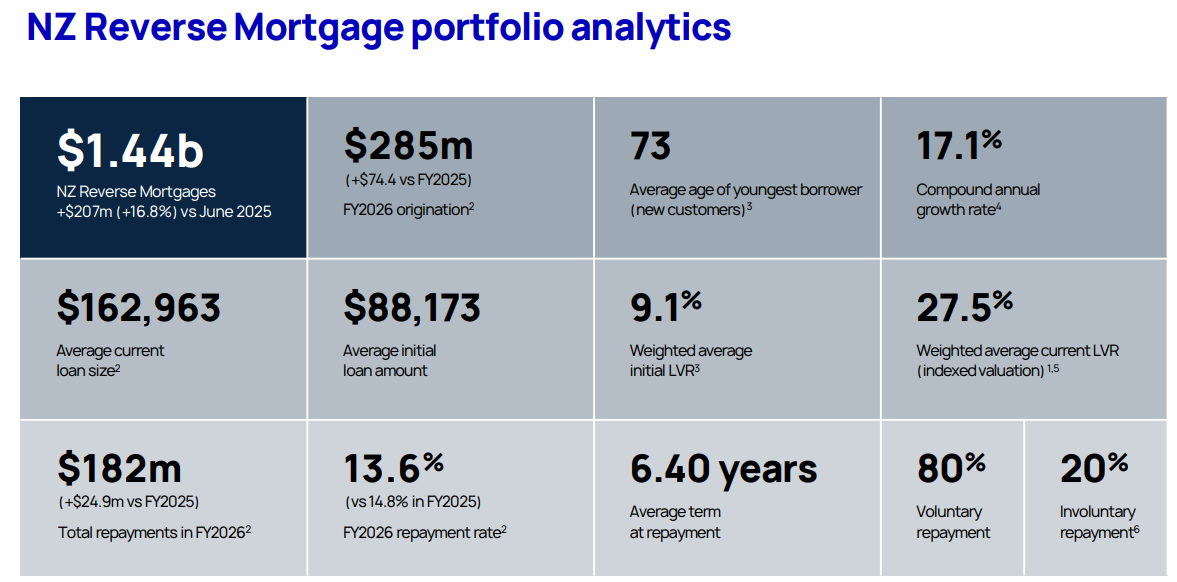
Annualised reverse mortgage growth for Heartland in NZ increased from 14% in the first quarter to 18.5% by the fourth quarter of the June year. Total reverse mortgage receivables for NZ rose 16.8%, or $207.4 million, to $1.440 billion in the June year. According to the bank, growth came from increased investment in market awareness, regional presence and product process improvements.
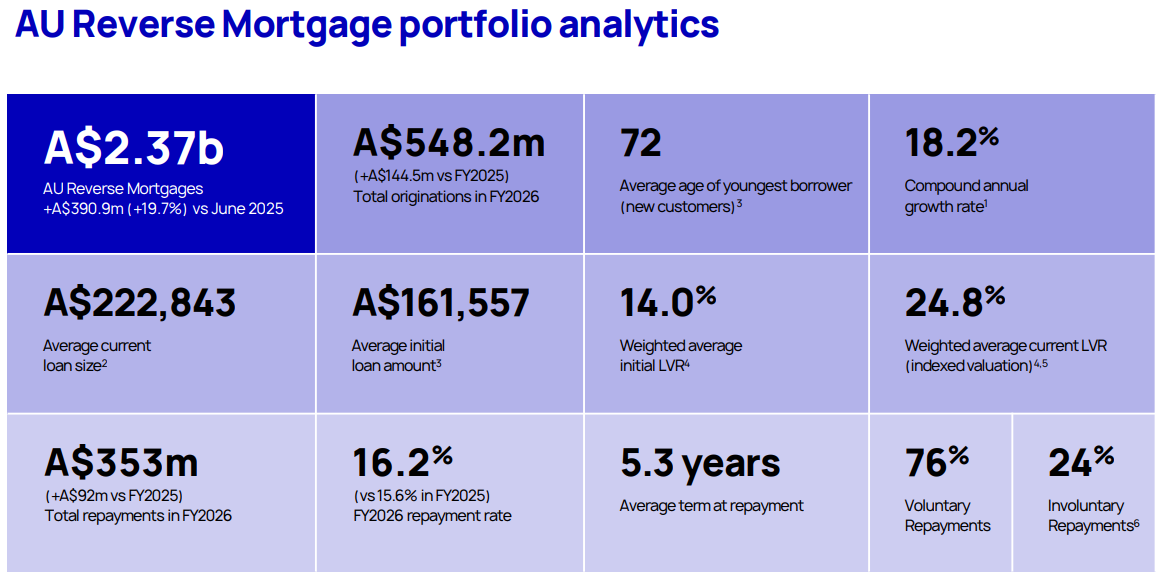
Reverse mortgage receivables in Australia jumped 19.7%, or A$390.7 million, to A$2.371 billion in the June year. Australia’s growth was supported by ongoing customer demand and continued momentum across both direct and intermediary channels, Heartland said.
In its annual results, Heartland outlined that its priorities for the financial year ending 30 June 2027 (FY2027) included lifting profitability “to at least $102 million” and targeting reverse mortgage growth greater than 18% in both NZ and Australia.
“It is an absolutely huge market,” Dixson told interest.co.nz. “We know that this demographic is ageing and we expect that number to increase as we go through time. It's incumbent on us to secure as much of that market as we can.”
Heartland’s reverse mortgages have a starting age limit of 60, and according to the bank the average age of new reverse mortgage borrowers in NZ is 73.
Since Heartland started offering the product in 2014, the bank has provided reverse mortgages to over 29,000 people in NZ alone.
In the year ending June 2026, Auckland holds the largest market share of Heartland’s NZ reverse mortgages, at 28%, followed by Waikato at 14%. The rest of the North Island accounts for 34%. Canterbury represents 12% of Heartland's reverse mortgages in NZ, while the rest of the South Island makes up 11%.
Heartland said customers often use loan proceeds from their reverse mortgages for more than one purpose, including home improvements, paying off existing debt and extra income.
‘We know the risks and outcomes’
“As the [reverse mortgage] market leader in this country and indeed Australia, we are the sector experts,” Dixson said. “We know the product better than anyone and we know the risks and the outcomes of the product.”
It’s why Heartland plans to participate in a review of reverse mortgage capital risk weights that the Reserve Bank (RBNZ) will be undertaking in the second half of the 2026 calendar year, although the exact timing of the RBNZ’s review has yet to be confirmed.
Risk weights are used to work out the minimum amount of regulatory capital a bank must hold. The capital requirement is based on a risk assessment for each type of bank asset or loan.
According to the group’s calculations, applying Heartland Bank’s expected risk weight changes to its June 2026 balance sheet brings excess capital to approximately $160 million.
“The Reserve Bank has signalled that reverse mortgage risk weights comparatively to where the new residential mortgage risk weights will be going to are quite high, and that gap has got bigger. So whilst not setting an expectation for risk weights to come down for reverse mortgages, that tone is positive,” Dixson said.
“What we would hope is that more granular LVR bandings were introduced for reverse mortgages from those that are held today.”
A loan-to-value ratio (LVR) is calculated from the amount borrowed as a percentage of the bank’s valuation of the property.
Once the new risk weight changes are embedded and the proposed merger of Heartland Bank and TSB is completed – subject to satisfaction of all merger implementation agreement conditions – Heartland said it intends to allocate excess capital towards opportunities that will support scaling and growing the company.
“We would expect, were risk weights to reduce, that to obviously be a benefit to Heartland Bank's capital position versus where it is today,” Dixson said.
We welcome your comments below. If you are not already registered, please register to comment
Remember we welcome robust, respectful and insightful debate. We don't welcome abusive or defamatory comments and will de-register those repeatedly making such comments. Our current comment policy is here.