
By Martien Lubberink*
Last Friday, the Reserve Bank published an announcement that it had requested TSB to commission an independent report under Section 95 of the Banking (Prudential Supervision) Act 1989. Soon thereafter, some journalists called me about this. I spoke with them for some time, and at some point, it looked like they were tempted to believe the bank was at risk. I answered that I would never preempt the outcome of the Deloitte report. Neither should anyone else. Frivolous speculation about the viability of a bank is not inconsequential. The suggestion of the R-word can severely affect financial stability.
What I can do is put the numbers that are already public on the table. There are quite a few of them. So here goes.
What happened
Earlier this month, the Reserve Bank (RBNZ) sent TSB a notice under Section 95 of the Banking (Prudential Supervision) Act 1989. The RBNZ made this public on 25 September. The notice followed TSB itself identifying and reporting “issues concerning aspects of the computation and reporting of its capital and liquidity ratios”. TSB must now provide independent assurance that it complies with the prudential requirements on liquidity, capital adequacy and regulatory reporting.
TSB has appointed Deloitte. A draft is due at the end of October and the final report goes to the RBNZ in November. The RBNZ says that, as this is an ongoing prudential matter, it won’t comment further.
In a press release, TSB says its “current liquidity and funding positions are sound, and the bank remains well capitalised”. It describes the review as “an additional level of independent assurance as TSB prepares for the proposed merger with Heartland Bank”. Just in case you missed it: In June, Heartland agreed to buy TSB from the Toi Foundation for $620m and merge the two banks. Heartland’s statement to the NZX on 25 September was careful. It mentions that it undertook “extensive due diligence” before signing. The relevant matters found “were reflected in the commercial and contractual terms” of the deal; and the deal still depends on shareholder approval, the RBNZ’s approval and a TSB “Material Adverse Change” condition. If the review turns up something “materially different to what is known today”, the deal may not complete.
Heartland’s shareholders voted on the deal at a special meeting held 30 September.
What is a Section 95 report?
Section 95 lets the Reserve Bank require a registered bank to supply a report, prepared by a person the RBNZ approves, on the bank’s corporate matters, financial matters, prudential matters, or anything else relating to its business, operation or management, including those of associated persons. Failing to comply is an offence.
In plain language, it is the RBNZ saying: “we want an independent expert to look at this, and to report to us”. It is part of the normal supervisory toolkit. RNZ notes that such notices are relatively rare, with only a handful issued over the last few years. It is what it is: a request for a report. In this case the trigger was a problem the bank flagged itself. (Even though in practice, in cases like this there may have been some back-and-forth correspondence between the bank and its supervisors before TSB reported this formally to the RBNZ. Supervisors and bankers tend to avoid surprising each other.)
TSB by the numbers
I used TSB’s Annual Report and Disclosure Statement for the year to 31 March 2026, and the RBNZ’s Bank Financial Strength Dashboard data (via my own RBNZ API) up to June 2026. The API data let me compare TSB with the other registered banks.
The errors
As interest.co.nz reported, TSB’s own disclosure statements already mention two errors. The first is in liquidity: since 2010, TSB classified some funding as “non-market funding” when it should have been “market funding”, which technically put it in breach of its liquidity condition of registration. TSB estimates that correcting it lowers its March 2026 core funding ratio by 1.67 percentage points and its one-week and one-month mismatch ratios by less than one point each. The second is in capital: in 2019 TSB found it had used loan-to-value ratios from when a loan was made, rather than recalculating them each period. TSB says those capital issues were resolved as at September 2025, with an immaterial impact, and the liquidity error has been identified and quantified. So both appear to have been dealt with, though confirming that is part of Deloitte’s job.
Neither error changes the picture much. The ratios stay far above the minimums. Part of TSB’s table-topping core funding ratio came from the misclassification, but after the correction it is still the highest in the system, just by a bit less. The Financial Markets Authority’s warning, the same week, about fees wrongly charged on business cheque transactions adds to the sense of patchy systems, though, as far as I know, we have no data on how material it is. None of this points to a shortage of capital or cash. But it does point to weak systems, data and controls, which is what a Section 95 report is designed to examine.
What the auditor said
The independent auditor’s report (EY, page 80 of the annual report) gives a clean, unqualified opinion, with no going-concern flag. The only key audit matter is the usual one for a bank: the allowance for expected credit losses.
One should know that an audit opinion does not extend to the capital and liquidity ratios, which only get a lighter “limited assurance” check. So, it looks like the numbers that went wrong are the ones with lower external scrutiny. This is not unique to New Zealand or TSB: auditors opine on the financial statements that are reported under International Financial Reporting Standards, or IFRS. Prudential reporting is is largely outside the audit opinion. That gap is also a reasonable argument for why the RBNZ wants a proper independent look.
How often does TSB revise its data?
I went through the RBNZ’s revisions log for the Bank Financial Strength Dashboard. Since 2018, it records every change banks make to data they previously reported. TSB revised 121 data points across nine quarters. That puts it fourth among the banks, behind Heartland (228), Bank of China (224) and Westpac (143).
The revisions are small, though. For dollar amounts, TSB’s typical revision is about 0.05% of risk-weighted assets, and its largest quarter averages 0.27%. ANZ, the Bank of Baroda and the Bank of China have all had revisions of 1–2.4% of risk-weighted assets. For ratios, TSB’s typical revision is about 0.3 percentage points, whereas ANZ and Westpac have had revisions of 5 to nearly 20 points. So TSB revises regularly, but by modest amounts, and it is far from the worst. The chart below shows this for dollar revisions: TSB’s cells sit in the light to middle shades, and none reaches the darkest band.
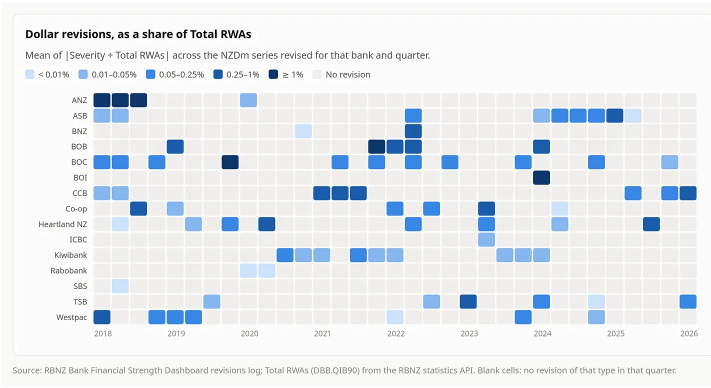
One honest caveat on my own analysis: the revisions log only shows what a bank chose to restate. TSB did not restate its liquidity ratios, so the 16-year liquidity error never appears in it. A tidy revisions record is not proof of tidy systems.
So, is TSB in trouble?
Looking at the data, I don’t see compelling evidence that it is. TSB has more CET1 capital than any of the big five banks and among the lowest non-performing loans in the country. Even after correcting errors, its core funding ratio is the highest of any registered bank and its mismatch ratios are comfortable. It is profitable, has a clean audit opinion and carries a stable investment-grade rating.
Of course, I may be wrong, because I have not seen what Deloitte will see, and neither has anyone else writing about this.
Many eyes on the books
There is another reason I doubt TSB is hiding a big nasty surprise. It is in the middle of being sold, and few banks are more closely examined than one being sold. Heartland says it carried out extensive due diligence before signing, and an independent expert’s report on the deal was published on 31 August. EY audited the March 2026 accounts. And the RBNZ oversees the change of ownership. It is already engaged with Heartland and Toi. With that many accountants, lawyers and supervisors in the data room, a large hole in the balance sheet would be hard to hide.
Again, a disclaimer, though. Due diligence doesn’t mean nothing was found. Heartland says what it found was “reflected in the commercial and contractual terms”, which suggests the known issues were priced in, not that there were none. And the Material Adverse Change clause exists precisely because buyers know surprises happen. Deloitte could still find something new. Until November, nobody knows.
Zooming out: the scale problem
Step back and the TSB story reveals a familiar structural problem.
TSB’s profitability is so-so, in line with the smaller New Zealand banks. A return on equity of around 5% is roughly half of what a bank needs to cover its cost of capital; the big four earn 8.5–13%. TSB’s cost-to-income ratio is 71%, against 35–51% for the big four. For every dollar of income, TSB spends 71 cents just running the bank. Kiwibank (70%), SBS (71%) and the Co-operative Bank (92%) are in the same boat. That is not sustainable in the long run.
Banks face three main risks: market risk, credit risk and operational risk. TSB’s credit risk looks well managed, and its market risk is modest. Operational risk is where small banks struggle. The costs of compliance, regulatory reporting, IT, cyber security and fraud prevention are largely fixed. The big banks spread them over millions of customers; small banks cannot. Without economies of scale, something gives, and for small banks it often shows up as manual workarounds, legacy systems, data gaps and, eventually, reporting errors. That is my take on what we are seeing at TSB.
Which is why, to my mind, joining Heartland is a good thing for TSB. The combined bank would still be small by New Zealand standards, but it would achieve critical mass: more customers to carry the fixed costs, and a stronger position to fund proper systems. The Section 95 review, with its “focus on ongoing compliance post-merger”, may well end up being part of making that transition work.
A word on speculation
Jonathan Milne has been writing about TSB for a while. But suggesting that the Reserve Bank asked Heartland to “rescue” a failing bank is a strong claim. I haven’t seen evidence for it. Claims like that are not harmless. If depositors believe them, they can become self-fulfilling.
Jonathan’s analysis in newsroom.pro also rests on the wrong capital ratio. He points out that TSB has the lowest Total capital ratio of the registered banks, and that was correct at March 2026 (in June 2026 it was second-lowest, just above Bank of China). But the Total capital ratio includes Tier 2 capital, which is subordinated debt. Other banks augment their total ratio by 1.3 to 3 percentage points with Tier 2 instruments. TSB has none, so its total ratio equals its CET1 ratio, which is capital of the highest quality.
The ratios that best measure a bank’s loss-absorbing capacity are CET1 and Tier 1. On those, TSB is better capitalised than ANZ, BNZ, ASB, Westpac, Kiwibank, and Heartland. By the very measure used to suggest TSB is weak, TSB looks weak only because it has chosen not to borrow its capital.
So a gentle plea to Jonathan and colleagues: by all means ask hard questions about systems and governance, because they are warranted. But let’s wait for the Deloitte report before suggesting TSB is a bank in distress. The data we have so far doesn’t support it.
Appendix
Profitability. TSB made a profit before tax of $63.3m in the year to March 2026 (up $5.8m), and $45.5m after tax. The net interest margin was 2.26%. Return on equity was 5.7% for the year, and about 5.4% over the latest four quarters. That is profitable, but only just about enough, as discussed in the post.
Capital. TSB’s CET1 ratio is 15.5%, and so are its Tier 1 and Total capital ratios. They are all the same number because TSB has no Additional Tier 1 and no Tier 2 capital: its capital is essentially all shareholder equity and retained earnings. The minimums are 4.5% (CET1), 7% (Tier 1) and 9% (Total), plus a 3.5% prudential capital buffer. TSB’s buffer ratio is 6.5%. On CET1, TSB is better capitalised than every one of the big five banks. Roughly, it holds about $340m more capital than the bare 9% minimum requires, and about $150m more even after the full buffer.
Leverage. New Zealand has no formal leverage ratio, but Tier 1 capital over total assets is a fair stand-in. At 8.5% TSB is right around the middle of the pack, and ahead of ANZ, ASB, Westpac and Kiwibank.
Asset quality. Non-performing loans are 0.3% of loans, among the lowest in the system. Impaired assets fell from $77.1m to $41.6m over the year. TSB’s book is mostly Taranaki and other regional home loans, and it shows.
Credit rating. Fitch rates TSB BBB+ with a stable outlook, according to the disclosure statement signed in June 2026. Fitch downgraded TSB from A- to BBB+ in July 2024. That is a solid investment-grade rating, not a distressed one.
Liquidity. The core funding ratio is 108% against a 75% minimum, the highest of any registered bank. The one-month and one-week mismatch ratios are 14.1% and 10.3%, against a minimum of zero.
Sources: RBNZ media release (25 Sep 2026); TSB and Heartland statements (25 Sep 2026); RNZ, BusinessDesk, interest.co.nz and Newsroom coverage; Banking (Prudential Supervision) Act 1989, s 95; TSB Annual Report and Disclosure Statement for the year ended 31 March 2026 and Disclosure Statement for the six months ended 30 September 2025; RBNZ Bank Financial Strength Dashboard and revisions log, accessed via my RBNZ API (github.com/blucap/RBNZ_API).
*Martien Lubberink is an Associate Professor in the School of Accounting and Commercial Law at Victoria University. He has worked the the central bank of the Netherlands where he contributed to the development of new regulatory capital standards and regulatory capital disclosure standards for banks worldwide and for banks in Europe (Basel III and CRD IV respectively).
This article first ran here and is used with permission.
We welcome your comments below. If you are not already registered, please register to comment
Remember we welcome robust, respectful and insightful debate. We don't welcome abusive or defamatory comments and will de-register those repeatedly making such comments. Our current comment policy is here.