

The Reserve Bank (RBNZ) says it stopped buying back cash from banks last December for the first time ever outside of a crisis response, at a time the banking sector was holding its lowest ever level of cash and while some banks were changing cash-in-transit arrangements.
The RBNZ, by law the sole supplier of NZ banknotes and coins, says it has progressively restarted buying back cash, notably in May resuming the buying of fit, or undamaged, surplus $100 notes from all banks. It says it has continued repurchasing damaged and worn out cash from banks throughout this period. The decision to stop buying back cash "applied to all banks that we sell cash to," the RBNZ says.
Karen Silk, RBNZ Assistant Governor for Money, told interest.co.nz the decision to stop buying back undamaged cash was a question of resilience through "a reasonably significant change" in the supply chain, and whether that "could pose some real risks to customers being unable to access cash."
In 2024 the Commerce Commission cleared Evergreen NZ Holdings' acquisition of ACM New Zealand Ltd leaving just one NZ supplier of cash-in-transit services. In mid-May this year the Commission confirmed it would authorise, with conditions, a New Zealand Banking Association application for it, a group of banks and other parties, to collectively negotiate with Evergreen (Armourguard) over cash-in-transit services.
"And so having banks hold a little more cash through a change period was really around risk mitigation, ensuring that they would be able to respond to customer needs both through business as usual, but also if there's some kind of crisis through that period. And when I talk about crisis it could be something like a weather related event as we saw with [Cyclone] Gabrielle where you have to get more cash into areas in those kind of periods. And it was also at a time where banks were holding very low levels of cash themselves," said Silk.
While the RBNZ is the sole supplier of NZ money and views cash as a core banking service, it relies on banks, as intermediaries, to meet their customers' cash needs. Providing cash services directly to the public is "not something that we believe we should be directly engaged in," Silk said.
The RBNZ earns income, seigniorage, from issuing currency and selling it to banks, which stems from the difference between the face value of the money sold and the total cost of producing and distributing it. When the RBNZ buys cash back from banks it pays the face value, so $100 for a $100 note, even if it's damaged. It does this by crediting the seller bank's Exchange Settlement Account, ESAS, with the RBNZ.
The RBNZ says that between December 2019 and December 2025 there was a 31% decline in banking sector cash in nominal terms. However, cash in circulation has been increasing.
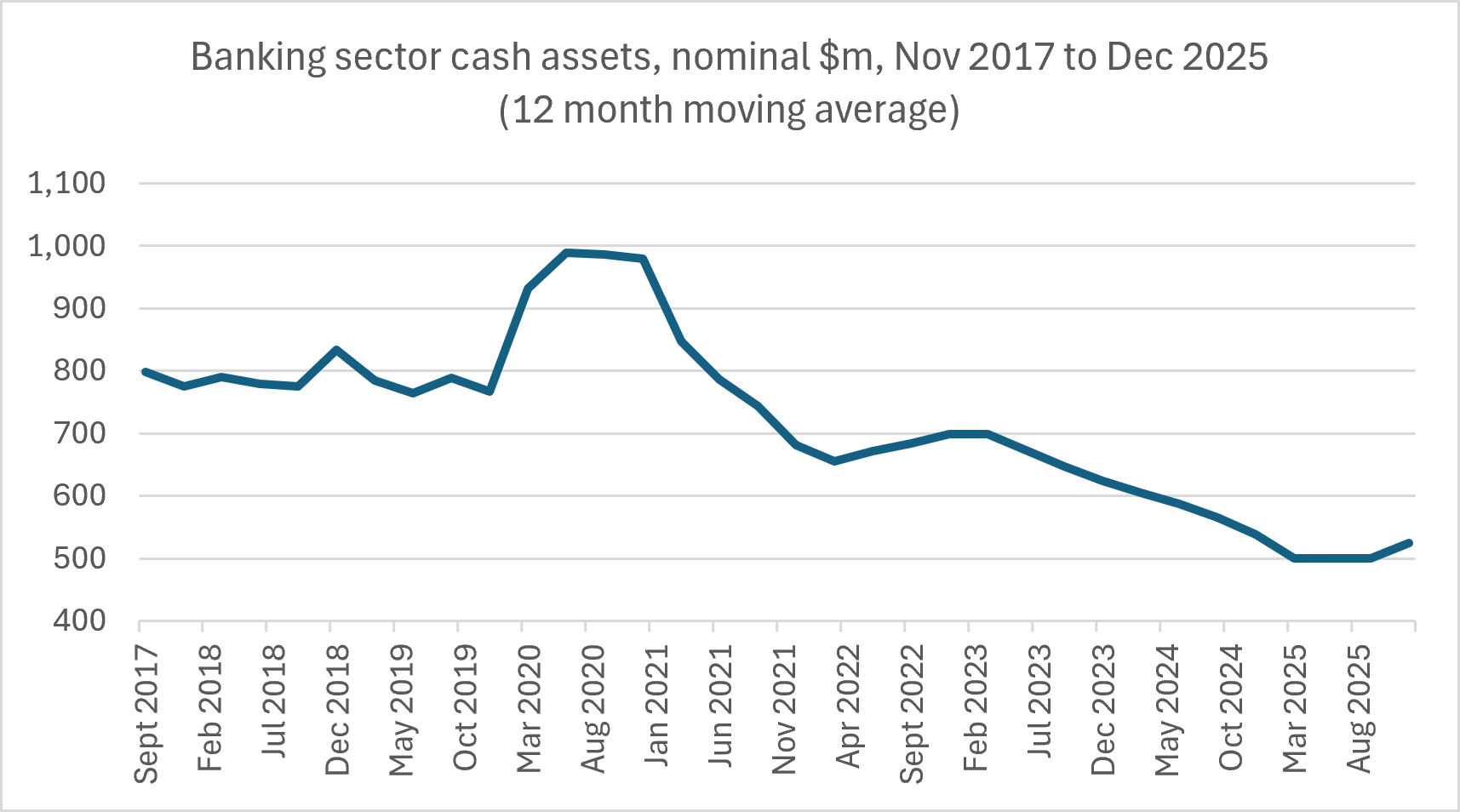
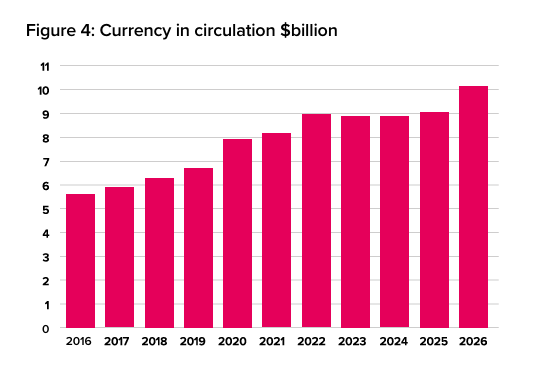
*The charts above come from the RBNZ.
'The cash paradox'
Interest.co.nz asked Silk, how the banking sector holding its lowest ever level of cash squares with the increasing volumes of cash in circulation?
"That is what we call the cash paradox," Silk said.
"The question is, are people valuing it for different reasons? And what we are seeing is an increase in the number of people who are holding cash as kind of that backstop for crisis management. You know, from their own resilience perspective, there seems to be more focus on valuing cash and ensuring that it's there for that. And that's sort of like this Cyclone Gabrielle effect."
After the Christchurch and Kaikoura earthquakes and after Cyclone Gabrielle on the East Coast, additional cash was delivered to affected regions, as it also was when digital payment systems were damaged in Australian floods in 2022.
"Cash becomes the means of payment for everyone at that point," Silk said.
The National Emergency Management Agency (NEMA) advises people to have cash at the ready, both at home and in a grab bag.
"Power cuts could affect EFTPOS and ATM machines, so it’s a good idea to have some cash at home. Coins and small notes are best," NEMA says.
A NEMA spokesman said it has recommended cash as a grab bag item since 2010, and refined its messaging last November to say small notes and coins after RBNZ advice.
'We can't quantify something of that nature'
Earlier this year Steve Symon, who chaired the Ministerial Advisory Group on Transnational, Serious & Organised Crime, told interest.co.nz that; "cash is the primary currency of organised crime. And so a huge amount of our cash right now, as we sit here, is in the hands of organised crime."
So what about the use of cash by criminals, in the black market for the likes of illicit drug and tobacco purchases, and by people trying to avoid paying tax? Does the RBNZ have any sense of how significant this is, and to what extent it has contributed to increasing cash in circulation?
"Quite honestly, we can't quantify something of that nature. The one thing I would say is that people do drop to that point on a consistent basis and say, 'look, it's all a black economy kind of story.' But clearly it's not when we look at it in terms of the feedback that we get out of our own cash survey where individuals who are not in that criminal area are saying that they value and require cash for very legitimate reasons. So we can't turn around and say this is all just kind of black economy," Silk said.
"The other thing I'd say is that criminals also have access to digital means as well. And I've seen other articles and speculation that things like Bitcoin are actively used more readily in that kind of area as well. So I don't think anyone could construe this as just a cash issue. And our job is to ensure that the ... very legitimate [cash] needs are being met."
RBNZ surveys, engagement with the public and cash trials "are indicating that cash is absolutely valued and is commonly used as a means of payment as well," Silk said.
"It is really clear when we have been out doing focus groups, deliberative workshops, all of these things in communities, that cash is still being used frequently as a means of payment. And that becomes, I think, more prevalent in terms of everyday use, particularly when you get out into some of the more rural communities, smaller towns."
'We're not going to direct the banks'
In February the RBNZ opened consultation on public and business cash access, proposing a cash service standard with minimum cash service requirements for banks. The RBNZ estimated this would cost banks about $104 million a year to run. Banks pushed back hard, describing the RBNZ's proposal as "extreme" and "back to the future."
The RBNZ notes Retail NZ's submission on its cash consultation says cash remains vital to retailers, with 45% of its surveyed members dissatisfied with the current level of cash services in their own district.
Silk said the RBNZ's desire is to reach a voluntary agreement with banks to ensure cash access "remains at an appropriate level" for their customers' needs.
"The banks have also expressed that they would like to go down a voluntary approach. We've started that engagement with the banks. So getting an aligned view on what problems need to be addressed, or issues that are being raised by their customers that we're asking them to address. And it's still early days, but actually it's a really constructive conversation that's going on," Silk, set to leave the RBNZ in mid-December, said.
In terms of the RBNZ's preference for the number of ATMs and branches it wants scattered around the country, Silk said "there's no defined number at this point that we're looking for," and there are "multiple ways," not just branches or ATMs, that requirements could be met.
"We're not going to direct the banks as to how they might deliver against meeting that customer need. It is about getting agreement on what that might look like and then it will be the individual bank's decision as to how they meet that," said Silk.
But what happens if a voluntary agreement can't be reached with banks?
"Then we'll step back and reflect on what might be required at that point in time. But again we're going into this with a very open mind and a positive approach. Voluntary will be the best way to ensure that customers get access to this, and access to cash and broader cash services, which includes businesses being able to have their needs met as well."
"And so speculation around what we might do or not do, if we can't reach agreement on that, I think it's just way too early to even talk about that," Silk said.
She wouldn't put a timeframe on how long the consultation process and discussion with banks might take.
"We've had an initial meeting, we're due for some more, and it is constructive. We're talking directionally around the right kind of outcomes."
*This article was first published in our email for paying subscribers early on Thursday morning. See here for more details and how to subscribe.
We welcome your comments below. If you are not already registered, please register to comment
Remember we welcome robust, respectful and insightful debate. We don't welcome abusive or defamatory comments and will de-register those repeatedly making such comments. Our current comment policy is here.