

For humanity to slow, arrest or even roll back climate change, it will require the agreed effort of all of us.
But humans are a cynical lot. And inherently selfish. The chance of us all agreeing to change the way we live doesn't only seem impossible to even the most optimistic of us, we also need to battle the idea that it would be pointless unless the 'others', especially the other giant countries, agree to change as well. And given the capture of our economic system by the autocratic and rich, that seems even less likely.
So adaption is the only realistic path forward.
The same is true in the economic world, especially the world of "interest rates" (that is, the cost of money).
Unless the world's largest economies change the way they operate, there is little we can do other than watch how the impact of their collective stupidity washes over us.
That applies to the US, with huge structural deficits and a dominant capital base, China, with an unbalanced economic system that is likely to unbalance global trade, Japan, with its own huge, but internal imbalances) and the European Union, with its inability to agree on any meaningful reform to resuscitate its stand-still economic model.
The largest of those four economies is the US and by a substantial margin. And interestingly, it is the one most likely to action a change and tolerate the transition pain. None of the others have any show of making meaningful change on their own. But they would if the US changed.
But the US faces a fearsome trajectory and daunting challenges. True, it has impressive attributes, and being able to survive having a crooked President shows its resilience. But it isn't clear that this will be enough.
Over the last 26 years, a generation, the economic fundamentals of the US have deteriorated significantly and have got sharply worse in the Trump1 and Trump2 terms. Any recovery from here will need to take an epic mindset shift.
The change in economic climate needs to happen because they are in a generational move to significantly higher interest rates. Long term interest rates are how this risk is priced, and the prospects don't look good.
First, here is what the long bond benchmark is signaling.
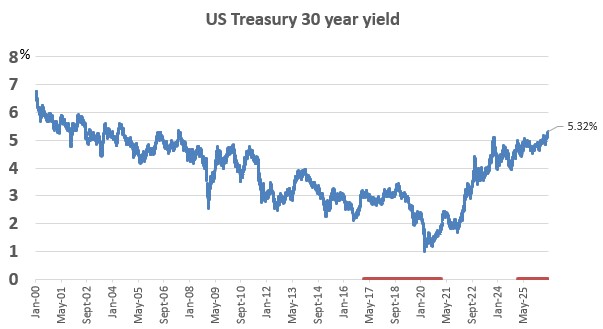
The key takeaway from this chart is the fundamental turn up in long term interest rates, one that turned from early 2021.
And that is because of an equally clear deterioration in US public finances, jerked worse by them having Trump as a President.
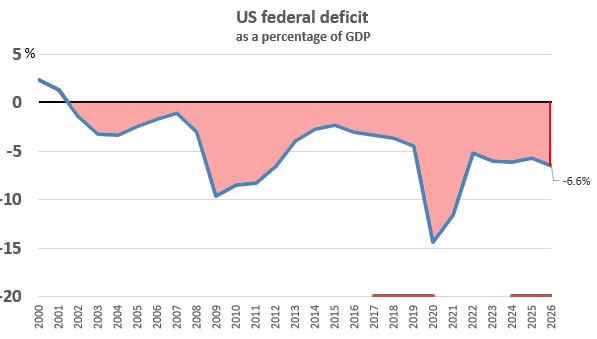
The Congressional Budget Office projects a sharply worsening deficit than they had expected, which could see a deficit approaching 8% in 2027.
Famously, the net interest payments on the US national debt consumes about 17% of total annual federal spending, or roughly US$1 trillion per year), making it one of the largest and fastest-growing items in their federal budget.
Rising American benchmark interest rates are going to suppress asset valuations. The key pressure is on American housing where most mortgages are priced based on a 30 year rate. That has been high for a while based on the background forces and is likely only to rise from here.
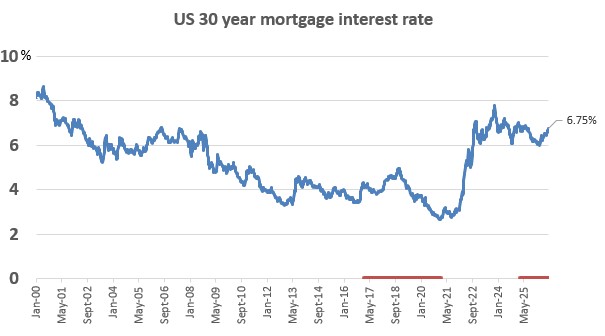
There is no way these rates are going to shift in any direction other than following US long term interest rates. And it will take them a generation to undo the damage being wrecked at present - and that clock wouldn't start on that until they begin a recovery process. Which at this time seems very unlikely.
The obvious takeaway for New Zealand is that we won't be able to avoid any of the fallout. We are a net debtor nation who needs to borrow in international markets, and at a premium, no matter how solid our own financials are. So we are facing this higher-for-longer scenario for interest rates too.
All we have done in this review is look at what the giant US economy is likely to do to us. There could well be shocks also coming from China, Japan, the EU or even Australia. But even if there aren't, the US size in the global marketplace is enough to affect us a lot on its own.
At a fundamental level the implications here over the next 25 years or so are likely to be lower asset valuations, especially yield assets. That includes for real estate, both commercial and residential, many equities that are utilities that rely on their valuation based on dividends, bonds, and increasingly utilities like tech infrastructure (and that is because their current borrowings are all based on sky-high valuations). That debt is likely to become very risky. Remember the Dot Com boom and bust of the 1990s?
If you are an investor, would you accept yesterday's low returns knowing that the price of money is in a long term rising trend? I thought not. With that view, you aren't on your own. There is growing acceptance that the economic climate has changed to a 'hotter' future. We will all need to adapt, and hope that inflation control remains professional and effective.
We welcome your comments below. If you are not already registered, please register to comment
Remember we welcome robust, respectful and insightful debate. We don't welcome abusive or defamatory comments and will de-register those repeatedly making such comments. Our current comment policy is here.