

The New Zealand Superannuation Fund has got itself into a Portuguese pickle as a client of Goldman Sachs.
The Super Fund has written down a US$150 million (about NZ$198 million) loan to Portugal's Banco Espirito Santo to zero after the loan turned sour.
CEO Adrian Orr says the Super Fund is one of a number of investors suing the Bank of Portugal, that country's central bank, after it transferred a Goldman Sachs arranged, Super Fund loan from the "good bank," Novo Banco, to Banco Espirito Santo, or the "bad bank"after the Portuguese bank failed and the central bank took charge.
Orr says the Super Fund has been treated "unequally and unlawfully," with its default insurance, which was also provided by Goldman Sachs, "inadvertently rendered ineffective" due to a retrospective central bank decision.
"We have a very strong legal case and a high level of confidence of success," Orr says.
Nonetheless he says the dispute is likely to be a lengthy one. Separately Goldman Sachs says it too is pursuing "all appropriate legal remedies without delay" against the Portuguese central bank.
Through the law suit, the Super Fund is striving to overturn the Bank of Portugal’s decision, which would return the loan to Novo Banco where the Super Fund's credit protection, and the money it lent, remains. On the insurance front the Super Fund says the issue it faces isn't with the credit protection per se, but with the "delinking of the credit protection from the underlying loan obligation."
The Super Fund had been expecting a return above 1% per annum of "pure net profit" from the deal with its loan having a weighted average life of 1.6 years. On the basis of zero recovery of assets, the Super Fund would lose US$150 million plus legal costs.
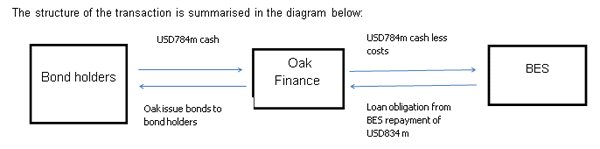
The Super Fund, alongside institutional investors and pension funds, is among Goldman clients that lent €835 million to Banco Espirito Santo on July 3 last year through the Dutch entity Oak Finance. The loan was financed through Oak issuing bonds to the investors, with the bondholders, including the Super Fund, effectively Oak's owners.
When Banco Espirito Santo reported an unexpectedly large half-year loss of €3.6 billion on July 30 last year, the Bank of Portugal intervened to save the troubled bank, splitting it into the good bank and run-off bad bank. It ultimately decided to leave the Goldman arranged loan in the bad bank, meaning it's unlikely to be repaid.
Bank of Portugal 'wrong'
Orr says the Bank of Portugal retrospectively decided to return the loan to the bad bank after having transferred it to the good bank. It was wrong to do so, he says, because of an erroneous view that Goldman was both an associate of Banco Espirito Santo and the lender. On July 15 last year Goldman borrowed Banco Espirito Santo shares as part of its client facilitation activity. This lead to a disclosure from Goldman under European Union transparency rules acknowledging a greater than 2% stake in the Portuguese bank.
Goldman says its actual physical holding was only 1.6% with the balance of 0.67% of its interest in cash settled swaps that didn't carry any voting interest in Banco Espirito Santo or any rights to acquire shares. However, the Bank of Portugal deemed Goldman a "qualified shareholder" with a stake above 2% meaning it couldn't benefit from a bailout.
"As Goldman Sachs has said publicly and to the Bank of Portugal, Oak Finance was an independent entity from Goldman Sachs International. We understand that at no point did Goldman Sachs hold a participatory interest in more than 2% of Banco Espirito Santo's shares," Orr says.
"Legally, the loan arranger's shareholding in Banco Espirito Santo should not be the basis for treating the Oak Finance loan as related party lending."
"We note that Novo Banco continues to have the benefit of the money that we lent," Orr adds.
"It will also be of considerable concern to any investor that the Bank of Portugal has not treated all senior debt holders equally. We understand that holders of senior bonds arranged and underwritten by at least one other financial institution have remained with Novo Banco when, unlike the position with the Oak Finance loan, the bonds were subscribed by a related party of a substantial shareholder in Banco Espirito Santo," says Orr.
'Standard investment activity'
He says by making the loan the Super Fund was providing needed liquidity to the Portuguese banking system. It protected itself against the risk of default by purchasing credit insurance from Goldman.
"This is a very standard, insured, investment activity globally that keeps the financial world liquid. The Bank of Portugal's actions, however, in treating the Oak Finance loan differently to all other senior debt obligations, appear to have had the effect of negating this insurance," Orr says.
He says it's concerning for investors in Portuguese banks that senior debt can be treated on a similar basis to equity and subordinated debt, solely by virtue of the debt arranger's, not lender's, shareholding in the bank.
"We are not entering into these legal proceedings lightly and have made the decision only after exhausting all other options," Orr says.
He says the Oak Finance investment was part of a credit strategy the Super Fund had operated successfully for several years. Although significant in dollar terms, it represents just 0.7% of the NZ$27 billion the Super Fund manages.
"Even after factoring a conservative write-down of the loan to zero, the (Super) Fund has returned 16.71% over the last 12 months, as at 31 January 2015, after costs, before tax," the Super Fund says.
It says these types of loan make up about 2.5%of the Fund's net asset value and overall have proven successful.
Here's a good back grounder on the broader dispute from Reuters' Neil Unmack.
Here's a press release the Super Fund issued, a back grounder it provided here and a timeline it provided here.

We welcome your comments below. If you are not already registered, please register to comment
Remember we welcome robust, respectful and insightful debate. We don't welcome abusive or defamatory comments and will de-register those repeatedly making such comments. Our current comment policy is here.