
By Bernard Hickey
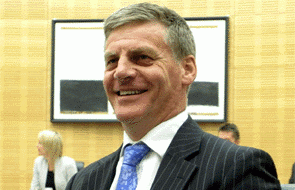
Finance Minister Bill English has used a Budget preview speech to signal a bigger than expected Budget deficit in the current 2014/15 year and a smaller surplus next year as lower inflation is expected to reduce the Government's revenue forecasts by NZ$4.5 billion over the next four years.
However, he said the Government did not plan to announce big new spending cuts and remained committed to income tax cuts before the 2017 election.
English said in a speech to the Wellington Employers' Chamber of Commerce that the Treasury now expected nominal GDP to be 1.5% lower over the next four years than was forecast in the May 2014 Budget, mainly because of lower inflation.
"That is about NZ$15 billion less and, to put that in context, that is more than half of the impact of the global financial crisis," English said.
"So these conditions are presenting some real challenges for the Government’s books because it’s the nominal economy that drives PAYE, company tax and GST receipts," he said, adding lower interest rates were also reducing tax receipts on bank deposits.
"In total, Treasury now expects the Government will collect NZ$4.5 billion less tax revenue over the next four years than it expected at the last Budget. The lower-than-expected revenue, as well as some quite significant non-cash items in the Government accounts, means getting back to OBEGAL surplus is more challenging," he said.
This is in line with English's recent comments downplaying the prospect of meeting the Government's four year old target of reaching an OBEGAL (Operating Balance Excluding Gains and Losses) surplus in the 2014/15 year.
In the December half year update, Treasury forecast an OBEGAL deficit of around NZ$570 million for the 2014/15 year, which was 0.2% of GDP, and forecast a similar sized surplus in the 2015/16 year.
"The Treasury is still finalising its forecasts for this year’s Budget, but it’s fair to say that both of those forecasts have deteriorated a little since the Half-Year Update," English said.
"So we expect the Budget to forecast a slightly bigger deficit for 2014/15 and to forecast a slightly smaller surplus for 2015/16," he said.
English said that progress to achieving surplus was slower than expected, but the Government was on a track to surplus and repaying debt.
"The surplus target is important. It has imposed a discipline on us and on government agencies to work hard on achieving value for money and providing new spending only where we can get better results," he said.
Prime Minister John Key said last month that the surplus target was "artificial" and the public would not want the Government to make "silly" cuts to spending to meet such a target.
"The factors that have reduced government revenue and therefore our surplus track are the same factors underpinning sustainable growth for households and businesses - low inflation and low interest rates," English said.
'Small deficit not a risk'
"A small deficit, should it eventuate this year, isn't a risk to the economy," English said.
"In fact, the downturn in revenue is due to positive economic conditions – strong growth but low inflation and low interest rates. And because we’re confident about the ongoing improvement in the Government’s finances, it won't constrain our decision making in the Budget," he said.
"We will not be pursuing cuts in services or income support in a knee-jerk response to lower tax revenue. Such measures would undermine the confidence of New Zealanders in the quality and effectiveness of public services. It would also undermine the excellent work done by so many public servants in recent years to improve public services."
English said that despite the downturn in revenue, the Government would stick with the NZ$1 billion annual operating allowances for Budgets 2015 and 2016.
"We’ve maintained welfare support, we’ve maintained and improved health and education, and we’re thinking ahead to the requirements of a growing economy and a better community through to 2020," he said.
"We won’t change that approach just to turn a small forecast deficit into a small forecast surplus. Other things matter more."
We welcome your comments below. If you are not already registered, please register to comment
Remember we welcome robust, respectful and insightful debate. We don't welcome abusive or defamatory comments and will de-register those repeatedly making such comments. Our current comment policy is here.