
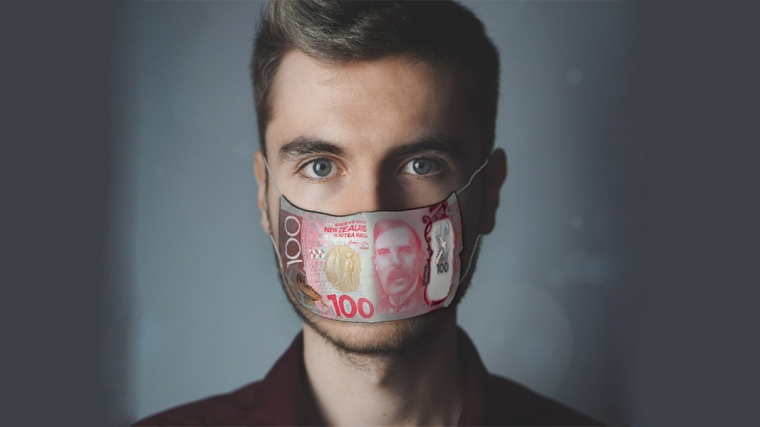
As I sit here at my tiny home-office desk, facing the window, I can see that in mere weeks, the trees here in Germany, where I’m currently working, have changed from barren branches to swaying masses of green leaves - but that’s not the only drastic change in view. I see closed businesses and cafes, and empty streets as social contact now happens via electronic devices. This is the fifth week of lockdown in Germany.
I can’t help but wonder how COVID-19 has, and will continue to, dramatically change our lives. After more than a month, the number of new cases is now declining and there are more new recoveries than new infections.
The situation in New Zealand is very similar, with the curve depicting the number of total cases definitely flattening and the number of active cases falling.
So, it is no surprise that the voices, asking for an end of lockdown conditions, are getting louder. A few days ago, for example, newsroom.co.nz ran a story titled ‘Contrarian’ academics oppose NZ lockdown. But, how do you decide when it’s time to return to a more normal life? If ‘social distancing’ didn’t come at a cost, the answer would be easy. Stay inside until a vaccine has been found and everybody has been immunised. But there is a cost, socially and economically. Given that I am an economist, I’ll focus on the latter.
The official December 2019 GDP value in current prices for New Zealand was $310 bln. It’s the first time this value has cracked the $300 bln mark. Annual growth was 2.3% which is pretty good by international standards. In comparison, the USA grew by around 2.1%, the UK by 1.1%, Australia and Japan by 1.7%, and Germany by 0.6%. According to the OECD, the direct impact for most economies could be a fall of GDP by 20-25 %. This would be worse than the impact of the GFC in 2008-09. For New Zealand, this would mean a 2020 GDP value of around $230 bln – the same as in December 2016.
How hard an economy will suffer from the coronavirus pandemic, of course, depends on how long lockdown conditions are imposed.
Suggestions by researchers around the world, including the OECD, are that every month of economic shutdown will reduce GDP by 2% annual percentage growth. Given that New Zealand hovers just around the 2% mark and has set an initial lockdown period of four weeks, GDP growth would be zero in a year’s time. This is in line with the government’s various scenarios. The most optimistic one is a one-month level four, followed by a month at level three and a further six months at levels one and two. This would shrink our economy by 4.5% in 2020 and by 2.5% in 2021. This is severe, but doable. The worst-case scenario, six months at level four followed by six months at level three, paints a different picture. GDP would fall by over 30% to around $219 bln.
Using the impact of the GFC on countries with similar characteristics to New Zealand as a benchmark and real GDP values rather than nominal values, I have estimated the impact on our economy as follows: A second month of shutdown might cost the economy 7-11% of GDP or $18-28 bln while a third month could push these values out to 10-20% or $25-$50 bln. This is slightly less optimistic than the government’s best-case scenario but not as pessimistic as the OECD predictions. These estimates are also based on no government intervention.
Currently, however, we see a variety of national and global political initiatives to ease the shock of this global pandemic. If these measures are effective then the impact could be less than anticipated. So, in conclusion, while New Zealand will feel the effects of the current crisis for years to come, it’s not all bad news. As with the GFC, our economy should bounce back.
*Christoph Schumacher is Professor in Innovation and Economics at Massey University and Director of the Knowledge Exchange Hub. This article is a post from the GDPLive blog, and is here with permission. The New Zealand GDPLive resource can also be accessed here.
We welcome your comments below. If you are not already registered, please register to comment
Remember we welcome robust, respectful and insightful debate. We don't welcome abusive or defamatory comments and will de-register those repeatedly making such comments. Our current comment policy is here.