
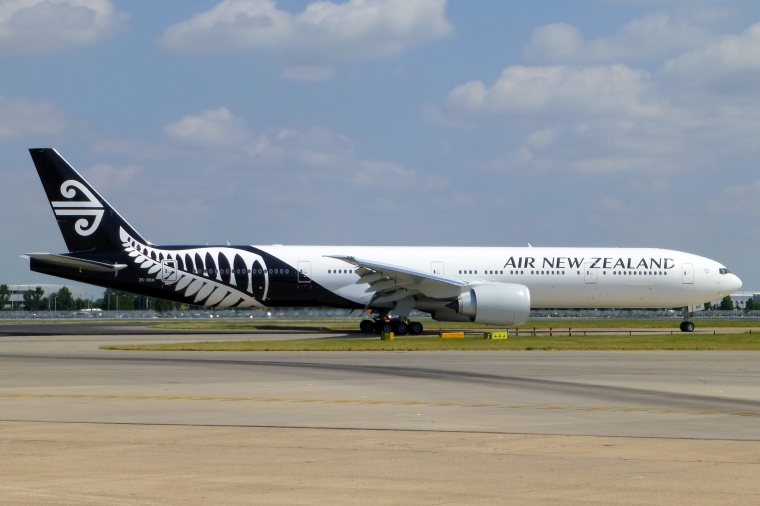
Air New Zealand’s chief financial officer Jeff McDowall expects the airline to draw on a $900 million loan facility, made available to it by the Government, “in due course”.
Speaking to Parliament’s Transport and Infrastructure Committee, McDowall explained the loan agreement includes a cash floor, meaning the airline can only access it once it forecasts its cash position will dip below this floor.
It hasn’t reached this point, but expects it will.
McDowall said the loan, offered by the Crown (which has a 52% shareholding in Air New Zealand), would be useful in supporting cashflow.
It’s been offered in two tranches - one of $600 million with an effective interest rate initially expected to be between 7% and 8% per annum, and a second of $300 million, with a 9% interest rate.
The deal gives the Government the ability to seek repayment by converting the loan into equity or getting the airline to do a capital raise after six months.
Asked by National MP Tim van de Molen whether the company was currently considering a capital raise or doing something like turning airpoints into equity, McDowall said it was “actively” looking at a “full range” of long-term funding options.
Air New Zealand chief executive officer Greg Foran said 4100 Air New Zealand staff were made redundant in the first phase of cost cutting.
He said the airline was working towards reducing its costs by a further $150 million through a second phase of cost cutting due to wrap up in October. Foran said further redundancies were a last resort.
Looking ahead, Foran said the situation would depend on what happens with New Zealand’s borders.
About $2 billion of the $6 billion of revenue Air New Zealand generated pre-Covid came from long-haul flight.
On the upside, McDowall said the cargo side of the business was still doing well.
Asked by van de Molen whether any government policy changes would’ve helped Air New Zealand, Foran said redundancies the airline made in April/May might have been delayed if it could’ve put a furlough in place, as its competitors in Australia, the UK and the US did.
Foran said Air New Zealand received $119 million in wage subsidies, which “helps, but doesn’t help to the extent that our competitors have had in terms of a furlough”.
Foran apologised to customers for hold-ups processing credits from flights cancelled due to government travel restrictions, saying its call centres were bogged down with 75,000 calls a day at its peak – an enormous jump from the usual 5000.
He said the airline couldn’t afford to refund customers.
Air New Zealand expects to report an underlying loss of $120 million for the year to June 30, 2020, excluding “Other Significant Items” like the impact of fluctuations in currency markets.
35 Comments
How does "He said the airline couldn’t afford to refund customers" square with "the airline (could) draw on a $900 million loan facility, made available to it by the Government, “in due course”.
Of course, it could 'afford it' it's just chosen not to.
My view? This enterprise is worth as much as Virgin Australia was before it went into receivership. Perhaps less.
Do we know what the refund amount would be? Given that they had something like $6b in revenue in 2019, it wouldn't surprise me if refunds due were more than the $900m figure.
That's why the business should have been re-nationalise; shareholders equity forfeit, creditors paid out ( fares refunded etc) and the guarantee of a loan non-existent.
The way it's been done is a heads we win, tails you lose effort.
I'm not following. The government has set up an equity grab, it is in effect preparing to nationality the airline, but first made sure to crater the value of the airline and then offer it a laughably expensive loan that will convert to equity. Its Heads NZ Govt wins, Tails Air NZ loses.
If AIR had refunded all tickets it was in the vicinity of 120mil. They were reluctant to do this due to there being a "cash floor" they needed to avoid so that the Govt loan wasn't triggered. At 7-8% interest I'm sure you can understand why they have delayed as long as possible.
There is a big part of this that I agree with. A ticket is effectively a contract between the airline and the customer for a service. If the airline is unable to provide that service either completely or under initial agreed terms, then the cost of that ticket should be refunded in full at no cost to the customer. End of story. The cash flow bit is just corporate BS to maximise profits at the expense of the customer.
Okay but if a ticket is a non-refundable contract wouldn't your argument actually be that they don't need to pay?
They are the only industry explicitly excluded from the CGA.
Any other contract with these provisions, "negotiated" with the power imbalance in this relationship would be void.
As a Govt (read taxpayer) owned enterprise it is a disgrace.
The non refundable part is applying in the case of the ticket holder not utilising the ticket but the flight being available anyway. Not sure what the contract implied in the ticket purchase says about it being non refundable if the airline cancels the flight, my money is on the airline still being liable to either provide the flight as contracted or refund the money. But if the flight remained available and the ticket owner decides not to fly, for any reason, then it must be non refundable.
Thanks RCD you nailed my response to Laminar above. The only thing I would add to it is what choice does the ticket purchaser have? Essentially it is a take it or leave it deal, with no negotiation. And with the average wage in NZ, most AIR customers don't have a lot to come and go on, and are vulnerable to the corporate pillaging. So what RCD said.
You guys are forgetting one major thing.. the flights were cancelled because govt's closed airports to passengers. I'm sure you wouldn't want AIR to kick you out the door at 30,000ft.
And the Government are majority shareholders. So they can suck it up! Same outcome, the Airline, through their major shareholders have breach the terms of their contracts with their customers! time to pay them back!
Haha, hardly. Ever heard of "force majeure"?
That is what the airlines responsibility towards taking insurance out is for. to protect their customers in the event of unforeseeable events. Instead they try to fob that responsibility off onto their customers.
There is no insurance available to pay customers for lack of delivery of service. Incidentally there is insurance available to customers but most choose not to pay for it. As always it's "buyer beware", if you choose to ignore or discount the risk then you shouldn't expect someone else to pick up the tab when the unexpected happens.
That is the airline offsetting the risk onto their customer and not carrying it themselves. Currently they can do that because there is no law that requires them to refund tickets when they cannot meet the implied contract of carriage in that ticket. The law needs to change here.
M86 if the law was changed (which I'm not necessarily arguing against) ticket prices would rise to cover the extra risk factor. Also you may find that rather than paying out passengers directly, AIR would seek help from it's majority shareholder. So instead of a loan (which has to be repaid) it would be a grant, due to the extra expense being Govt mandated. Look at the Blns paid out to the US airlines, which do operate under such a law.
I think you need to read the conditions of carriage when purchasing a ticket.
I don't agree with it, but very much worded in favour of the airliner.
The initial agreed terms under the conditions of carriage is nothing more than the obligation to get the person from point A to point B. Its doesn't even need to occur on the stated date.
I would not want to be a shareholder of this airline , thats for sure
Yep but it will probably go up now...that's the world at the moment.
..you are. A 4.8 millionth of 48%. I guess a 4.8th million of 100% will be next?
Just wait a few months. Your certificates will be in the mail.
So glad none of you are share analysts because you haven't got a clue. The post saying that the govt " tanked the share price for an equity grab" is particularly humourous. As for ticket refunds, AIR was under no legal obligation except for the flights through US airspace
No need for the insults. If you want to reply to the comments, do that by all means. If you just want to be a jerk, do it somewhere else.
It's not an insult.. it's a bonafide observation. If you don't like the tone do some basic research before making spurious and off the wall comments. bw, M86 and laminar are a case in point.. rastus isn't even aware of the Govt shareholding level, or our current population count. The only guy with a clue is Masher.
I watched some Foran's comments today. He seems like a genuine, intelligent, considered CEO. Heck of a time to be in the role but I guess it's the sort of thing a high performer woukd thrive on.
Too many of NZ's CEOs appear to be part of an insider club and it's nice to see someone different playing a leading role.
Foran is a total asset for AIR. Turned Walmart around and is probably the best person to be at AIRs helm going forward.
I'd still suggest there should be some "unbundling" of air services to encourage more competition.
Air services in NZ are already pretty competitive. Also the addressable market is too small to viably sustain that many competitors, hence Jetstar pulling out earlier. More international capable airports might help but most councils can't afford to build them. It's the price we pay for living in a small country
And the Government is sure to convert it into equity, down the line.
Is it time to pile up on AIRNZ shares ?
I'm not so sure the Govt would be that keen Contrarian, they're already the majority shareholder @ 52%. AIR will take at least a couple of years to get back into profit so it would be a medium term (5-7yrs) "buy and hold" before you got any real returns. The August release of the FY results won't be pretty methinks, the write down on aircraft alone will be steep. Forsyth Barr and Craigs have a target price of 80c and 100c respectively so I'd wait a bit.
I think if the Government increases its stake by conversion of the loan, then it would be easier to justify more assistance, if needed for the airline. It is good politics now and in the future.
I'm not convinced it would be that simple. At CMP the 900mln would equate to around 670mln extra shares needing to be issued which would drop the price by over 50%. That would be a severe erosion of value for no great gain. SOEs haven't got a great track record of ROE increase due to the lack of outside scrutiny. It would also leave AIR vulnerable to political meddling. I wouldn't want to see Mr Jones anywhere near the board table that's for sure, although Robertson might be useful. The interest rates on the current loans will ensure they are used very prudently and sparingly and should be sufficient to last. I think AIR might go for a Capital raise on the market before they succumbed to increasing the Govt stake. The FY20 release will make interesting reading
The loan carries a much higher rate of interest which is not good for the profitability of AIRNZ. Better to convert and save heaps. That might push up the stock price or at the least not let it slide much.
Since we are saving our publicly owned airline I would hope they would reflect this in future prices for NZ citizens and residents. Also customers should be able to just switch their canceled flights by another equivalent one since refunds will not cover current flight prices.
We welcome your comments below. If you are not already registered, please register to comment
Remember we welcome robust, respectful and insightful debate. We don't welcome abusive or defamatory comments and will de-register those repeatedly making such comments. Our current comment policy is here.