
Here's our summary of key economic events over the long weekend with news US payrolls rose much more than expected, reinforcing market expectations the Fed will raise rates at its next meeting.
But first, we start today with something we don't usually track. Indonesia’s GDP data showed that the economy returned to its pre-pandemic size in Q4-2021, expanding +5.0% from the same quarter a year earlier, as the recovery regained momentum after the setback from the Delta wave in Q3 (+3.5%).
In China, according to the private Caixin services PMI, business activity is now barely expanding with momentum slowing to a five-month low. Lockdowns affected them but new orders slowed as well. Their employment measure is in fact now contracting in the service sector. This report is very similar to the official services sector PMI.
China FX reserves were expected to rise slightly (by about +US$10 bln) in January, but in fact they fell (by about -US$28 bln) to US$3.2 tln. These are small shifts but are watched closely for early signals.
Meanwhile China has signed a 30 year deal for Russian gas. It is a lever Russia is holding over the EU, just at a time the Chinese are trying to woo some EU countries, like Poland. China might end up a stabilising influence on Moscow's Ukrainian ambitions - or they could accentuate the pressures.
In the EU, their retail sales data for December was a significant disappointment, falling from November and rising a very weak +2.0% from December 2020 when a +5.1% gain was expected. And given rising inflation, that meant that retail volumes are falling now.
German industrial production slipped unexpectedly in December - and it was a chunky move lower.
The OECD reported that overall inflation rose to +6.6% in the 12 months to December 2021, compared with +5.9% in November, and just +1.2% in December 2020, reaching its highest rate since July 1991. This increase was driven in part by a surge in annual inflation in Turkey (to +36.1% in December). Excluding Turkey, inflation in the OECD area increased to +5.6% in December.
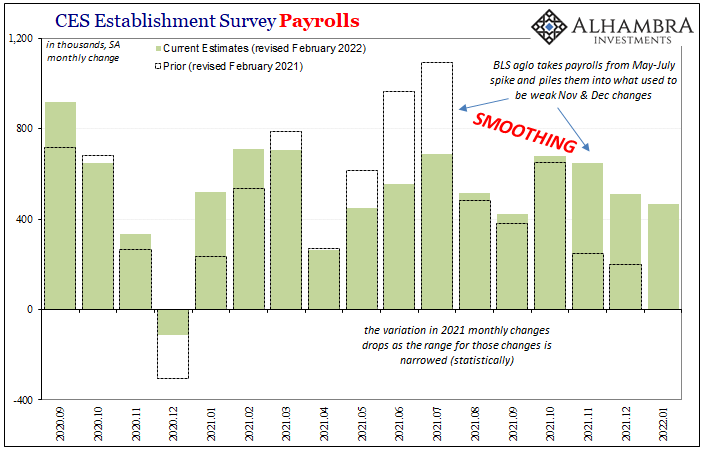
If you missed it on Saturday, the big news was the US non-farm payrolls report was unexpectedly positive. The headline gain reported was +467,000 and far above the +150,000 gains which was widely expected, and nowhere near the -400,000 loss that some pessimists had feared.
Better, there were some significant revisions to job gains in November and December which mean employers added +700,000 more jobs than these non-farm payrolls reports had previously indicated. That is pretty significant.
The January 2022 employed workforce now total 147.5 mln, up +6.5 mln from January 2021. But it is down -2.5 mln from pre-pandemic January 2020 so they still have a long way to go to fully recover the pandemic effects. The US participation rate is an improving sign however. For the first time in a long time it rose significantly, up to 62.2% from 61.9%. More people are back entering their workforce and wanting to participate in their labour market. It is not yet back to the levels last seen in the Obama years, but at least it is back above most of the Trump period.
The other positive out of this data is that average hourly earnings increased to US$31.63 (NZ$47.70), up +5.7% over the past year. It was the largest monthly increase in the last year, and although inflation is high, it shows that wages are largely keeping up. CPI was up +5.5% in an actual (not seasonally adjusted) basis. Core PCE was up +4.9%.
Canada also released its jobs report for January and that was not positive at all. They lost -200,000 jobs on a seasonally adjusted basis (much more on an actual basis) and this was worse than the -118,000 analyst estimates. Their participation rate fell. Their jobless rate rose, and wage gains came in far less than current inflation. They will be grumpy with this result, especially after their neighbour's positive surprises.
In Australia, they bounced back with a strong expansion in their services sector in December and January and putting behind it the lockdown contractions in the prior four months.
The Reserve Bank of Australia has updated and upgraded its economic forecasts for the country in its Monetary Policy Statement released on Friday. But although they now say their economy will grow by +4¼% this year, growth will slow to +2% in 2023. However, both are upgrades from their October forecasts.
In NSW, there has been a drop to 7,437 new community cases reported yesterday, now with 85,344 active locally-acquired cases, and another 14 daily deaths. There are now 2,099 in hospital there, now well off their highs. In Victoria they reported 8,275 more new infections yesterday. There are now 59,801 active cases in that state - and there were 7 more deaths there. Queensland is reporting 4,701 new cases and 19 more deaths. In South Australia, new cases have slipped to 1147 yesterday but they had 5 deaths. The ACT has 399 new cases and one death, and Tasmania 473 new cases and no deaths. Overall in Australia, about 23,300 new cases were reported yesterday.
The UST 10yr yield opens today at 1.93% and up another +1 bp and another two year high. The UST 2-10 rate curve starts today a little steeper at +63 bps. Their 1-5 curve is little-changed at +90 bps, while their 3m-10 year curve is also little-changed at +189 bps. The Australian Govt ten year benchmark rate is up +1 bp at 2.03%. The China Govt ten year bond is +1 bps as well at 2.73%. The New Zealand Govt ten year is unchanged at 2.60%.
On Wall Street, the S&P500 has opened its Monday session soft and down -0.3%. Overnight, European markets all rose by about +1% catching up with teh US data. Yesterday, Tokyo fell -0.7%. Hong Kong was little-changed. Shanghai was back in action and in catch-up more, and up +2.0%. Yesterday the ASX200 fell a minor -0.1% while the NZX50 was closed of course.
The price of gold starts today at US$1818/oz and up +US$12 from where we left it on Saturday.
However oil prices are lower from Saturday by a bit more than -US$1 at just over US$90/bbl in the US, while the international Brent price is now just over US$92/bbl.
The Kiwi dollar will open today little-changed at 66.2 USc. Against the Australian dollar we are firmish at our lower level of 93.1 AUc. Against the euro we are a lot lower at 57.9 euro cents. That means our TWI-5 starts today just on 70.6 and about where we were this time last week.
The bitcoin price is up another +8% since this time Saturday and now at US$43,674. Volatility over the past 24 hours has been high at +/- 3.2%.
The easiest place to stay up with event risk today is by following our Economic Calendar here ».
We welcome your comments below. If you are not already registered, please register to comment
Remember we welcome robust, respectful and insightful debate. We don't welcome abusive or defamatory comments and will de-register those repeatedly making such comments. Our current comment policy is here.