

Overall spending on cards fell by 0.6% or $40 million in June on a seasonally-adjusted basis, according to new figures from Statistics NZ.
Core retail spending which doesn’t include fuel and vehicles fell by just 0.1% or $5.7 million on a seasonally-adjusted basis last month as well.
During June, cardholders made a total of 157 million transactions across all industries, averaging $55 per transaction, resulting in electronic card expenditure of $8.5 billion.
It’s the fifth fall in retail spending in five months. In that period, total retail spending figure movements have fallen by, in order, 0.8%, 0.7%, 0.4%, 1.1% and now 0.6%.
Stats NZ said seasonally-adjusted specific movements by retail spending category in June 2024 included:
- fuel, down 4.6% or $24 million
- durables, down 0.5% or $8.2 million
- hospitality, down 0.5% or $6.6 million
- motor vehicles (excluding fuel), down 2.8% or $5.3 million
- apparel, down 0.8% or $2.4 million
- consumables, up 0.5% or $12 million
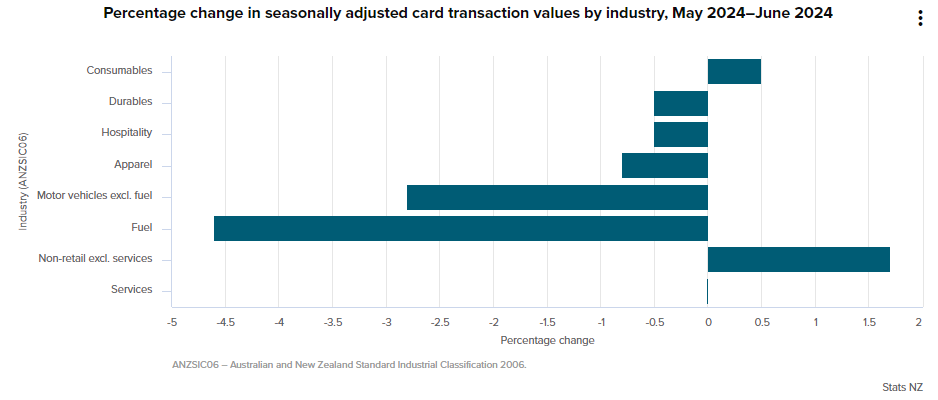
In the month of June, the non-retail sector (excluding services), which includes medical and health care, travel and tour arrangements, postal and courier services, and other non-retail industries, grew by 1.7% or $38 million.
Stats NZ said services spending which covers repair and maintenance, personal care, funeral services, and other personal services, remained unchanged from May when it was down 5.8% or $22 million.
Overall electronic card spending, incorporating both non-retail categories, declined by $45 million (0.5%) from May 2024.
When comparing the June quarter with the March quarter, total retail spending dropped by 3.7% or $740 million, while core retail spending declined by 2.3% or $410 million on a seasonally adjusted basis.
During the June quarter, the non-retail sector (excluding services) rose by 1.4% or $91 million and the services sector rose by 1.8% or $19 million.
However, the total value of electronic card spending spent during the June quarter, including both non-retail categories, fell by 1.1% or $302 million compared to the March quarter.
Household squeeze
Westpac senior economist Satish Ranchhod said in a note that the downturn in retail spending was deepening and June’s 0.6% spending drop was higher than the retail bank had expected.
Westpac had anticipated a 0.2% drop in retail spending during June.
“Over the past year, households have seen their spending power squeezed by the continued rise in living costs and the related increases in interest rates,” Ranchhod said.
“Those pressures have been compounded by the softening in the labour market. Against that backdrop, consumer confidence has fallen to low levels, with nervousness about the economic outlook meaning that many households are keeping their wallets firmly shut.”
Ranchhod said the Government’s new income tax cuts which will be applied from the 31st of July may give spending a boost through the back half of the year.
“However, with lingering pressure on household budgets and the labour market continuing to weaken, we expect spending will remain soggy for some time yet,” he noted.
ASB senior economist Kim Mundy said the latest electronic card transactions painted a bleak picture.
“The cumulative impact of past monetary policy tightening and growing job insecurity fears are playing out clearly in the retail space,” she said.
Mundy added that ASB had long maintained that consumer spending held up well against initial Reserve Bank of New Zealand (RBNZ) tightening due to high household savings, population growth, and strong income growth from a tight labour market.
“But the change we’re seeing in the labour market is consistent with consumers taking an even more cautious approach to spending. We expect challenging conditions in the retail sector will prevail, in part driven by our expectation that the unemployment rate will peak at around 5.5% in mid-2025,” she said.
ANZ’s merchant card spending for the month of June also came out on Friday and painted a similar story to Stats NZ’s data.
The bank’s chief economist Sharon Zollner said annual spending growth fell under 1% year-on-year in June, which suggested that sales volumes are still falling.
She noted that year-on-year decline in durables spending “continues to deepen.”
Seasonally-adjusted tourism-related spending also saw a “particularly sharp fall” during June with monthly spending falling 4.7% and annual spending decreasing by 1.9%.
The only categories that showed year-on-year growth were miscellaneous services, miscellaneous goods – including supermarkets – and utilities and repairs, she said.
We welcome your comments below. If you are not already registered, please register to comment
Remember we welcome robust, respectful and insightful debate. We don't welcome abusive or defamatory comments and will de-register those repeatedly making such comments. Our current comment policy is here.