

Air New Zealand (AIR) is not offering any profit guidance for the new financial year after a year just completed in which it made, to all intents and purposes, no profit in the second half.
Our national carrier has reported a plunge in after-tax profits to $146 million in the year to June 2024 compared with last year's second-highest ever profit of $412 million.
In the first half of the 2024 year the airline reported after-tax earnings of $129 million, but it had warned of "markedly lower" profits for the second half.
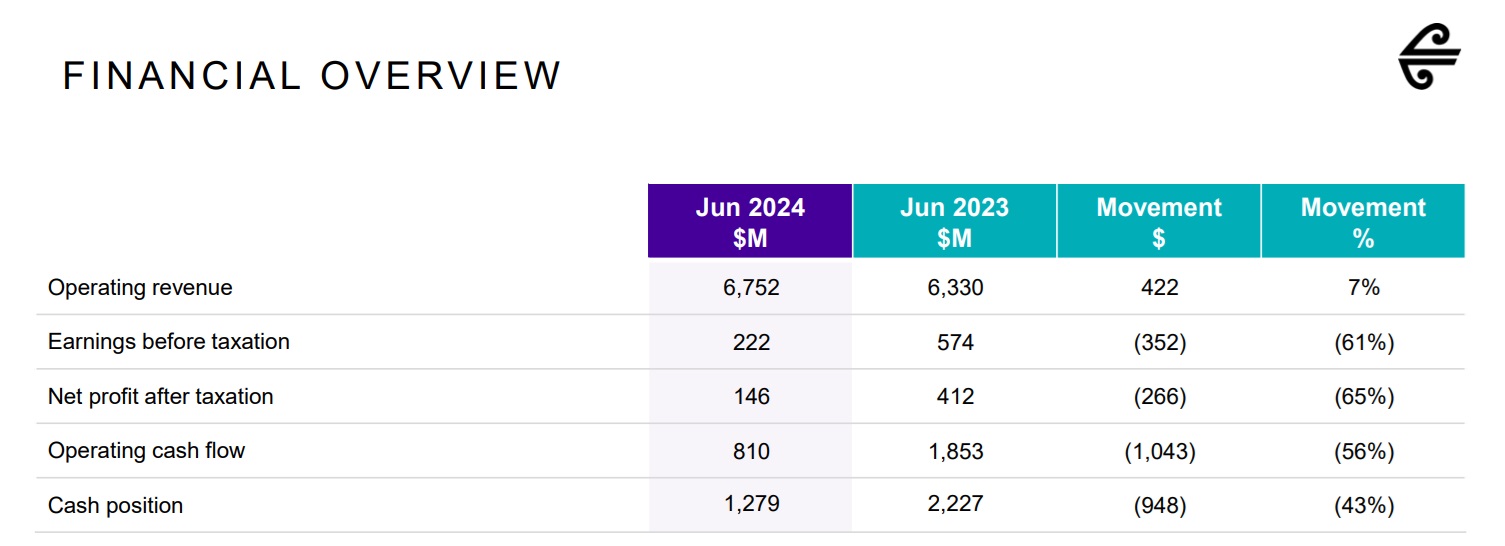
The picture would have been worse if Air New Zealand had not included $90 million of "credit breakage" for unused customer credits - mostly related to Covid-period cancellations - that the airline said were "considered highly unlikely to be redeemed". (The airline still has about $96 million of these 'flexibility policy credits' with an expiry date of up to January 31, 2026 outstanding and says they "could potentially be subject to further breakage either in FY25 or FY26".)
The airline is paying a final dividend for the year - of 1.5c a share - "based on the airline’s balance sheet strength and the result announced today", making a total payout for the year of 3.5c a share.
In highlighting some of the challenges it faced, Air New Zealand said the tougher economic backdrop in New Zealand drove a deterioration in domestic demand in the second half, particularly for corporate and government segments.
"Accelerated maintenance requirements for Pratt & Whitney PW1100 engines worldwide have meant that up to six of the airline’s newest and most efficient Airbus neo aircraft have been out of service at times. Ongoing additional maintenance requirements on the Trent 1000 engines that power the existing Boeing 787 Dreamliner fleet and reduced levels of spares in the market have meant that up to three Dreamliners are also on the ground at times.
"These issues, alongside elevated competition from US carriers and the cumulative effect of high inflation, have had a significant impact on the airline’s operational and financial performance for the 2024 financial year."
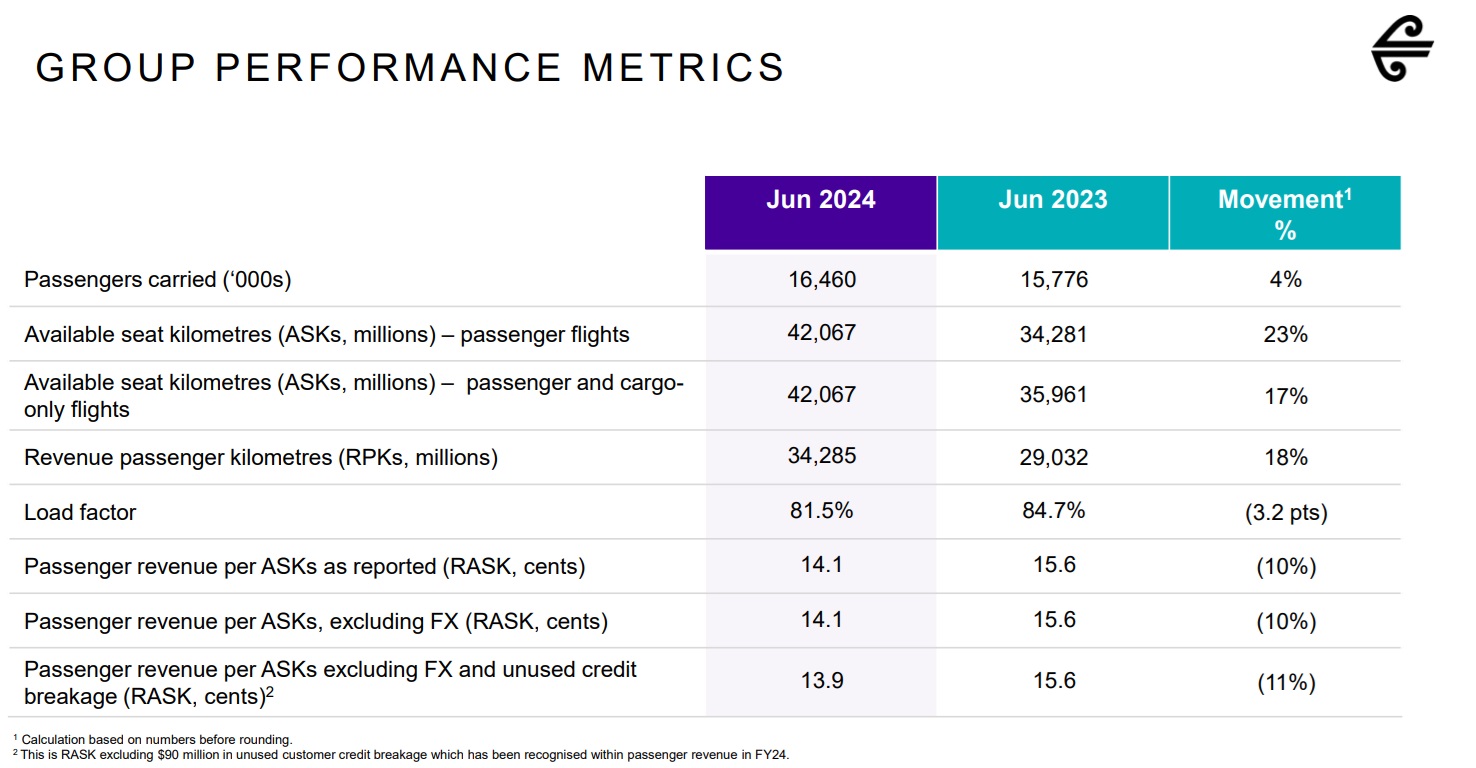
Air New Zealand's passenger revenue increased 11% to $5.9 billion, driven by a 23% ramp-up in capacity, primarily across the international long-haul network. "This was partially offset by the weaker demand environment and higher levels of competition."
The airline said while average jet fuel prices were slightly lower for the year, total fuel costs increased by around $190 million, driven by capacity growth across the network.
"Non-fuel operating costs increased faster than revenue, also driven by the increase in capacity, as well as broad based inflation across the cost base.
"Non-fuel operating cost inflation of approximately $225 million was a significant drag on the airline’s financial performance. With landing charges, air navigation fees and engineering materials leading the increases, the non-fuel operating cost uplift of 6% for the year brings the cumulative impact of inflation across the past five years to 20%-25%.
"While growth in the network has provided some scale benefits, productivity remains below the levels achieved pre-Covid as the airline carries extra costs to help manage ongoing disruptions in the supply chain."
Air New Zealand chair Therese Walsh said without such challenges the company's pre-tax earnings of $222 million (down from $574 million last year) "would have been around $100 million higher, net of compensation, had we been able to operate our aircraft and schedule as intended".
The airline's key operating metric of revenue per available seat kilometre (RASK) dropped overall by 10.9% from the high levels that were seen 12 months ago as the airline then enjoyed the post-Covid 'revenge travel' boom.
However, RASK on Air New Zealand's domestic operations improved 2.1% in the latest year.
Air New Zealand chief executive Greg Foran said a key priority for the company continues to be delivering "excellent customer service and a range of competitive fares".
"This requires ongoing discipline around our cost base, and you will see us make targeted adjustments, including around a 2% reduction in headcount [total headcount is currently given as 11,700], as well as pursuing improvements in the controllable cost base," he said.
The airlne remained "committed to investing for the future", with expected aircraft-related capital expenditure of $3.2 billion over the next five years.
"This includes a significant, multi-year interior retrofit programme on our 14 existing Dreamliner aircraft. We anticipate delivery of the first new GE-powered Boeing 787-9 aircraft towards the end of the 2025 calendar year, which will provide options for continued growth, cost efficiencies and network expansion opportunities."
Air New Zealand was "focused on operating effectively through the current economic and operating conditions, which are expected to continue through the first half of the 2025 financial year", Foran said.
In its brief 'outlook' section, therefore, Air New Zealand says it has outlined a number of trading conditions that have significantly impacted the result for the second half of the 2024 financial year, in particular the tougher economic backdrop in New Zealand driving softness in demand, the cumulative impact of inflationary cost pressures, the impacts of aircraft availability issues and significant competition on its US network.
"Air New Zealand expects these trading conditions to remain similar through the first half of the 2025 financial year. Given the ongoing uncertainty, the airline is not providing guidance at this time."
We welcome your comments below. If you are not already registered, please register to comment
Remember we welcome robust, respectful and insightful debate. We don't welcome abusive or defamatory comments and will de-register those repeatedly making such comments. Our current comment policy is here.