
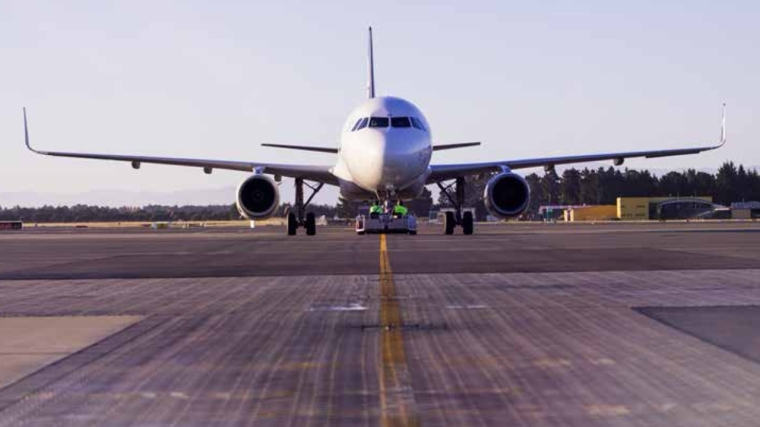
Air New Zealand (AIR) is bemoaning the fact that up to 11 of its jets may be grounded between now and the end of June due to global engine maintenance requirements and is warning that profits in the second half of the year will be much lower than those in the first half.
The airline says the 2025 financial year will be the first full 12-month period impacted by global additional engine maintenance requirements on the Pratt & Whitney and Rolls-Royce engines that power its Airbus neo and Boeing 787 Dreamliner fleets.
The airline says a large degree of uncertainty exists regarding engine maintenance timeframes.
"In light of these aircraft groundings, the associated diseconomies of scale and inefficiencies, and potential compensation, the airline currently expects performance for the second half of the 2025 financial year to be significantly lower than the first half. Given the degree of uncertainty surrounding the number of grounded aircraft across the second half and any associated compensation, the airline is not in a position to provide guidance at this time," Air NZ says.
For the half-year to December 31 our national airline carrier has reported after tax earnings of $106 million, down from $129 million from the same period a year earlier.
Air NZ says the latest first half profit would have been about $40 million higher if not for engine maintenance requirements.
This is now the second year in a row that the airline has warned at the half-year mark that the second half profit would be much lower. Last year for the full year the after tax earnings were $146 million, when the first half earnings were $129 million.
The airline's paying a reduced (1.25c) a share dividend to shareholders, down from 2c at the same time a year ago, but it has launched a $100 million share buyback.
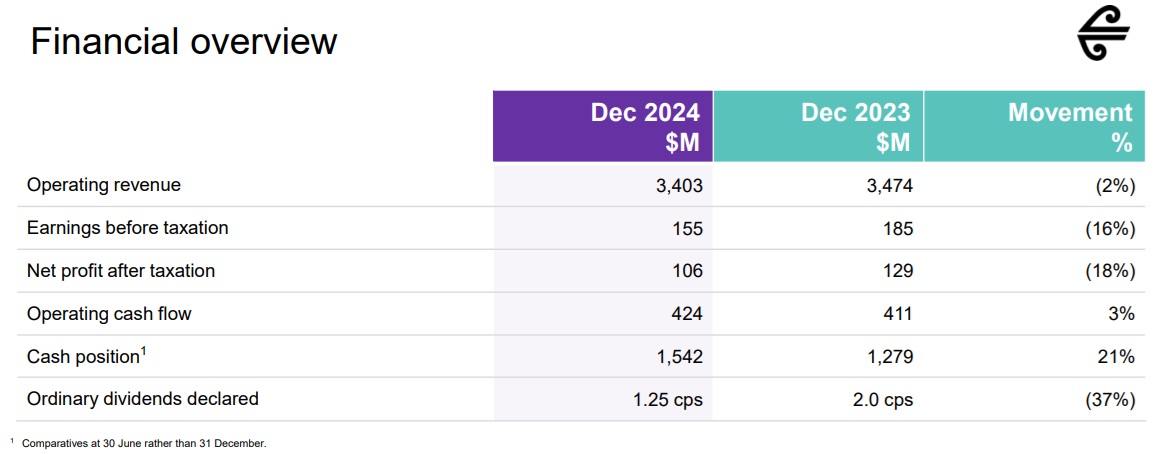
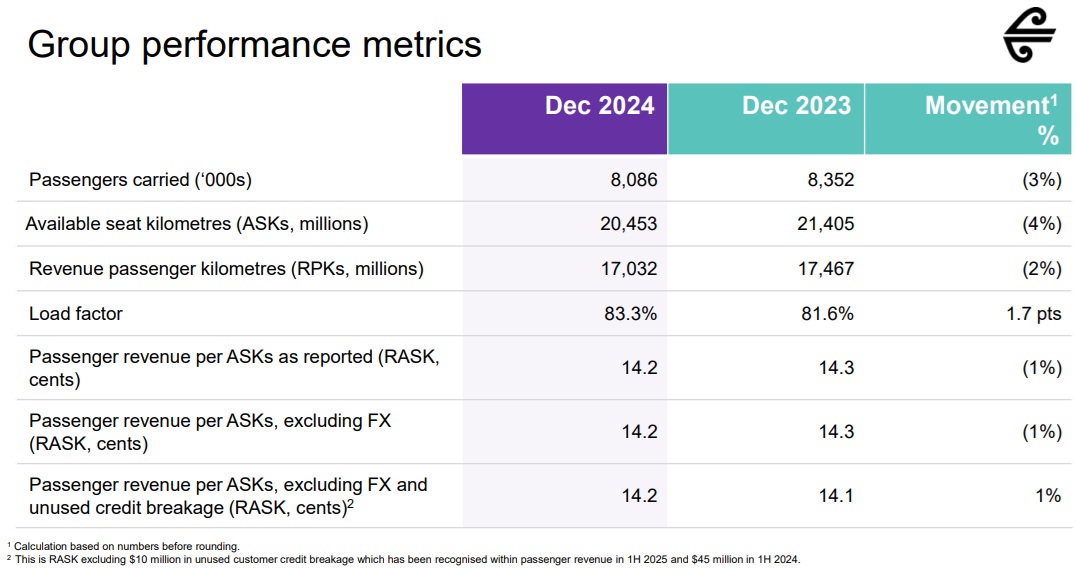
Air NZ said in the first half of the year network capacity was down 4%, with up to five narrowbody and three widebody jets grounded due to global engine maintenance requirements.
Air New Zealand's chief executive Greg Foran said despite the airline receiving $94 million in compensation from engine manufacturers, the airline estimates that first-half earnings would have been approximately $40 million higher had it been able to operate aircraft as intended.
"This financial impact reflects the adverse economics of suboptimal deployment of aircraft, significant overhead costs associated with managing disrupts and resiliency measures taken to protect market share," Foran said.
"While compensation has played an important role in offsetting some of the financial impact of the delays, it falls well short of making the airline whole for the operational and economic losses sustained.
"We strive to deliver a reliable experience for our customers, however with 4% less capacity available largely due to the engine maintenance delays, this has been a real challenge for the airline."
Foran said non-fuel operating cost inflation of approximately $100 million for the half continues to weigh heavily on the airline’s financial performance. With landing charges, labour and engineering materials leading the increases, the non-fuel operating "cost uplift" of 5% for the period brings the cumulative impact of inflation across the past five years to 25% to 30%.
He said 2025 is set to be particularly challenging financially, as the airline navigates its first full 12-month period with up to 11 jets (six narrowbody and five widebody) out of service at any time.
"This is a significant volume of aircraft to have on the ground, but we continue to take steps to build resilience into our operations through schedule adjustments, leasing additional engines, and prioritising customer experience improvements."
He said, however, there was still "much to look forward to in the coming months".
"By this time next year, Air New Zealand expects to have more than half of its Boeing 787 Dreamliner fleet modernised with completely new cabin interiors, including the latest Business Premier Luxe™ seats.
"Additional leased engines are expected to arrive shortly to bolster network resilience, and a new uniform will be revealed in the coming months.
"The airline also plans to trial innovations such as digital bag tags and onboard domestic Wi-Fi, alongside the arrival of an all-electric demonstrator aircraft mid-calendar year.
"The road ahead is not without obstacles, but our balance sheet strength, our clear strategic priorities, and the skill and commitment of our team position us well to navigate the year ahead," Foran said.
We welcome your comments below. If you are not already registered, please register to comment
Remember we welcome robust, respectful and insightful debate. We don't welcome abusive or defamatory comments and will de-register those repeatedly making such comments. Our current comment policy is here.