
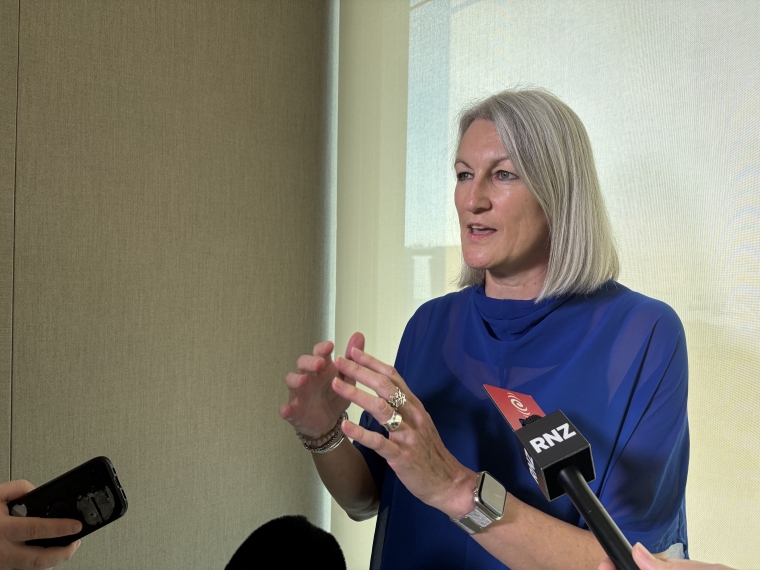
Have your plan B ready, ANZ NZ CEO Antonia Watson urged businesses as the shaky ground beneath the US and Iran ceasefire begins to give way to fresh volatility in the Strait of Hormuz.
"Watch, worry and wait, is really where we're thinking at the moment," Watson said.
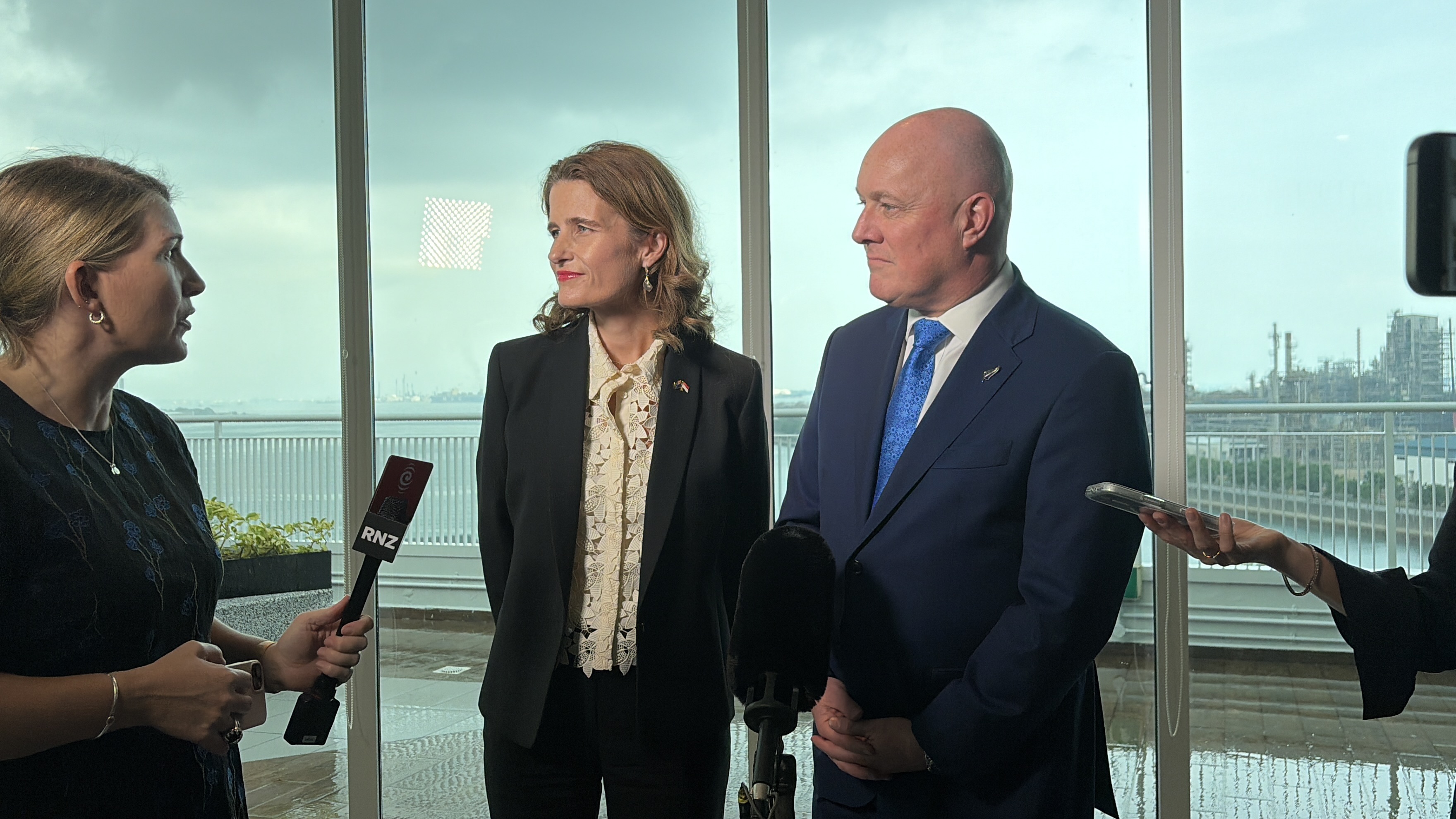
Talking to New Zealand media from ANZ Singapore as part of Prime Minister Christopher Luxon's business delegation at the Singapore-New Zealand Leadership Forum, Watson said being prepared was essential.
Watson's warning drives home the underlying message from the forum - first put bluntly by Singapore PM Lawrence Wong's opening comments on Monday, who said the shocks spurring from the Middle East crisis "remind us that perhaps, such shocks are no longer one-off - they are becoming part of the new normal in our business environment".
"We cannot assume that markets will always function as before. We have to diversify, de-risk, and build resilience into our systems."
The potential looming economic fallout from the Middle East crisis remained a constant talking point across the political and business delegation, with the trip's end coinciding with military escalations from both sides in the Strait of Hormuz - US President Donald Trump warning Iran forces would be “blown off the face of the Earth” should it target the US.
Watson said a discussion over the last two days of the trip was, "in all these scenarios, what are we going to do, and how is it going to help?"
"One of the things that we were talking about over the last day or so was, what are people's Plan B?"
Some businesses, especially those unable to pass costs on, were facing significant impacts.
Watson said ANZ customer spend numbers had a 30% increase in petrol in March, with less spent on discretionary items.
"There are real impacts flowing through and… the sooner this crisis is over, the better, but equally, the more we can do to make ourselves more diverse in terms of who our partners are globally.
"Partnerships like we've just announced with Singapore, that’s great," Watson said, referring to the Agreement on Trade in Essential Supplies (AOTES), which ensures New Zealand and Singapore keep trading essential goods during crises and when supply chains are disrupted, meaning no export restrictions would be put in place.
Watson's remarks were made just prior to an ANZ hosted roundtable on supply chain disruption, with the likes of Zespri, Comvita, New Zealand Trade and Enterprise and the Ministry of Primary Industries in attendance. Swire, Aon and Toll Holdings had also come to the roundtable.
“The plan is to have a very constructive and open conversation about how we can do things better, how we make sure the supply chain isn’t overtly impacted by what’s going on at the moment," Watson said.
"The Middle East crisis has probably brought it to a head... it seemed like a really relevant topic to bring people together on."
Luxon said at the roundtable's opening there was a need to have a “braver” conversation around medium to long term structural reform and to talk about the crisis in regards to what they were seeing in costs and logistics.
After the roundtable, Luxon said they spoke about what they can do over the next 15 years to improve supply chain efficiency, “so that we can continue to actually grow our economy and get our exports to market all around the world”.
Asked if he was starting to get a picture about the costs businesses were facing because of the crisis, Luxon said; "it's completely different by market and it's completely different about where source of origin is coming... so it's not possible to get a nationally aggregated picture at all around that".
"Suffice to say, it's a no-brainer that when you've got higher fuel costs, you've obviously got higher input costs, and that's why we've been saying we want to mitigate and minimize the impact."
On who was facing it the worst, Luxon said, "it's generally different by different sectors... from day one, we've been tracking our top, key critical inputs".
"Think about urea, think about plastics and other petrochemical inputs into New Zealand. And we've getting a good supply of that."
*Anna Whyte is reporting from Singapore for Interest.co.nz, with funding support from the Asia New Zealand Foundation.
9 Comments
The economic shock isn't a mystery; it’s the inevitable result of global central planning and state intervention. When governments and central banks spend decades artificially manipulating interest rates, printing fiat currency, and distorting international trade with political regulations, they destroy the natural stability of the free market.
When political leaders step in to "build resilience" through top-down government strategies, they usually just create new distortions, subsidize inefficiencies, and protect favored industries from market realities.
The only genuine way to build an economy resilient enough to withstand global shocks is to separate the state from the economy entirely, stop manipulating money, and let a true free market function.
How is the rule of law created and enforced in this mythical 'free market'?
He's a vested interest.
The 'free market' is a system where the rich get richer and the poor get the picture. But it cannot work without laws, penalties, police and prisons. Nor can it exist without energy and resource inputs. And as it has constructed itself to grow exponentially, it is a temporary state upon a finite planet.
This completely misunderstands what a free market actually is. A free market isn't a "system" designed by the rich to exploit the poor; it's simply the sum of all voluntary, peaceful human exchanges.
The rich only get richer at the expense of the poor under corporatism—the current system where big business partners with big government to secure subsidies, bailouts, and regulatory monopolies that crush competition. In a true free market, the only way to get rich is by continuously serving consumers better than your competitors do.
Read Murray Rothbard if you want to understand how true free markets work.
The market enforces the law through accountability: if a security firm is brutal or an arbitrator is corrupt, they lose customers and go bankrupt. If a criminal refuses to comply with a court's ruling, their insurance is dropped. (Read Murray Rothbard if you want to understand how true free markets work.)
The state monopoly on law doesn't protect us; it protects itself. When the government controls the courts and the police, it acts as the judge and jury in its own disputes, leading to corruption, inefficiency, and the erosion of actual justice. A free market doesn't eliminate the rule of law—it finally subjects the law to the accountability of the market.
I've read a lot of Austrian School mantra.
Totally ignores the impacts of growth, overshoot and depletion (aka entropy).
The Laws of Thermodynamics are immutable; agreements between humans are mere wishes, compounded. Yes, egalitarian is the only way to go, long term, but we've never done it in a surplus-energy format.
Surplus Energy Economics | The home of the SEEDS economic model – Tim Morgan
I'd be interested in your take on that link
To claim the Austrian School ignores growth, overshoot, and depletion completely misdiagnoses the root cause of the problem. The "growth at all costs" trajectory and ecological overshoot we see today aren't free-market failures—they are the direct result of fiat-driven central banking, which pumps artificial credit into the economy and forces a cycle of hyper-consumption and debt.
True resource preservation and the physical laws of entropy are only accurately managed through an unmanipulated price system and strict property rights. In a genuine free market, when a resource depletes, its price spikes. This market signal instantly forces society to conserve, recycle, or innovate substitutes. Overshoot only happens when property rights are missing or when central banks distort those vital economic signals, causing the very capital destruction and resource misallocation you are blaming on the market.
Nope.
Logically flawed.
Price 'spikes' (actually, it would be permanent in real depletion, not a 'spike') are retroactive. If that is low-entropy energy for which there is no like-for-like substitute, and society has built every piece of infrastructure using it, to be dependent on it - then retroactive is both a little late - and a lot stupid as an approach.
Thus I'm guessing you are of the cohort who thing there's more of everything, at a certain price-point - which is clearly a nonsense.
Who makes the 'law', who appoints the judges and critically who pays for these services?....because as we know he who pays the piper calls the tune.
The only true free market is anarchy....the absence of law...and power by force. How do you think your accountability of the market will function in that environment?
We know from example.
We welcome your comments below. If you are not already registered, please register to comment
Remember we welcome robust, respectful and insightful debate. We don't welcome abusive or defamatory comments and will de-register those repeatedly making such comments. Our current comment policy is here.