
There's an election in November, and it is increasingly clear tax is going to be one of the big topics according to a recent Herald on Sunday editorial. One of the tax issues was highlighted by Jenée Tibshraeny in her column about criticism of the Inland Revenue and the Minister of Revenue's approach to the taxation of tech companies during Parliament’s Scrutiny Week.
The Herald on Sunday’s leader was written with the Green Party's tax policy in mind. Meanwhile, the Labour Party has previously announced that it will introduce a capital gains tax on residential and commercial properties, but it has also reiterated that it does not agree with the Green Party's suggestion for a wealth tax.
Chlöe Swarbrick goes on the attack
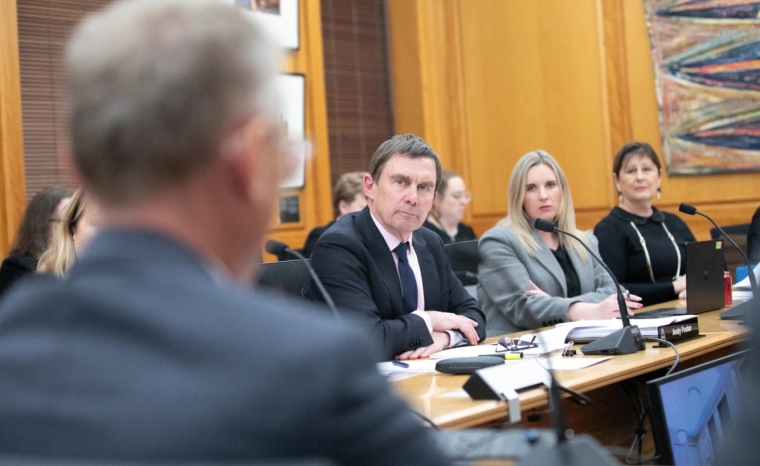
None of this is a surprise to see in an election year. But it's interesting to see that Chlöe Swarbrick, the co-leader of the Green Party, foreshadow part of the Green Party’s tax policy during Scrutiny Week. She took the Minister of Revenue, Simon Watts, and Commissioner of Inland Revenue, Peter Mersi, to task about the transfer practices of the large tech companies, the likes of Google, Uber, Apple, Oracle, etc. In particular, the large fees service fees that these companies paid to offshore associates.
Swarbrick also hammered away at Inland Revenue about leaving the tech companies alone but hitting small businesses hard over tax debts. A lose-lose situation for Inland Revenue there, by the by, but still an interesting political point to make.
What about royalty withholding taxes?
What was interesting to me about the Green Party's questioning during Parliamentary Scrutiny Week was this question of royalty withholding taxes. The Minister and Commissioner were both asked why Inland Revenue did not appear to be pursuing the question of whether some component of the service fees paid offshore represented a royalty and therefore subject to what we call non-resident withholding tax (NRWT). The rate of NRWT applicable depends on the country to which the payments are being made. If it's to the US, it's 5%, to countries such as the Netherlands it’s I10%.
This was an issue picked up and examined in some length by Tax Justice Aotearoa in their Big Tech Little Tax report last year. It cited the example of Google New Zealand, which appeared to earn revenues in the year ended 31 December 2024 of $1.139 billion, but paid service fees of $1.052 billion to the Singapore related party, leaving an operating profit of just over $29 million. Service fees represented 92% of Google's Google New Zealand's earnings and similar numbers have been observed in the case of other tech companies such as Oracle.
Big Tech Little Tax 2026 update
In the same week, Tax Justice Aotearoa and the Better Taxes for a Better Future campaign have released an update of their Big Tech Little Tax report, which includes the latest results for the year ended 31st December 2025. Just to stick with Google New Zealand its December 2025 results showed revenues of $1.259 billion and service fees of $1.166 billion, again around about 92% of total revenue.
The update looked at Amazon Web Services and also Uber’s trading companies, Portier New Zealand Ltd (UberEats) and Rasier New Zealand Ltd (Uber Rides). Both companies paid substantial service fees offshore. Interestingly the authors think Facebook New Zealand is using a slightly different model to Google New Zealand because reported revenue of just under $175 million for December 2025 seems low given there are two million users in New Zealand.
A potential $600 million leakage?
Apart from Amazon Web Services, Facebook, Google and Uber the report includes updates for Microsoft New Zealand, Oracle, SAP New Zealand and Samsung. It estimates that if royalty withholding tax was applied to the estimated $11.4 billion of service fees paid overseas over a five-year period the NRWT payable would have been $634 million.
The original Big Tech. Little Tax report and its 2026 update were prepared by Nick Miller, a highly qualified former transfer pricing specialist at Inland Revenue and HM Revenue and Customs. The update also considered what would be the corporate income tax payable if these tech companies actually had a 5% return on sales. (Facebook’s return on sales in 2025 was 2.2% and Microsoft’s five-year trend shows a drift downwards to 4%). Based on the available data this could represent another $102 million over the 2021-2025 five-year period.
How did the Government respond?
In response to Chlöe Swarbrick the Minister of Revenue, Simon Watts, said the Government wanted to work within the Organisation of Economic Cooperation and Development Pillar Two Framework to find a lasting solution. But to all intents and purposes, the Pillar Two minimum global tax of 15% is essentially dead in the water following Donald Trump's re-election as President of the United States.
There is also politics at play as I think the Government is not too keen to pick a fight with the United States tech companies and therefore attract the ire of President Trump. But notwithstanding that, applying the treaty royalty withholding tax rules might seem a more supportable action to take. If you're talking about $600 million over 5 years, it's not an unsubstantial sum of money.
A winning Green tax policy?
Politics aside it was an interesting exchange between the Green Party and the Minister of Revenue. It’s perhaps no surprise to see the Green Party’s tax package include a promise to enforce the current rules relating to withholding taxes and on these service fees and give Inland Revenue the funding to do so.
Politics and elections aside this is something I think Inland Revenue may push ahead with regardless of who forms the government after the Election. All tax jurisdictions around the world are starting to look very seriously at this question of transfer pricing and service fees going offshore. Across in Australia the Australian Tax Office tried to apply an embedded royalty argument in the PepsiCo case.
Managing tax debt – a lose-lose situation?
Moving on, Inland Revenue was also questioned during Scrutiny Week about its management of tax debt. As I said earlier, this is a bit of a lose-lose situation because it's always going to be under pressure whether its approach is considered too hard or too soft.
As part of its campaign to collect debt, Inland Revenue has advised that it has started making pre-recorded calls or voicemail messages to taxpayers with overdue debt or late tax payments and returns. Inland Revenue by law must maintain the integrity of the tax system and as part of this it must pursue debt.
Lessons from Australia’s Robodebt scandal
That said, I'm not a fan of these automated calls as they can ignore existing arrangements in place which just upsets clients who think the matter is in hand. There is also the Australian experience with the so-called “Robodebt” scandal, which ultimately ended up with a Royal Commission and over A$2 billion legal settlement. I'm very interested to know what advice ministers have received regarding the Robodebt scandal in relation to the proposal to increase the use of AI by government agencies.
The problem with increasing the use of AI and going down the path of further automation is that tax has a lot of discretion around its administration, which is not specifically outlined in legislation and sometimes even internal administrative practice. There is always the issue of keeping taxpayers onside. Push too hard and you could see a Robodebt type scandal or taxpayers pushing back over priorities by asking “Why are you picking on me and leaving Oracle [for example] alone?”
Calling in Baycorp
Inland Revenue therefore has something of a dilemma around debt collection. But it still has a job to do to collect an enormous amount of tax debt. In addition to the automated calls, Inland Revenue is advising debtors may with tax debt which has been overdue for more than six months be contacted by Baycorp, which it has engaged as a third party debt collection agency.
According to Inland Revenue's press release, this is intended to encourage earlier engagements on overdue debt, improved compliance outcomes and reduce the risk of debt escalating. All perfectly reasonable objectives in my mind. I just think the one concern that the Revenue has to be careful about, is with the increasing prevalence of phone and e-mail scams is how does it get cut through and connect with defaulters.
To me, a key objective for Inland Revenue with debt management is earlier intervention. If a taxpayer has missed a couple of GST and/or PAYE payments it should act immediately rather than let debt pile up.
Inland Revenue is torn between trying to enforce the law, collect the debt and also keep showing that it is acting equitably and preserving the integrity and people's perception of the integrity of the tax system. Not an easy task, to be fair.
2026 home office and kilometre rates confirmed
Finally, a couple of Inland Revenue updates. The square meterage rate that may be claimed for home office use for the 2026 income year has been set at $57.30 per square metre, which is up from the previous rate of $55.60 in the 2025 income year. This square metre rate is based on the average cost of utilities and housing for the average New Zealand household. Taxpayers may in addition claim a proportional mortgage interest and rates or rent based on the percentage of floor area of the property used for business purposes.
Separately, Inland Revenue has also published the kilometre rates for the 2026 income year.
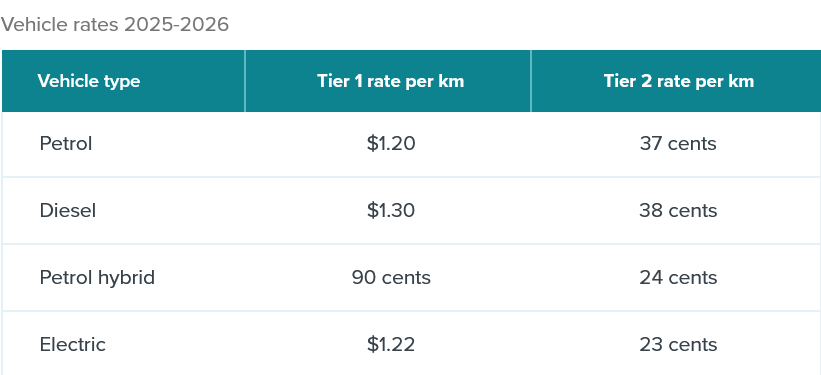
These kilometre rates are published annually after the end of the relevant tax year. But Inland Revenue also noted it's considering publishing some further guidance on kilometre rates for the current tax year to 31 March 2027 because of the dramatic increases in fuel prices. In the meantime, taxpayers can use these 2026 rates as a reasonable estimate of the employee cost of using their private vehicle for business purposes for the current tax year.
And on that note, that’s all for this week I’m Terry Baucher and thank you for listening. Please send me your feedback and requests for topics or guests. Until next time, kia pai to rā. Have a great day.
[My apologies for my recent silence – I am presently recovering from RSV but hope to restore regular service shortly].
We welcome your comments below. If you are not already registered, please register to comment
Remember we welcome robust, respectful and insightful debate. We don't welcome abusive or defamatory comments and will de-register those repeatedly making such comments. Our current comment policy is here.