
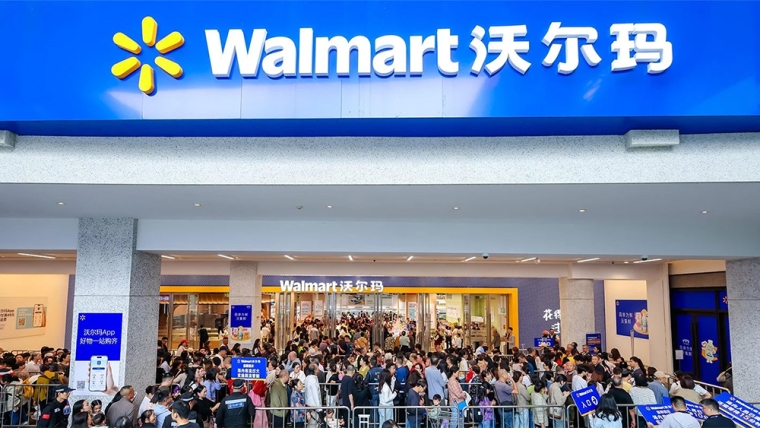
Potato chips flavoured like pigeon stewed with tianma, a herb used in traditional Chinese medicine, might come as a surprise at an all-American retailer like Walmart. But Walmart is far from being all-American in China.
Just across the aisle, there are durian sausages in the chiller. Opposite them are kale, avocado and chia mooncakes. Shoppers are joking online that Walmart’s product team must be using a random word generator.
The novelty gets people talking and gives them a reason to come back and see what’s on the shelf this week.
How Walmart grew as others pulled back
Other foreign supermarket giants such as Carrefour and Tesco have exited China. Even domestic chains have struggled as e-commerce, instant retail and convenience stores have taken share from large-format grocery chains. Despite this, Walmart has held its lead in China and continues to grow. Sales were up 20.7% in the quarter to July, largely on the back of Sam’s Club, with growth also picking up at Walmart stores.
Walmart recognised the importance of online sales early. It digitalised its offering, used its stores as fulfilment centres and added local depots to deliver within the 60-minute window shoppers expect. Online sales now account for 55% of Walmart’s sales in China, compared with less than a quarter in the US.
Chinese consumers are used to a huge range of products. More than 60,000 new products launch every day, and at the recent Double 11 festival, more than 1 million brands ran promotions on 72 million products. Some Chinese supermarkets offer more than 20,000 SKUs. Walmart’s Sam’s Club has kept its range tight at about 4,000 SKUs. Shoppers can be confident that what Sam’s Club does carry will be high quality, good value and suited to local tastes.
Regional flavours and traditional Chinese wellness
Building on the success of Sam’s own brand, Member’s Mark, Walmart refreshed its Marketside label last November, introducing or revamping nearly 1,000 products. Its China team leads the range, drawing on regional flavours for products such as Guizhou red sour soup chips and Yunnan-style wild mushroom and beef chips. For its spring matcha range, Walmart sourced tea from Tongren in Guizhou and Jingshan in Zhejiang for everything from puddings to cornflakes.
Marketside also taps into renewed interest in yào shí tóng yuán, a core principle of traditional Chinese medicine (TCM) that means ‘food and medicine share the same origin’. In July, Walmart worked with century-old Chinese brands on a range expected to include more than 100 products. Among them are milk with poria and Job’s tears (生牛乳茯苓薏仁奶) and walnut cake with sour jujube seeds (酸枣仁核桃蛋糕). Comvita has also embraced the trend with its TCM and honey gift box.
Earlier this year, Walmart worked with Xiaohongshu on a ‘Mashu Store’ concept area where products were grouped by ‘vibe’ rather than category. Instead of finding products in snack or breakfast isles, products are curated into “interest islands,” such as those that are visually stunning and photogenic; clean labels and health; exotic finds; and unusual flavours and textures. Shoppers could scan QR codes beside the co-branded products to see reviews and other content on Xiaohongshu.
Walmart has recognised how people discover, choose and share products on social media and brought that experience into its stores.
What foreign FMCG brands can do
There’s plenty foreign brands can learn from the success of Walmart and Sam’s Club in China. The big one is to localise, while recognising regional differences. Keep things novel and interesting without feeling you have to launch a million new products. Consider traditional influences such as TCM, which increasingly shape product preferences. Make good use of China’s modern influences, such as e-commerce, social commerce and speedy delivery, and look for ways to bring what shoppers enjoy online into physical stores, as Walmart has with Mashu.
Walmart’s success should illustrate that there is rarely one silver bullet, rather the sum of many China-specific initiatives that help keep consumers interested and coming back.
*Mark Tanner is the CEO of China Skinny, a marketing consultancy in Shanghai. This article was first published here, and is re-posted with permission.
We welcome your comments below. If you are not already registered, please register to comment
Remember we welcome robust, respectful and insightful debate. We don't welcome abusive or defamatory comments and will de-register those repeatedly making such comments. Our current comment policy is here.