
By Paola Subacchi
US Treasury Secretary Scott Bessent has a packed agenda. Alongside trying to crash Iran’s economy, he is concerned about the cost of servicing federal debt, which surpassed 100% of GDP earlier this year. Interest payments on America’s debt have shot up to more than $1 trillion this year, exceeding annual US defense spending.
To keep a lid on Treasury yields, Bessent—who spent most of his career in capital markets, notably at Soros Fund Management, where he helped “break” the British pound in September 1992—is now seeking to move market sentiment from the other side of the fence.
First came a joint intervention by the US and Japan to prop up a weak yen. To raise the dollars required on its own, Japan would have had to sell US Treasuries. Japan is the largest holder of US debt and has long been a reliable buyer, putting around 25 cents of every surplus dollar into Treasuries for the past two decades. A forced sale would have been a very public break from precedent.
The next step revealed Bessent’s real concern. He suggested that, instead of selling securities, Japan could gain access to dollars to buttress the yen through the Foreign and International Monetary Authorities Repo Facility, which has been little used since the pandemic. He also proposed using the facility to relieve pressure on the US bond market, as well as raising its borrowing ceiling to support dollar funding more widely.
Most recently, Bessent has turned his attention to demand, with a commitment to double long-dated buybacks to “at least” $4 billion per operation. Here the arithmetic doesn’t add up. The US Federal Reserve can bend a yield curve because it operates in larger amounts—at the height of the pandemic, its daily Treasury purchases peaked at roughly $75 billion. But the Treasury cannot do the same. It pays for long-dated buybacks by selling short-dated debt, reducing the duration of America’s debt while claiming to steady long-term Treasury yields.
This sequence of interventions has not delivered the expected outcome: the 30-year yield, which reached its highest level since 2007 right before Bessent’s buyback announcement, fell temporarily but soon bounced back. It has also confused bondholders. That puts Bessent—the self-described “nation’s top bond salesman”—in an uncomfortable position.
At around $30 trillion, the US debt market is huge and liquid. But the attempted intervention is concerning, as is an administration showing no fiscal restraint. The Congressional Budget Office (CBO) projects that the national debt will reach 108% of GDP by 2030 and 120% by 2036. A major driver is interest on existing bonds. The low-rate pandemic window was used to borrow rather than pay down debt, leaving more to refinance once rates rose.
The race that matters is between the interest rate the government pays and the rate at which the economy grows, with the latter ideally outpacing the former. That has been the case in the United States for two decades, but the CBO projects that the gap will close around 2031, after which stabilizing the debt ratio will require outright surpluses. Meanwhile, inflation remains above the Fed’s 2% target.
President Donald Trump has embraced the view that the world has been freeloading on US debt, and that the terms should change. Whether his administration acts on that view remains an open question, but the genie is out of the bottle.
A similar question hangs over the Fed, which came under pressure from the White House to cut interest rates during former Fed Chair Jerome Powell’s final months in office. Powell’s successor, Kevin Warsh, has not yet felt Trump’s breathing down his neck, but that seems like a matter of when, not if. The consequences could be profound: the Fed’s ability to stabilize markets depends on its perceived independence from politics.
Thirty years is a long time for a creditor to trust a debtor. Will they repay the debt in full or try to inflate it away? It is not surprising, then, that the Treasury’s buybacks reduce the duration of federal debt.
But the marginal buyers of that short-term debt are now domestic, private, and more price-sensitive than central banks are. That means the US government, which is issuing bonds at record volumes, is drawing from the same pool of domestic savings as large-scale corporate borrowers. At that point, the yield needed to clear the market becomes a relevant factor.
Far from suggesting financial Armageddon, the current situation recalls that described in 1971 by then-US Treasury Secretary John Connally, after the US government unilaterally abandoned dollar convertibility: “The dollar is our currency, but it’s your problem.” Treasury holders like Japan, China, and European countries are not running for the exit just yet, but they are looking for one—and finding few options.
The problem is simple: no other market can absorb the same volume. The German Bund market is around $2.3 trillion. Japan’s bond market is larger, at around $7.6 trillion, but the Bank of Japan owns roughly 43% of it. The dollar’s share of global reserves has decreased slowly, from nearly 70% in 2000 to under 59% in 2024, precisely because reserve managers have nowhere else to turn. The US, not its creditors, holds the pricing power, and foreign holdings reflect structural necessity, not strategic choice.
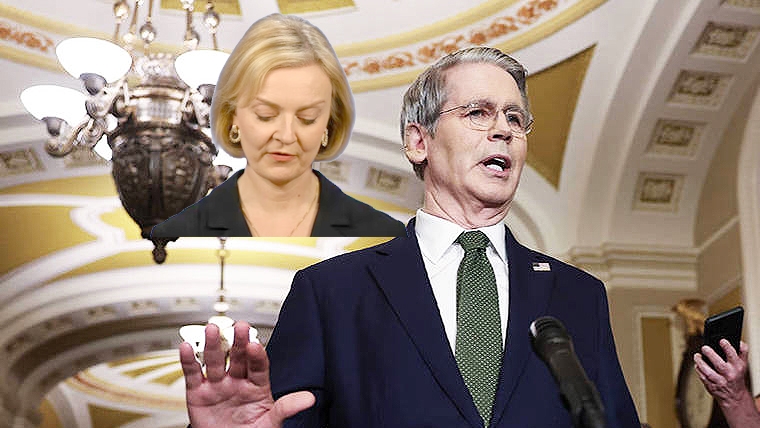
But even as sovereign buyers continue to purchase Treasuries for exchange-rate management, crisis insurance, and trade settlement in a dollar-priced world, the bond-salesman-in-chief cannot be complacent. Tampering with markets may fail to deliver the expected result and, at worst, trigger instability across asset classes, as the British gilt and even the German bund are already under pressure. The risk of another “Liz Truss moment”—when the UK prime minister resigned after sending the gilt market into freefall in 2022—is never far away.
Paola Subacchi is Professor and Chair in Sovereign Debt at Sciences Po. Copyright: Project Syndicate, 2026, and published here with permission.
We welcome your comments below. If you are not already registered, please register to comment
Remember we welcome robust, respectful and insightful debate. We don't welcome abusive or defamatory comments and will de-register those repeatedly making such comments. Our current comment policy is here.