

The five indicators to watch over coming weeks for the direction of the NZD/USD exchange
- Political polls and outcomes in New Zealand and the USA
- Fortitude of the RBNZ to lower inflation
- Hyperscaler’s debt, equity raises, the bond market and AI bubble risk
- US economic data trends and how the Fed responds
- The Middle East conflict, oil prices and inflation
There are certainly a stack of potential “event risks” for the Kiwi dollar foreign exchange market to navigate its way through over coming weeks until the end of the year. US dollar appreciation on the back of rising US interest rates over recent months has forced the NZD/USD exchange rate to the very bottom end of its 24-month trading range between 0.5600 and 0.6100. Over that two year period since October 2024, the Kiwi dollar has recorded four spikes higher above 0.5900 and four plunges lower to 0.5700 and 0.5600. How the NZ dollar and the US dollar react to upcoming announcements and events will determine whether the Kiwi dollar can once again rebound higher from the current low point.
It might be easy to conclude that the NZD/USD exchange rate is trading lower at just above 0.5600 in the lead up to the New Zealand general election on 7th November because the FX markets are factoring in the political risk of the New Zealand public being bribed by their own money and voting in a left-bloc Labour coalition government. Higher taxes, higher Government debt and higher Government budget deficits would be the consequences of a left bloc collation government, which in turn would lead to lower investment, lower GDP growth and a likely lower NZ dollar value.
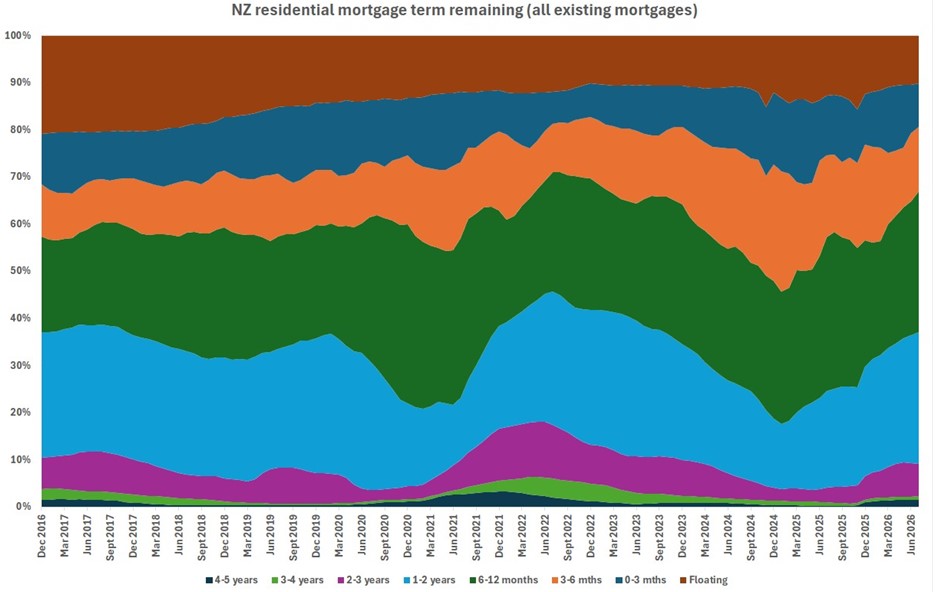
There is no evidence that the NZ dollar is being sold on its own due to any elevated political risk at this point in time. A month ago, the NZ dollar was independently sold down on its own when the RBNZ surprised the markets with a monetary policy U-turn to a “go slow” on OCR interest rate increases. Over the last three weeks the NZD/USD rate has been forced lower by the stronger USD against all currencies, as evidence by stable NZD cross-rates to the AUD and Euro. The political opinion polls are basically all over the place in respect to being regarded as accurate and reliable indicators of just how the NZ public will vote. A centre-right National Coalition victory (even if PM Christopher Luxon has to go back on his word a negotiate with the Opportunity Party if they achieve the 5% party vote threshold) would be seen as more positive for the Kiwi dollar as they continue with fiscal discipline (unlike many other countries) and advocate pro-business/growth economic policies. A higher OCR interest rate to near 4.00% over coming months will not stifle economic growth, spending or investment as 70% of mortgage borrowers have fixed their interest rates (see chart below), as have most business borrowers as well.
In stark contrast to New Zealand’s tight political landscape, the US’s mid-term elections on Tuesday 3rd November appear to be a forgone conclusion. Political opinion polls, consumer sentiment surveys and President Trump’s plummeting approval rating all point to a rout for the Republicans and a landslide victory for the Democrats in both the House of Representatives and in the Senate. What such a political outcome means for the US dollar value is less clear-cut. The Democrat’s economic policies are not likely to reduce the fiscal deficits and Government’s debt levels anytime soon. President Trump would not have a public mandate to continue the Iran war, however that would not stop him from continuing the conflict. The American public want lower gasoline prices and Trump has delivered the opposite. An impeachment crusade against Trump on financial corruption charges may well be a feature of the last two years of his Presidency. The likely political and economic environment in the US through 2027 and 2028, outside of the equity markets, does not look positive for a stronger US dollar. Political instability and disappointing economic growth suggest continuing foreign disinvestment from the US. The AI equity market bubble bursting badly would be another potential negative risk event for the US dollar.
Fortitude of the RBNZ to lower inflation
RBNZ Governor, Dr Anna Breman faces her first rest test in respect to her understanding of the nuances of the New Zealand economy with the decision to lift the OCR interest rate (or not) on Wednesday 28th October. Whilst it is not her sole decision, as Chairperson of the Monetary Policy Committee, she will have a responsibility to bring the other members of the committee with her on the decision to lift interest rates another 0.25% to 3.00%. When the inflation rate is already well above your target band and the exchange rate continues to depreciate, keeping inflation rate elevated through higher import costs, you have no reason to pause and go slow on returning interest rate settings to neutral. The price of petrol at the pump increasing back to record highs mainly due to exchange rate depreciation over the last six weeks is sufficient evidence not to delay needed interest rate hikes. Dr Breman must surely understand by now the significant impact the exchange rate has on domestic inflation due to our high import penetration levels. It is not the same as Sweden.
Central bank decision making is also about credibility. The RBNZ’s decision to pause interest rate increase in early September prompted immediate selling of the NZ dollar on its own account as it was not what the FX markets were expecting and it sent a message that the RBNZ was uncertain about the timing and requirement to reduce inflation. Governor Breman told us early on in her tenure that she was “laser focused” on controlling inflation to within the 1.00% to 3.00% target band. Now is the time to demonstrate that commitment.
The results of the September quarter CPI inflation numbers to be released this Thursday 22nd October will be critical as to what way the RBNZ goes with the 28th October OCR review. Consensus market forecasts are for a 0.70% increase in inflation over the quarter, marginally reducing the annual rate of inflation from 4.10% to 3.70%. Current forecasts are for the inflation to increase again in the December quarter back to a 4.20% annual rate as the lower currency value feeds through into higher fuel and other prices. The RBNZ are forecasting a 0.80% increase for the September quarter and then a succession of low quarterly increases the sees the annual inflation rate reduce dramatically from 4.00% to 2.10% through the course of 2027. It is these somewhat heroic forecasts the RBNZ need to be revising upwards due the current NZ dollar depreciation.
An inflation outcome above the 0.70%/0.80% forecasts would certainly bring some buyers back to the Kiwi dollar as it provides more certainty of another OCR increase on 28th October.
Hyperscaler’s debt, equity raises, the bond market and AI bubble
The extraordinary demand for debt to fund the capital expenditure on data centre builds for the AI revolution has exerted pressures on the financial and economic ecosystems across the globe. US bond yields have increased largely due to the one-sided market demand for funds from these corporate borrowers and the investors into the debt needing a higher and higher return to compensate them for the risk of owning such debt securities. The US dollar has strengthened on global FX markets as US interest rate yields have been increasing faster and further than other interest rates.
Over recent weeks some cracks are starting to appear in the belief that all these data centres will be built, whether the computing demand will be there and whether they will make any money. The risks are accumulating, one being that over 50% of the property developers building data centres in the US are first time developers who just appear to be riding the band wagon.
Closer to home, the pulling of the planned Firmus A$8 billion IPO in Australia to fund neocloud data centres just before its launch this month on investor demand and valuation concerns, is an indication of the rising risk levels around data centre builds. Investors getting cold feet at the last minute tells you a lot.
The amount off debt being raised to fund data centres in the US is mind-blowing. US tech giants Broadcom, SpaceX and Oracle are together planning to borrow more than US$100 billion to finance the purchase of AI chips. The pricing in the credit default swaps market is shooting higher for these hyperscaler borrows. A growing chorus of market commentators are expressing worries about the AI bubble bursting. Whether the bubble slowly deflates or bursts badly with a loud bang is the debate. The first indication will be share prices in the equity markets. There are 200 hyperscalers such as Firmus around the world all attempting to ride the AI spending boom. If there is just not enough sales revenue to cover the enormous amount of debt in this industry there could be some spectacular failures ahead of us. In addition, just where the additional electricity generation is coming from is far from clear in most cases. If equity markets start to fall, valuations and confidence will also decrease, leading to the cancelation of debt issues and data centre builds.
The implications for the NZ dollar exchange rate form these potential developments or risk events is both potentially negative and positive. A major correction downwards in US equity markets led by the AI tech companies would be negative for the Kiwi dollar as it never does well in an investment “risk off” environment. On the other side, US bond yields would likely reverse sharply lower as investors seek safety away from the hyperscalers, which in turn would depreciate the US dollar in global currency markets.
US economic data trends and how the Fed responds
According to Fed Chair Kevin Warsh, US economic growth is robust, the labour market is evenly balanced between supply and demand, and inflation has been above the 2.00% target for far too long. Therefore, the Fed increased interest rates last month and will increase again to drive inflation lower. Also, according to Mr Warsh, current credit conditions in the US economy do not suggest any financial pressures and households can handle higher interest rates.
However, evidence is emerging on the state of the US economy that paints a significantly less rosy picture than that described by Chair Warsh. Two reports released over this last week are examples of a completely different economic and financial environment in the US at this time: -
- For the three-year period ended 2025 the portion of families behind on loan payments soared from 12% in the prior Fed survey to 20%, the highest level since the GFC in 2010. Households with share investment portfolios in the US are much better off, unfortunately the vast majority are not in that position.
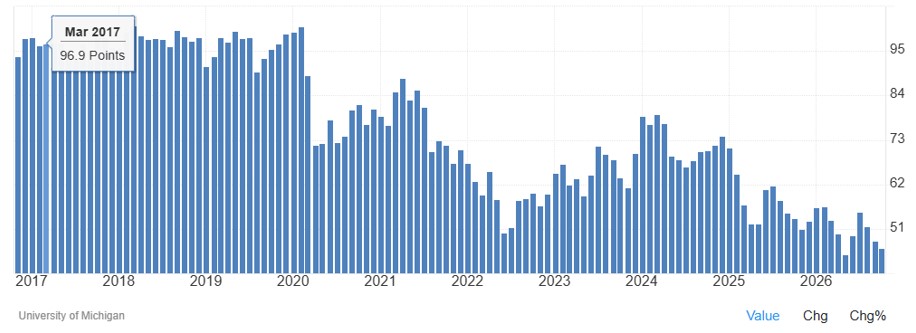
- Consumer confidence as measured by the University of Michigan survey plumbed new lows in October. The confidence index decreasing to 46.3, well below prior forecasts of 47.9 and 48.1 in September. The collapse of consumer confidence through 2025 and 2026, the period Trump has been in office, is startling and must have a negative impact on US GDP growth going forward (refer chart below).
In the Fed’s eyes, growth in the economy is still robust. However, the expansion is very narrowly based on building data centres.
Upcoming US economic data that will contribute to the Fed’s decision as to whether they need to increase their interest rates further, or not, includes: -
- CPI inflation for September on 14th October. The month’s core increase likely to be +0.20%, leaving the annual core inflation rate stable at 2.40%.
- Retail Sales for September on 15th October. A low 0.10% increase is forecast.
- GDP growth for the September quarter on 29th October. An annualised increase of 3.00% is forecast, up from 2.20% in the June quarter. A lower than expected outcome is likely if consumer spending falls away. Business investment and AI infrastructure builds remain strong.
Outside of oil price impacts, none of this US economic data suggests a compelling need to rein-in excessive demand that is causing inflation. The probability is increasing, in our view, that the Fed will not increase interest rates again, either in October or in December. Interest rate market pricing will adjust lower on the expected softer economic data, resulting in a weaker US dollar exchange rate.
US Consumer Confidence - 2016 to 2026
The Middle East conflict, oil prices and inflation
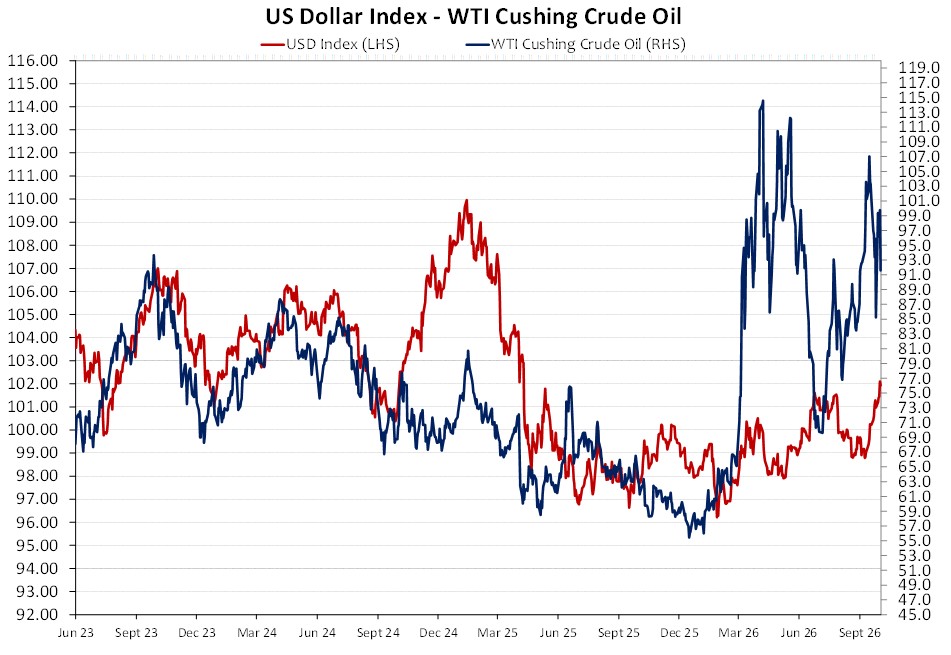
Desperate men do desperate things. President Trump, in last ditch attempts to save his Republican Party from being trounced at the mid-term elections on 3rd November, has halted military strikes on Iran until after the elections and has “done a deal” with the Russians to supply the US with diesel. Don’t worry about the economic sanctions in place against Russia, driving lower pump prices is more important. Time will tell how these two Trump decisions will play out with the price of oil. Certainly, lower WTI crude oil prices back into the US$80/barrel region would greatly assist the Fed in ensuring that second round price increases from oil do not push US inflation back upwards. Lower oil prices over coming weeks will help to reverse the direction of US interest rates and pull the US dollar value back down from its current 102.00 level on the Dixy Index.
Daily exchange rates
Select chart tabs
*Roger J Kerr is Executive Chairman of Barrington Treasury Services NZ Limited. He has written commentaries on the NZ dollar since 1981.
We welcome your comments below. If you are not already registered, please register to comment
Remember we welcome robust, respectful and insightful debate. We don't welcome abusive or defamatory comments and will de-register those repeatedly making such comments. Our current comment policy is here.