

Summary of key points: -
- US bond market sell-off is a vote of no-confidence in the Trump regime
- Australian monetary policy management in a right pickle !
- Disappointing mixed messages from the RBNZ
More often than not, it is the changes or movements in foreign exchange markets that do not occur that are more telling and informative than the movements that do occur. Up until a few weeks, global FX markets were marking the US dollar value higher against other currencies when US long-term Treasury Bond interest rates increased and/or when oil prices increased. Those connections and cause and effect relationships have seemingly broken down over recent times. It seems the currency markets are currently struggling to decide what is more positive or more negative for the US dollar’s future direction.
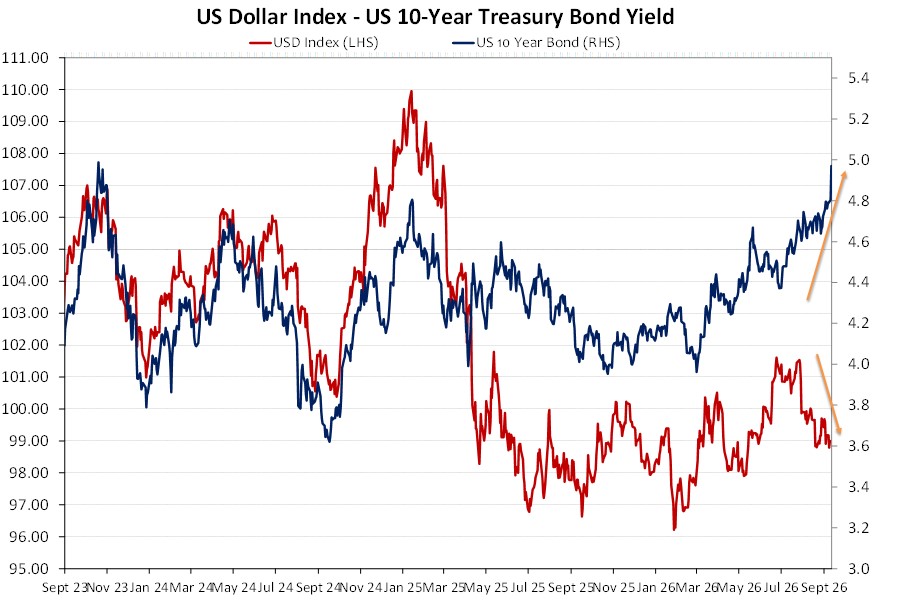
As the chart below confirms, the USD Dixy Index largely followed the ups and down in US 10-year Treasury Bond yields up until a few weeks ago at the end of July when the correlation stopped. The US dollar was sold lower, despite the sell-off in the bond market which has sent 10-year yields to new highs of close to 5.00%. One explanation is that foreign investors are ditching out of US Treasury Bonds as they have lost all confidence in the Trump regime to rein-in the US Government budget deficit and control the increasing debt levels. The selling of bonds pushed the yields up. The offshore bond investors, off course, sell the USD as they depart and repatriate funds to home base. Trump’s latest desperate attempt to buy votes ahead of the upcoming mid-term elections with a wacky US$5,000 “dividend” (bribe) payment to all US adults will only add to the ballooning budget deficits. As well as adding to inflation and interest rates!
The failure of the US dollar to follow US bond yields higher also tells you that with other currency’s interest rates also increasing around the word (Europe, Australia and New Zealand), the increase in US market interest rates is not enough investment return compensation to cover the risk that the US dollar could depreciate further. It really is a telling indictment of global investors finally turning their backs on the shenanigans and incomprehensible economic policy changes of the Trump regime.
Consider the following futile, irresponsible and damaging economic and political initiatives promulgated by Trump: -
- Stopping trade with countries who have trade surpluses with the US if his own appointment to the Federal Reserve, Kevin Warsh increases US short-term interest rates this week.
- Being forced to refund US$100 billion in trade tariffs illegally levied on US importers last year.
- Promising a US$5,000/adult “dividend” handout/bribe which will increase inflation and increase the current US$40 trillion of US Government debt by another US$1 trillion.
- Starting a war with Iran six months ago to end the Iranian regime and destroy their nuclear arms capability. Neither objective has been achieved, however US households are now paying US$4.28 per gallon for gasoline compared to US$3.00/gallon at the pump in February.
- The Trump election campaign promise of “reshoring” US manufacturing jobs from offshore has been unmitigated disaster, with the US Bureau of Labour Statistics reporting 134,00 manufacturing jobs lost in the US over the last two years. Material cost increases and fluctuating global trade policies cited as reasons for the US manufacturing job losses.
- Trump’s preoccupation with increases in US share market values representing how well the US economy is doing. AI stocks and data centre construction will boom until the day the music stops. Sharply higher “risk-free” bond yields may already be stomping on the orchestra!
Trump promised the US public more jobs and lower inflation, he has delivered the opposite. You wonder how many Americans will understand this fact when they come to vote in November.
The US dollar has also failed to follow oil prices higher over recent weeks. WTI oil prices were US$70.00/barrel two months ago in early July and the USD was sitting at 100.75 on the Dixy Currency Index at that time. Today, WTI oil prices have spiralled higher to US$100/barrel, and the USD value is lower at 99.10. There has been a sea change in perceptions towards the US dollar as a safe haven asset to be holding in times of global upheaval and uncertainty.
The question from here is the counter-factual situation of whether the US dollar will depreciate when ultimately oil prices reverse back downwards, and inflation/interest rates reduce in the US economy? US business and economic “exceptionalism” has been strong and had to be admired. However, the world is moving on and starting to ignore the US as the powerhouse they previously could not ignore. The results of the upcoming US mid-term elections will send a message to the world that the US public is also now rejecting the antics of the conman currently occupying the White House.
The US CPI inflation result for the month of August was bang on prior market forecasts and did nothing to resolve the debate whether inflation is at risk of increases or decreases going forward. Excluding volatile food and energy prices, the core inflation rate increased by 0.30%, leaving the annual rate of change unchanged at 2.40%. Most of the 0.30% increase was airfares going back up again as jet fuel prices lift on higher crude oil prices. The US interest rate markets are now pricing a Fed rate rise this week, it would now be a surprise if the Fed held rates steady. There is enormous pressure on Fed Chairman, Kevin Warsh as his appointor, President Trump continues to call for interest rate cuts.
Whilst Kevin Warsh, and a number of members of the Fed FOMC monetary committee, have become impatient with the annual inflation rate being well above the 2.00% target for some time now. The difficulty for them is the fact that most of the inflation has come from the supply side of the economy. Increasing interest rates will not impact those prices. Higher interest rates are designed to clobber demand and therefore stop price increases. Currently, demand appears to be significantly softening in the US economy. The University of Michigan Survey of Consumer Confidence was again lower in September (data released last Friday 11th September). The consumer sentiment index dropping to 47.8 from 51.7 in August, and well below prior forecasts of 51.5. Households in the US remain under pressure from higher gasoline prices and not much in the way of wage increases. Consumer sentiment has returned to the lows seen in May (after an improvement to 55 in July) when oil prices were last above US$100.00/barrel. The US dollar value depreciated to 97.50 on the Dixy Index in May when the University of Michigan Consumer Sentiment Index fell away to 45. In some respects, it should be surprising if the Fed increased interest rates when consumer confidence is already so weak and declining further.
US market interest rates have already increased, and the USD has been unable to make any gains, therefore the USD is unlikely to appreciate on a Fed rate hike that is only catching up a little way to the market interest rate levels. On the other side, the USD will depreciate if the Fed hold interest rates unchanged this week.
Australian monetary policy management in a right pickle!
The conundrum the Reserve Bank of Australia (“RBA”) are currently facing with being forced to increase interest rates again to control inflation at a time the economy is abruptly slowing is really of their own making. In the interests of retaining jobs at the time, the RBA only increased their interest rates to 4.00% in 2022 when sharply higher inflation all around the world saw the US and New Zealand increase interest rates to 5.50%. Their reluctance to tighten policy to drive inflation down four years ago has delivered the problem they have today, with annual inflation rates well above the US and New Zealand. High inflation in a slowing economy is a massive challenge for the RBA.
Another OCR interest rate increase from 4.35% to 4.60% on 29 September will likely send house prices lower, hit retail sales and lower GDP growth. RBA Deputy Governor, Andew Hauser provided a strong indication in a media interview last week that further interest rate increases are likely needed to get inflation under control. Eventually, those negative economic outcomes will become a burden on the Aussie dollar. Weaker economic performance in Australia in 2027 will contrast starkly with 3.00%+ GDP growth in the New Zealand economy.
Australian CPI inflation data for the month of August is released on Wednesday 30th September, the day after the RBA’s interest rate decision. With the preferred trimmed-mean annual inflation rate expected to stay at a high of 3.60%, the RBA would be justified in hiking interest rates one last time.
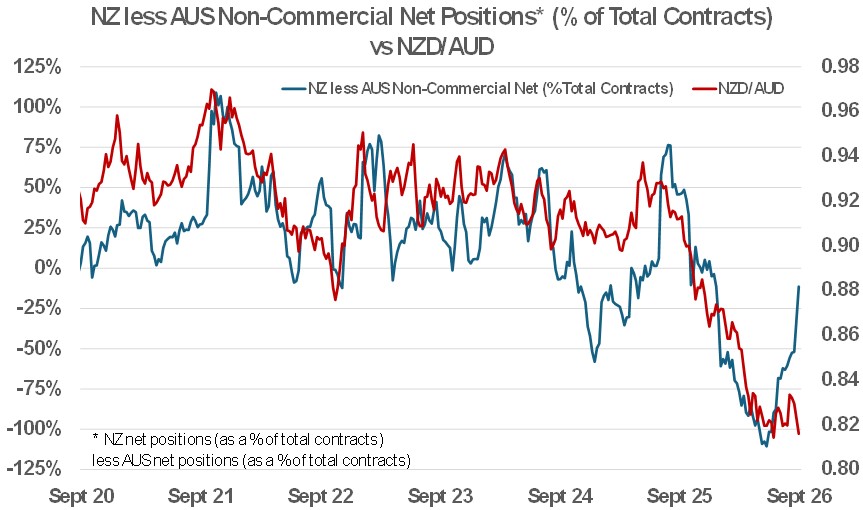
The contrasting directions of the Australian and New Zealand economies next year will see the RBNZ still increasing interest rates in mid-2027, whereas the RBA are likely to be cutting their interest rates. A forward look for the NZD/AUD cross-rate has to be significant NZ dollar gains from the current 0.8100 level to nearer 0.8600/0.8700. Speculative trader positioning in the respective NZD/USD and AUD/USD foreign exchange markets combined into a single NZD/AUD speculative positioning picture certainly suggests are sharp reversal upwards in the NZD/AUD cross-rate (refer to the chart below).
The recent push down in the NZD/AUD cross rate from above 0.8300 to 0.8100 has come about by the AUD/USD exchange rate staying near to 0.7200 on expectations of another interest rate hike, whereas the NZ dollar was driven down 1 ½ cents against the USD by the RBNZ deciding to go slow on interest rate hikes (contrary to FX maker expectations). Stronger than expected economic data in New Zealand (GDP growth figures this week) pitched against weaker data in Australia will soon reverse that NZD/AUD cross-rate direction.
Disappointing mixed messages from the RBNZ
RBNZ Governor Anna Breman has rapidly built a respected reputation, over the last nine months that she has been in the seat, as a clear communicator who chooses her words very carefully. However, the last RBNZ Monetary Policy Statement and subsequent media interviews by Anna and by some members of the monetary policy committee point to the RBNZ perhaps being too cautious and too careful so as to not upset anyone. Being hesitant on firm convictions and overly cautious on the economic outlook runs the risk of sending mixed messages to the markets on the speed and extent of required interest rate increases to return monetary policy settings to neutral (OCR at 3.25% to 3.50%).
The first perplexing messaging was that four of the six members of the monetary policy committee saw upside risks to their own inflation forecast. However, the group decision was to remove the earlier signalled October OCR hike i.e. go slower on interest rate increases. The NZ dollar depreciated 1 ½ cents against the USD following the RBNZ’s statement on 2nd September because the financial markets were not expecting them to deviate away from the interest rate increase track they signalled back in May.
The second contradictory messaging was from the external monetary policy committee member, Professor Prasanna Gai who was interviewed in Sydney on 7th September. Gai suggested “it is plausible that the OCR is already within the neutral zone”. All previous communication from the RBNZ and market expectations is that the neutral zone for the OCR is between 3.25% and 3.50%. The Kiwi dollar was sold lower on this comment as previously Professor Gai was seen as more on the hawkish side as a committee member. The inconsistency as to how this member sees inflation and the required level of the OCR to return inflation to the 1.00% to 3.00% band is worrying to say the least.
The current regime at the RBNZ seems to be disregarding or downplaying the importance of the exchange rate in managing inflation in New Zealand. The high import penetration levels we have means that the exchange rate is probably more important in influencing the inflation rate than interest rates. Previous RBNZ Governors such as Don Brash and Alan Bollard well understood the importance of the exchange rate and always enquired about importer and exported currency hedging levels. The more recent Governors appear to be less concerned at exchange rate impacts on inflation and the economy.
If the RBNZ have good financial market intelligence they should know what impact their monetary policy statements and public media interviews will have on the exchange rate value. The current regime does not seem interested or care too much as recent statements have pushed the NZ dollar value lower. The irony here is that the RBNZ actually need a higher NZ dollar value to help them return inflation to the 1.00% to 3.00% band.
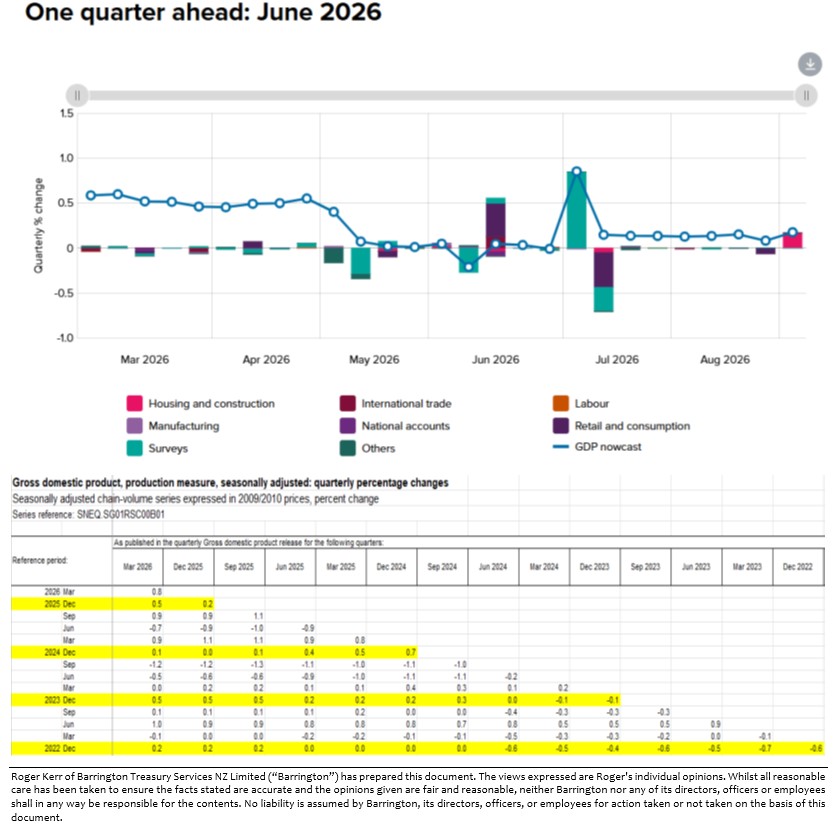
Despite the RBNZ unknowingly or unwittingly driving the NZ dollar lower on its own account over the last two week, stronger than forecast GDP growth for the June quarter this Thursday 17th September should do the opposite. The RBNZ are forecasting 0.00% for the June quarter and market consensus forecasts are for a 0.10% lift in growth. The RBNZ’s own GDP Nowcast predictor model points to a 0.20% increase. An actual outcome above that would not surprise and that would send the NZ dollar up.
The second table below highlights the very large subsequent historical revisions that Statistics NZ make to originally released quarterly GDP growth figures. The subsequent changes to the December quarter’s figures over recent years (highlighted rows) is significant and alarming! Trust that released economic data is accurate to what is actually happening in the economy is important to everyone, unfortunately that is not the case with the GDP growth series in New Zealand.
Daily exchange rates
Select chart tabs
*Roger J Kerr is Executive Chairman of Barrington Treasury Services NZ Limited. He has written commentaries on the NZ dollar since 1981.
We welcome your comments below. If you are not already registered, please register to comment
Remember we welcome robust, respectful and insightful debate. We don't welcome abusive or defamatory comments and will de-register those repeatedly making such comments. Our current comment policy is here.