

Summary of key points: -
- Intervention and interference in the financial markets now the norm in the US
- Japanese Yen carry-trades belatedly start to unwind
- Foreign investors reducing US exposures
- RBNZ now on the go slow for no reason
First, it was US Treasury Secretary, Scott Bessant intervening in the USD/JPY foreign exchange market and the US Treasury Bond market, now it is President Trump imparting considerable pressure on his own appointment, Kevin Warsh at the Federal Reserve in respect to interest rate direction. Instead of focusing on the emerging economic data as pointers for future US interest rate and currency direction, the financial and investment markets end up attempting to decipher the relationship and posturing between the US Government and their central bank. In response to a much stronger than expected Non-Farm Payroll jobs increase, President Trump has yet again undermined the independence of the Federal Reserve by insisting that interest rates need to be lowered as the US Government’s credit standing has greatly improved! The US August employment increase of 162,000 was far in excess of the +60,000 expected and continues the pattern of large and unpredictable changes in the US labour market data. Not too much should be read into this one strong number as the reliability and accuracy of this measure of employment has been under question for some time with significant historical revisions following initial releases. Just as Kevin Warsh and some of the more hawkish Fed members are stating that the disinflation trends in the last two months’ CPI numbers should not be relied upon until there is more confirmation of the data, the jump up in US employment in August should also be treated with considerable scepticism.
The Trump regime is again on a collision course with the independent Federal Reserve over interest rates with Trump desperately needing some favourable financial news for households and voters ahead of the mid-term election in November. The US interest rate markets are now pricing in a 60% probability of the Fed hiking the Fed Funds interest rate by 0.25% at their next meeting on 16th September. The markets are now focused on the US CPI inflation numbers for August due for release this Friday 11th September. Another monthly increase for core inflation of 0.00% or +0.10% will enhance the argument that the underlying US inflation trend is downwards and there are no unexpected surprise increases in prices lurking in the statistical data as some of the hawkish members of the Fed consistently (and incorrectly) state. A softer than forecast result should be sufficient evidence for the Fed to hold interest rates steady at the 16th September meeting. Such a decision would be negative for the US dollar value as the FX markets are now priced for US interest rate increases.
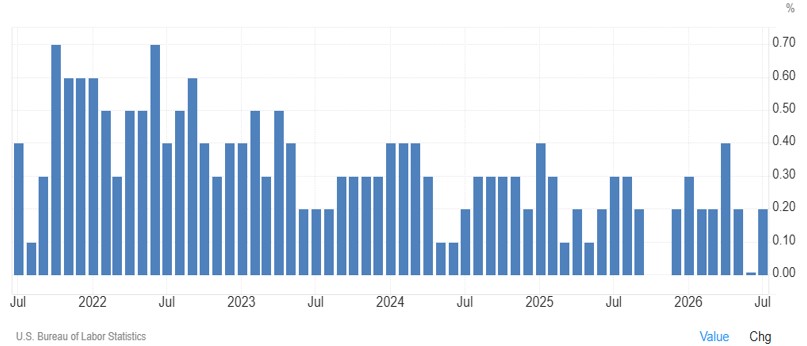
Core goods and services inflation (excluding food and energy) continues the pattern of monthly price increases in the middle of the year being well below the annual price hikes by business firms in the months of January and February. It does appear that more members of the Fed are seeing that the oil price increases earlier this year are not feeding into second-round price increases in other goods and services. The trend of core inflation is clearly downwards as the bar chart below confirms.
It is interesting to observe that the US dollar gains from the stronger jobs increase were quite muted, the USD Dixy Index only marginally improving from 98.80 before the data release to 99.13 afterwards. The NZD/USD exchange rate dipping from 0.5900 to 0.5865 at the time of the jobs release on Friday night, however recovering to 0.5885 at the New York close.
US Monthly Core Inflation 2023 to 2026
Japanese Yen carry-trades belatedly start to unwind
Aided by some direct pressure by the US Treasury Secretary, Scott Bessant, the Bank of Japan are set to increase their official interest rate from 1.00% to 1.25% at their next meeting on 18th September. The Japanese have been very slow to increase their interest rates over the last 18 months to combat rising inflation and also to help their own case of stopping the Yen currency from depreciating. The massive direct intervention in the USD/JPY foreign exchange market by the Japanese back in May, and again last month with the help of the US Government, was looking like it was not having much impact to turn the Yen around. The initial intervention drove a stronger Yen to 155.00 against the USD, however through June, July and August the USD/JPY exchange rate returned to 160.00 again. However, over this last week the prospect of higher interest rates in Japan has finally convinced the holders of carry trades against the Yen to unwind their positions. Higher interest rates in Japan make it less attractive to enter and hold sold Yen/bought speculative carry-trade transactions.
The Yen has appreciated against the USD from 160.30 to 156.25 over the last seven days and looks set to continue those gains as more carry-trades are unwound. The USD/JPY movements are an important lead-indicator for the NZD/USD exchange rate as the Yen is the largest freely traded currency in Asia and the Kiwi dollar is an Asian currency. The correlation is undeniable (refer to chart).
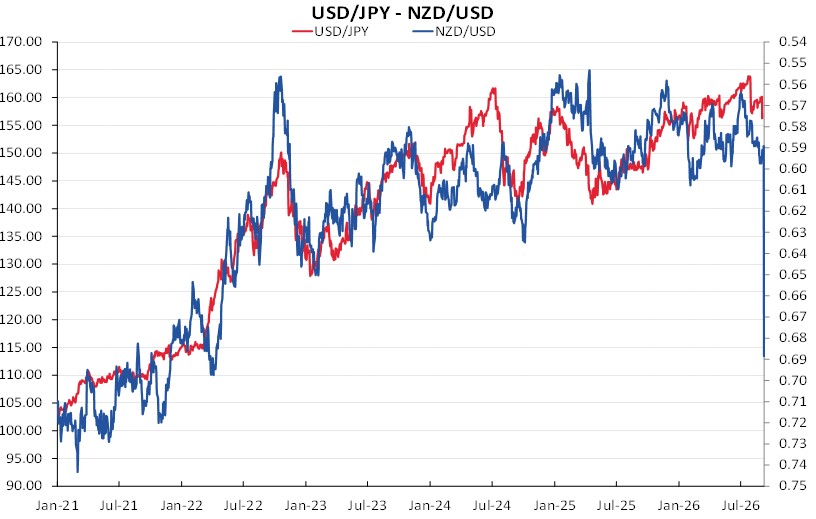
Further Yen gains to the previous trading range between 140.00 and 145.00 against the USD would pull the NZD/USD rate higher to 0.6000/0.6100.
Foreign investors reduce US exposures
It has been difficult to gauge the extent and impact of foreign disinvestment from the US over recent times as the AI/semi-conductor equities market bonanza has pulled investment funds into the US as the investors have a fear of missing out. However, the evidence is mounting that fund managers around the world as looking to decrease their exposure to the US economy by physically exiting their cash or increasing their FX hedges against the US dollar. Whether the capital outflows are from selling the USD to return funds to home base currencies or by entering derivatives to hedge the USD risk, the net outcome is the same, a depreciation in the US dollar.
We have already seen the Chinese significantly reduce their holdings of US Treasury Bonds and switch their foreign reserves into gold and the Euro. The Japanese are now the largest holders of US Treasury Bonds and there is a real risk that they sell-up as well and return funds home to Japan as the interest rate differential to the US closes up. The US Government helping the Japanese with their Yen currency intervention was designed to prevent the Japanese investors from selling their US bonds.
It has now been reported that the manager of Norway’s US$2.3 trillion sovereign wealth fund is overhauling its Government Bond portfolio, which may result in them reducing their holding of US Treasury Bonds by US$80 billion. The Norwegians are unlikely to hedge their USD currency exposures; therefore, they will be selling the USD as they exit the bond market. In a further vote of no confidence in the Trump regime and what it is doing to the US economy, The Dutch central bank is shifting 78 tonnes of its gold reserves from New York to London, citing “increasing geopolitical unrest”. The Europeans are rightly concerned that an unreliable and untrustworthy US Government under President Donald Trump could seize such assets amid growing trans-Atlantic tensions. The French removed all their gold from New York last year. The Bank of England appears a safer place to hold your gold than an increasingly politicised US Federal Reserve.
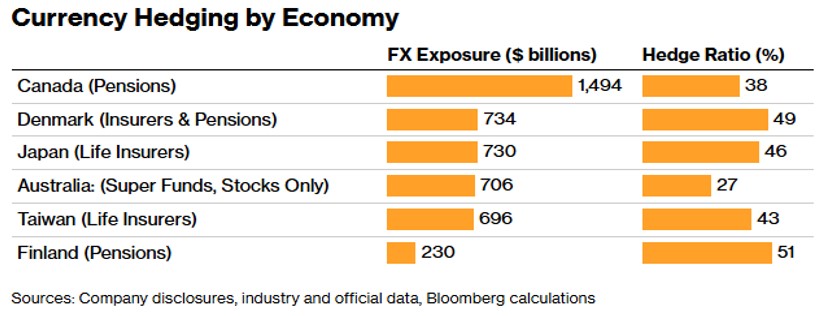
According to Bloomberg reports, large pension fund and sovereign wealth fund investors in Japan, Canada, Taiwan, Australia, Denmark and Finland have only hedged 40% of their currency exposure to the US dollar. The 40% hedged position is the lowest level since 2015. Foreign investor hedging against the US dollar increased last year when Trump introduced his trade tariffs, however it drifted back down again as the US dollar subsequently stabilised. Leaving US investments largely unhedged is now being questioned as the USD debasement trade rears its head again as US economic policies erode the currency’s value. The US Government is trying to push their interest rates down through Scott Bessant’s buying of longer-dated bonds and Trump’s rhetoric. Should the Fed not lift short-term interest rates this month, the risk of US dollar depreciation increases
Changes to the hedge ratios of foreign investors in the US can have a material impact on the US dollar value. A five percent increase in their hedge ratios on US$4.6 trillion of investment assets in the US would translate into US$230 billion of FX transactions. An increase to say 60% hedged by these six foreign investors would seriously hurt the US dollar value (refer to the chart below).
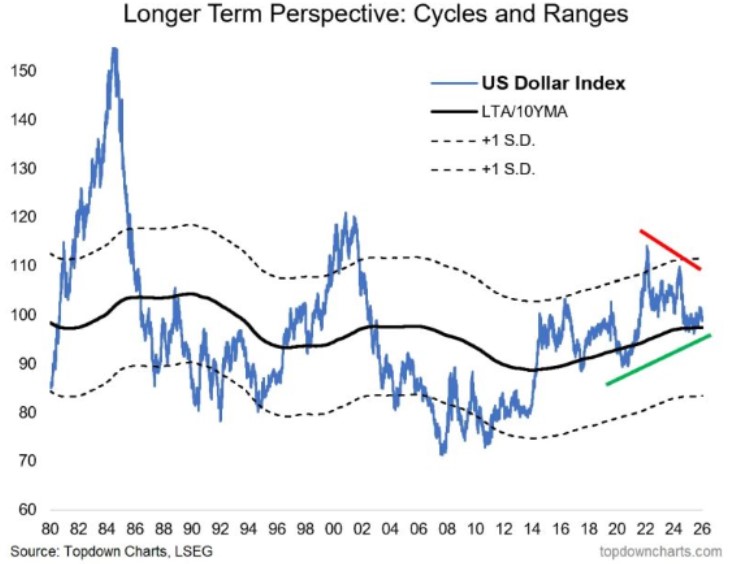
The chart below (from Topdown Charts) shows that the USD value today at 99.00 on the USD Dixy Index is just above its 10-year moving average. A move below that average rate and a breaking of its uptrend (since 2012) support level at 97.00 would certainly encourage the foreign investors mentioned above to lift their FX hedging ratios against further USD depreciation.
RBNZ on the go slow for no reason
The RBNZ’s messaging and signalling from last week’s Monetary Policy Statement was that they are in no hurry to return monetary policy to “neutral” settings, which they say is their intention. As a result of their “go slow” strategy with interest rate increases to remove the 2025 stimulus, the Kiwi dollar was sold down to a low 0.5805 last week, as their statement was more on the dovish side to what the FX markets were expecting. The NZD/USD has bounced back up again to 0.5885 over the two days trading after the RBNZ statement on Wednesday 2nd September. We have seen this typical pattern previously of the Kiwi dollar being sold down one cent on the RBNZ disappointing, however within a week the NZD/USD rate is back to the level prior to the RBNZ statement. Depending on US dollar movements in response to oil price and Middle East military developments, the Kiwi dollar looks set to return to the 0.5900’s this week as the NZD short-sold positions taken on the RBNZ statement are unwound.
The RBNZ’s messaging is becoming somewhat inconsistent as they seem very unsure as to the sustainability of the current export-led economic growth. They continue to expect risks to the increases in our export commodity prices. Their forecasts of lower export commodity prices over the last two years have been horribly inaccurate, therefore we would not have much faith in their risk assessment on this front. The RBNZ’s GDP growth forecasts are also proving to be inconsistent and underestimating the robust activity levels in the economy outside of the cities of Auckland and Wellington. The RBNZ’s latest forecast for GDP growth in the September quarter, which we are now in, is an expansion of +0.50%, however their own GDP Nowcast Indicator model points to a stronger +0.90% expansion. Their May forecast for the September quarter’s GDP growth was +0.20%. The June quarter GDP growth data is released on 17th September, it will be subdued due to the oil price shock on the economy over the months of April, May and June. The RBNZ are forecasting 0.00% for the quarter, but again their GDP Nowcast Indicator is suggesting a stronger +0.20% lift. Once the evidence is available to prove that the RBNZ are underestimating growth in the economy in 2026, the interest rate markets will keep the pressure on by pricing further significant increases in the OCR in late 2026/early 2027 to 3.50% and possibly higher. What is difficult to reconcile with the RBNZ decision to go slow on removing last years’ monetary stimulus, is the fact that four of the six Monetary Policy Committee Members see risks to the upside of actual inflation being higher than their current forecasts. The RBNZ have previously highlighted that the lower NZ dollar value in 2025 (that they caused with interest rate cuts) had added to the higher inflation track in 2026 as imported goods prices increased. With inflation still well above their allowable 1.00% to 3.00% band, they deliver a policy statement that sends the NZ dollar lower again. A few things do not quite add up!
Although the RBNZ make OCR interest rate decisions completely independent of the Government and any political pressure, it is looking like something of a convenient coincidence that they are skipping an October OCR hike immediately before the general election on Saturday 7th November.
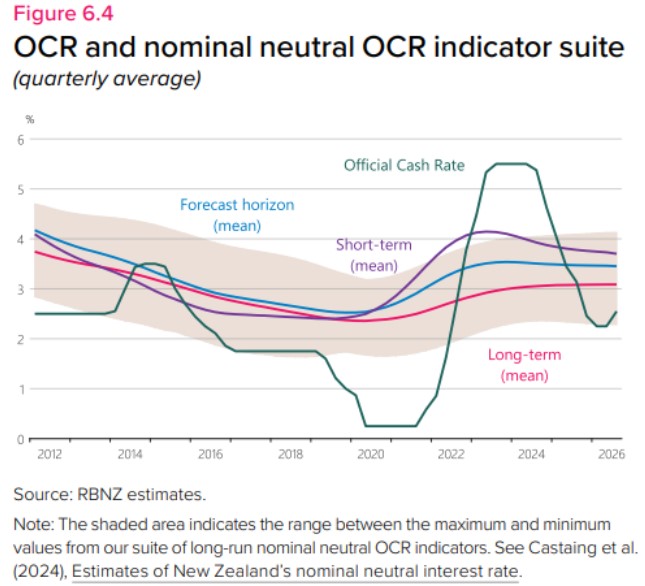
Buried at the back of their Monetary Policy Statement on page 58 was the chart below of the “neutral” OCR interest rate this is neither stimulatory nor restrictive on the economy. The current OCR at 2.75% remains a long way below the neutral forecast horizon mean OCR (blue line) at 3.50% and the neutral short-term mean (purple line) at 3.75%.
Whichever way you examine it, our interest rates still remain too low to return the sticky high inflation to within its target band. The RBNZ have absolutely no responsibility for growth or jobs in the economy as many would have you believe, their sole purpose is inflation control.
Daily exchange rates
Select chart tabs
*Roger J Kerr is Executive Chairman of Barrington Treasury Services NZ Limited. He has written commentaries on the NZ dollar since 1981.
We welcome your comments below. If you are not already registered, please register to comment
Remember we welcome robust, respectful and insightful debate. We don't welcome abusive or defamatory comments and will de-register those repeatedly making such comments. Our current comment policy is here.