

Summary of key points: -
- Conflicts between US Government and the Federal Reserve on interest rates
- Conflicting and changeable views on the direction of Australian interest rates
- No conflict about the direction of New Zealand interest rates
There is no sign yet that Bessant’s intervention to reduce long-term interest rates is working, 10-year Treasury Bonds yields increased from 4.66% to 4.72% following Warsh’s Jackson Hole speech. There is also no immediate fix to the ballooning fiscal deficit in the US that is causing the interest rates to increase, in fact the deficit is deteriorating at a faster clip with Trump’s defence spending and tax cuts. The inflation driver of interest rates is still very much in question as to whether it justifies the current higher market interest rates, or alternatively, the evidence of reducing inflation causes interest rates to decrease from the current elevated levels. As always, it will depend on the evolving economic data over coming months to provide the evidence that inflation is continuing to decrease in the US or is at risk to increases as several Fed Board members still seem to firmly believe.
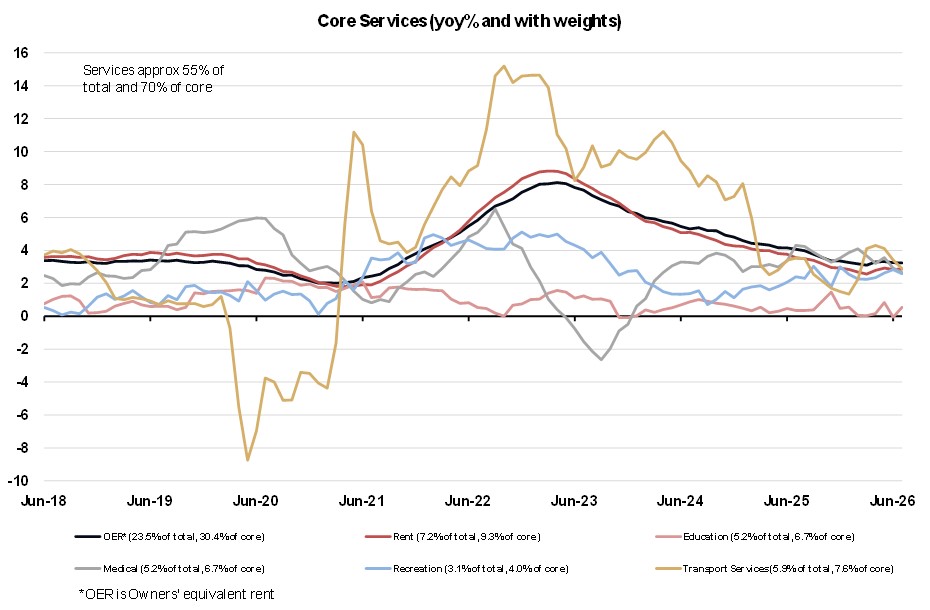
The chart below of core services inflation components (core services is 70% of the overall core CPI) does not show any evidence of rising inflation, indeed the opposite is the case with all trends lower.
The markets will receive the next read on US inflation trends on Friday 11th of September with the core CPI inflation results for the month of August. A +0.10% or +0.20% monthly increase will reduce the annual rate of core inflation to 2.30% or 2.40% from the current 2.50%. Annual increases in rents/owner equivalent rents (“OER” black line in the chart) and transport services (largely airfares) continue to decline. The Fed adjusts monetary policy on the trends of core inflation, not the headline inflation rate which currently stands at a higher 3.40% due to gasoline price increases.
In our view, the evidence is mounting that US core inflation is not in danger of increasing, it continues to decline and given time the US interest rate markets will belatedly recognise this and price interest rates lower. Current market prediction platforms and interest rate futures markets are pricing a 50% probability that the Fed will hike interest rates by 0.25% at their 16th September meeting. However, forward market pricing for Fed hikes in interest rates can change rapidly if the economic evidence is compelling. Lower US short-term and long-term interest rates from current levels seems inevitable to us. Yet another monthly decrease in jobs in the US economy from the Non-Farm Payrolls employment report for August on 4th September would add to that expected shift in direction and sentiment in US interest rates.
Then greater probability is that the USD Dixy Index decreases on lower US interest rates over coming weeks/months, allowing the NZD/USD exchange rate to finally make its break higher above 0.6000.
Conflicting and changeable views on the direction of Australian interest rates
There has been considerable waxing and waning over recent times in market pricing and economist’s views in Australia as to whether the Reserve Bank of Australia (“RBA”) will need to hike interest rates further, or not. Lower than expected jobs and inflation results prompt the market pricing to moderate about future hikes. However, over recent months both jobs’ data and inflation results have come out on the stronger than forecast side, causing interest market pricing to increase again as the RBA’s job to control and bring down high inflation has more to do. Over the three months to the end of July, the RBA’s preferred “trimmed mean” measure of inflation jumped up to an annualised pace of 4.70%. The evidence is coming through that despite a falling housing market; Australia’s inflation trend is accelerating and therefore the RBA needs to act. The next RBA meeting is not until Tuesday 29th September, therefore we may still go through a few more gyrations of forward interest rate pricing before then. It appears that the building of data centres in Australia for the AI revolution is pushing up prices as demand exceeds supply for materials.
In many respects the Australian economy is in a strange Jekyll and Hyde situation with the mortgage belts in New South Wales and Victoria suffering from higher mortgage interest rates and falling house values, whereas the mining states of Western Australia and Queensland sail merrily on with stronger economic activity. The split and mixed signals producing the “on again/off again” indecisiveness about whether the current 4.35% interest rate is tight enough monetary policy to slow the economy and inflation, or whether further policy tightening is needed to get inflation under control. The difficulties in the Australian housing market evidenced by a major residential property developer Bathla, plunging into financial strife.
The Australian dollar has been a top performer against the US dollar for most of this year. The AUD/USD rate trading above 0.7200 last week on the higher-than-expected inflation increase for the month of July. The Aussie dollar has pulled back 0.7165 on the stronger US dollar following Kevin Warsh’s speech last Friday.
We would expect that upcoming Australian economic data being released through September will resolve the conflicting views as to whether the RBA need to increase their interest rates further: -
- 2nd September: GDP growth for the June quarter. A low 0.20% increase is forecast, reducing the annual GDP growth rate from 2.50% to 1.60%.
- 10th September: Consumer inflation expectations, potentially increasing to 5.10%.
- 24th September: Employment Chane data for August. Monthly figures are highly volatile.
- 30th September: CPI inflation rate for August, unfortunately it is released the day after the RBA meeting on the 29th.
Our conclusion is that the RBA will be forced to hike interest rates again at the end of September to ensure once and for all that they reverse inflation downwards. Therefore, expect the Australian dollar to maintain its upward momentum against the USD. The NZD/USD exchange rate should follow the AUD higher, however at this time of year in August and September the Kiwi dollar is belted down periodically against the AUD as some of the local banks transfer their large dividend amounts to the Australian parent bank.
Looking further ahead into 2027, we are likely to see a scenario of rising NZ interest rates, however reducing Australian interest rates as their economy slows from the previous tight monetary policy, resulting in a rising NZD/AUD cross-rate from the current 0.8300 area to 0.8600/0.8700.
No conflict about the direction of New Zealand interest rates
The Reserve Bank of New Zealand (“RBNZ”) will present their full set of updated economic forecasts at this coming Wednesday’s Monetary Policy Statement. There has been considerable change to both local and international economic conditions and expectations since their last full statement on 27th May and OCR review on 8th July. The global geo-political risks from the Iran/US war and oil price movements have reduced in intensity and the New Zealand and other economies have come through the energy crisis over the last six months in much better shape than most were anticipating. Therefore, the RBNZ’s more upbeat assessment of New Zealand economic growth this year will not be qualified with unknown offshore risks as much as it was in May and July. They look set to continue their path of rectifying the monetary policy errors of late 2025 when they slashed our interest rates to unjustified low levels of 2.25%. The increase in the OCR this week from 2.50% to 2.75% will have no impact on the economy or investment/spending decision making as the interest rate markets are already pricing in further increases to 3.50%. The housing market will not be adversely impacted as 80% of mortgage borrowers are already fixed and new mortgage fixing is priced off wholesale swap interest rates which have been above 3.50% for some time.
The question for the RBNZ is by how much they will adjust their inflation forecasts higher for the remainder of 2026 and into 2027 due to GDP growth being stronger, reduced spare capacity in the economy and tradable inflation being higher than previously forecast? The RBNZ’s May forecasts had the annual inflation rate plummeting in 2027 from 4.10% in December 2026 to 2.00% by September 2027. Such a rapid decline in the annual rate is feasible only when the large quarterly increases above 1.00% in 2026 are replaced by quarterly increases below +0.50% in 2027. The probability of inflation being so subdued in 2027 when the economy is expanding at an annual growth rate above 3.00% is difficult to see.
The RBNZ will inevitably be forced to increase their current 2026 GDP growth forecasts of 0.20% for September quarter and 0.50% for the December quarter. In turn, their econometric model will dictate that their inflation forecasts for 2027 will need to be increased, removing the previous sharp decline. The end result of the stronger economy in the second half of 2026 is the RBNZ forecast for the OCR in 2027 being adjusted higher than previous forecasts of remaining at 3.10%. The implications for the Kiwi dollar value are obvious with NZ interest rates being required to move up to higher levels than previously indicated by the RBNZ. The RBNZ are already forecasting stronger growth in 2027, however the upswing is coming earlier with their own GDP Nowcast indicator signalling growth of +1.00% in the September 2026 quarter alone.
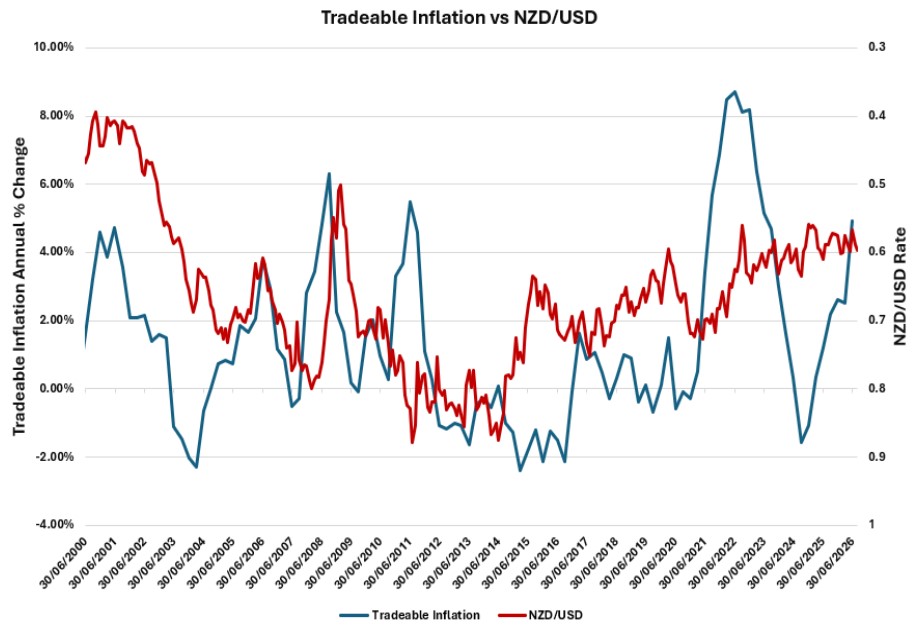
The NZ dollar exchange rate plays an important role in respect to monetary conditions in the economy with the NZD/USD rate trading in its lower quartile between 0.5600 and 0.6000 over recent years adding to inflation, however also assisting the export-led economic recovery. The chart below confirms the direct impact of the NZD/USD exchange rate movements (red line, right hand axis - inverted) on the tradable inflation rate. The current increase in tradeable inflation (blue line) to above 4.00% being caused by higher import costs due to the lower currency value. The RBNZ themselves causing the current increase in tradable inflation when their aggressive interest rate cuts in late 2025 forced the NZD to depreciate on its own, with all the NZD cross-rates ratcheted down. With the domestic/non-tradable inflation component always remaining sticky above 3.00% pa, coupled with rising tradable inflation, the RBNZ still have more work to do with monetary policy to reduce inflation to their 2.00% mid-point target.
The NZD/USD exchange rate has been kept at its lower levels over the last three years due to New Zealand’s interest rates being well below those of the US. That situation is now clearly changing with significant increases in NZ interest rates still to come over coming months, whereas the debate in the US continues as to whether their inflation trends require higher or lower interest rates from their current 3.65% Fed Funds rate setting. Market interest rates in the US have moved higher over recent times due to concerns about their fiscal deficit and debt levels. However, evidence of lower inflation trends in the US must increase the probability of US interest rates reducing from current levels over the rest of 2026 and into 2027. The interest rate differential between New Zealand and the US is set to close up significantly over coming months.
Daily exchange rates
Select chart tabs
*Roger J Kerr is Executive Chairman of Barrington Treasury Services NZ Limited. He has written commentaries on the NZ dollar since 1981.
We welcome your comments below. If you are not already registered, please register to comment
Remember we welcome robust, respectful and insightful debate. We don't welcome abusive or defamatory comments and will de-register those repeatedly making such comments. Our current comment policy is here.