
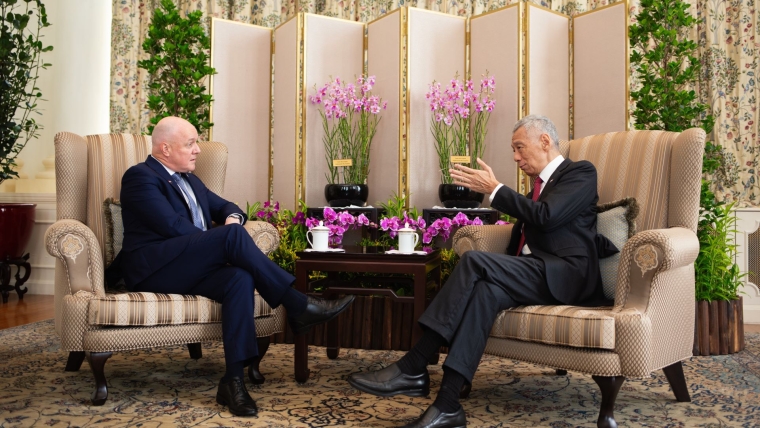
Prime Ministers Christopher Luxon and Lee Hsien Loong announced on Monday they would upgrade a formal partnership between New Zealand and Singapore by the end of 2025.
The Enhanced Partnership is a cooperation agreement signed by Prime Minister Jacinda Ardern in 2019 which covers trade, security, science, people, and climate.
What exactly the upgrade will be remains to be seen. Officials have been told to find some additional areas of cooperation to mark the 60th anniversary of diplomatic relations.
In the meantime, a “sixth pillar” is being added to the partnership covering supply chains, which have become a big focus for businesses and governments after the pandemic.
Negotiators will begin to work on adding electronic certification for primary products and a way to facilitate trade in “essential items” during crises to the existing trade deal.
It's okay if that sounds boring. The point isn’t so much about the details and more about the message being sent: New Zealand and Singapore are pro-trade.
That message was not a countercultural one a few years ago, but there has been a sudden turn inwards as some big countries seek to become more self-sufficient.
While it is a global trend, it matters most in the United States and China. These two superpowers are seeking to localise strategic industries and insulate domestic ones.
Whether it is a good strategy for those countries is an open question, however it is not an option for New Zealand or Singapore which are dependent on international trade.
“Other countries can deglobalize — we can not,” Lee Hsien Loong said, in a press conference.
If New Zealand had to eat all of the food it produced, he said, pausing for laughter, it wouldn’t be able to make a living. Small nations have no choice but to trade.
When asked whether Singapore and New Zealand should be diversifying trade relationships and becoming less reliant on China, Lee appeared unconvinced.
“We would like to do business wherever the business is — and China is a very big market. To say that you don’t want to do business in China, well, you have to have a very stout heart”.
But it was also important for the region to remain connected to the United States, Europe, and India—as well as New Zealand and Australia—so that trade can operate “omnidirectionally”.
“If there are ups and downs in one place you can’t help being affected by them, but you will hopefully not be swamped by them,” he said.
National interest = international order
The world was “troubled” and, while small countries couldn’t solve these troubles, they should take a stand in favour of international cooperation.
“Our vital national interest is an international order which is orderly … and enables countries big and small to live together — where there is a basis to decide things objectively and not just based on the law of the jungle,” he said.
The Prime Minister of Singapore gave lengthy and thoughtful answers to the four questions the media were permitted to ask following his bilateral meeting with Luxon.
Staff later reflected he may have been savouring his last moments in the job, as just hours after the press conference he formally announced his long-planned resignation.
When Luxon spoke it was mostly to agree with Lee’s comments. However, his government has been shifting New Zealand’s foreign policy towards Australia and the United States.
This is mostly a defence posture, related to the AUKUS nuclear submarine pact, but could easily have trade implications if relations between China and the US worsen.
In a worst case scenario, a war over Taiwan could split the world into two trading blocs and entirely upend global supply chains. The best case is that the status quo continues.
Luxon’s visit to the Philippines will put the security agreement in the spotlight, as it is another likely candidate for ‘Pillar II’ of the AUKUS pact — along with Japan and Korea.
China sees all of this as an effort to put the rising power under siege and protect US hegemony in the Pacific and beyond. Which, understandably, it doesn’t like.
As New Zealand seeks to improve its trade relationships in South East Asia, it will do so in the shadow of two economic and military superpowers who are struggling to co-exist.
We welcome your comments below. If you are not already registered, please register to comment
Remember we welcome robust, respectful and insightful debate. We don't welcome abusive or defamatory comments and will de-register those repeatedly making such comments. Our current comment policy is here.