

The likelihood of annual inflation moving below 3% in the September quarter appears to have been given a boost by the latest release of Statistics NZ's Selected Price Indexes (SPI).
The monthly SPI features goods that make up about 45% of the quarterly Consumers Price Index, the official measure of inflation.
And the August SPI figures are suggesting that we are on track to see annual inflation fall back into the targeted 1% to 3% range for the first time in about three-and-a-half years when the September quarter CPI results are released on October 16.
The Reserve Bank (RBNZ) has already started reducing the Official Cash Rate (OCR), by dropping it in August from 5.5% to 5.25% in the belief that it is now getting inflation under control.
And the latest SPI seems to offer further encouragement.
Indeed ASB senior economist Mark Smith said the "moderating annual inflation impulse" visible in the latest figures "increases our confidence that annual CPI inflation will fall below 2.5% in [the September quarter] of this year".
The ASB economists have maintained their September quarter CPI pick for annual inflation of 2.3% - which is what the RBNZ itself is actually picking too.
Smith said "if anything", lower oil prices, highlight some "downside risk" to the CPI figures.
"We also remain confident that conditions are in place that will deliver sub 3% inflation outcomes on a sustained basis even with OCR reductions.
"At 5.25% the OCR is still highly restrictive and needs to come down. We have pencilled in a further 200 bps [basis points] of OCR cuts by the end of next year (including 50bps of cuts by the end of this year) but note that actual OCR moves will be heavily conditional on the inflation, labour market and wider economic outlook," Smith said.
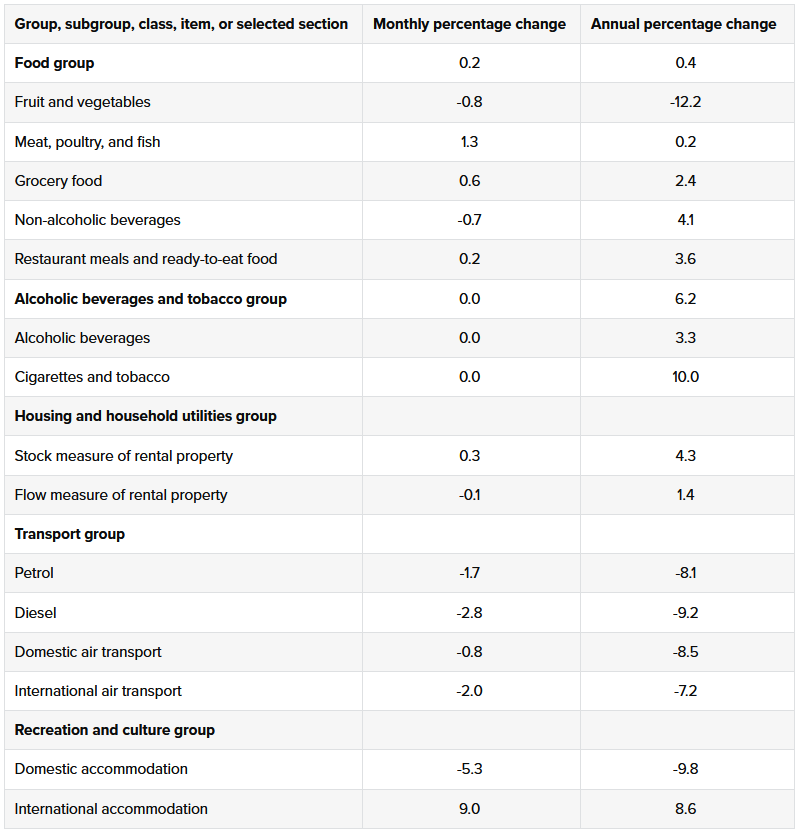
In the August month food prices rose 0.2%, following a 0.4% rise in July. The latest figures took the annual increase in food prices to just 0.4% for the 12 months ending August, compared with a rise of 0.6% in the 12 months to July.
This is all a far cry from as recently as June 2023 when we were seeing annual food price increases of 12.5%.
'Sticky' rents
One 'sticky' area of inflation that continues to be sticky but doesn't at least now appear to be getting any worse is rents.
In August the 'stock' measure of existing rentals rose 0.3%, which is up on the 0.2% seen in July, but the annual rate of increase remained at 4.3%. However, that's a rate of increase that remains well above the 1%-3% target for general inflation and would therefore be something the RBNZ is watching.
Fuel and air travel prices can be very volatile, but in the latest month they were 'good' volatile as far as consumers would be concerned.
Stats NZ said prices for petrol, diesel, and airfares were all cheaper in August 2024 than they were in July 2024.
In August 2024, petrol prices fell 1.7% while diesel prices fell 2.8%.
The 1.7% decrease in petrol prices follows a 0.5% decrease in July 2024.
"Petrol prices fell in all centres we collect prices for in New Zealand, except for Whangārei, which recorded a slight increase in August,” Stats NZ's consumer prices manager James Mitchell said.
"The decrease in August was much more widespread than in July, when only Auckland recorded a decrease, due to the ending of the Auckland regional fuel tax."
In August 2024, domestic air transport prices fell 0.8% while international air transport prices fell 2.0%.
The choc block's expensive
In terms of the annual food price rise of 0.4%, Stats NZ said higher prices for restaurant meals and ready-to-eat food (up 3.6%) and grocery food (up 2.4%) were the largest upward contributors.
Mitchell said the price increase in restaurant meals and ready-to-eat food was due to higher prices for lunch/brunch, hamburgers, and takeaway coffees.
The price increase in grocery food was due to higher prices for olive oil, chocolate blocks, and butter.
"The average price of a 250g block of chocolate has increased 20% since this time last year," Mitchell said.
Against these rises, the fruit and vegetables group fell 12.2% in the 12 months to August 2024. Fruit and vegetable prices were driven by lower prices for kūmara, potatoes, and lettuce.
Kūmara and potato prices were coming down from near-record-high levels in 2023. In the 12 months to August 2024, the price of kūmara fell 53.9%, while the price of potatoes fell 26.6%.
"The average price of 1kg of potatoes in August 2024 was $2.18. This is the cheapest recorded since 2021," Mitchell said.
Here is the detailed SPI information as supplied by Stats NZ:
We welcome your comments below. If you are not already registered, please register to comment
Remember we welcome robust, respectful and insightful debate. We don't welcome abusive or defamatory comments and will de-register those repeatedly making such comments. Our current comment policy is here.