
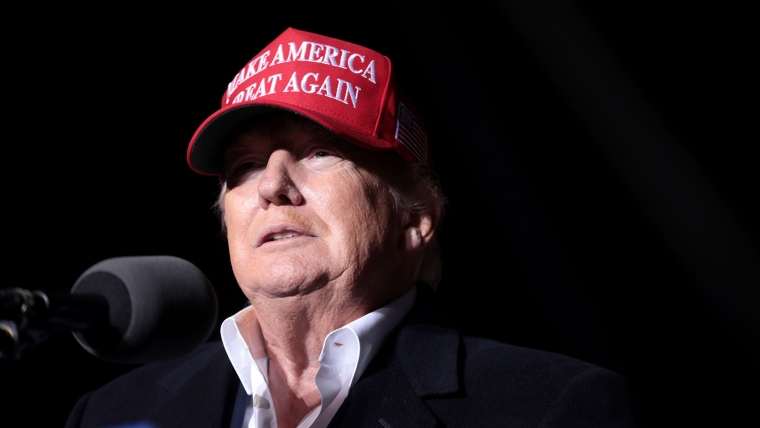
It was easy in 2016 to think of Donald Trump as an aberration, a temporary blip in the arc of history which would inevitably bend toward democracy, peace, and open economies.
His reelection confirms that was not the case. History has not yet ended and the orbit of global politics has brought us back to the 1970s, or even the 1930s.
In both these periods, economic and geopolitical insecurities fed off one another and fueled protectionism, nationalism, and militarism with pitiful outcomes — and it’s happening again.
Trump now looks more like an early adopter, than an aberration. He didn’t just fall out of a coconut tree, he exists in the context of all that came before him.
China started to ramp up its industrial policies in 2013, Russia annexed Crimea a year later, ISIS caused a migration crisis and European backlash in 2015, then the United Kingdom voted for Brexit in 2016.
Heck, there were even street protests in New Zealand over the signing of the Trans-Pacific Partnership that same year. Trump met the moment and withdrew from the deal once elected.
The Republican Party, which was once horrified at Trump’s hostile takeover bid, has transformed completely into the MAGA Party and will not revert back to neoliberalism any time soon.
More people supported his third run at the presidency than ever before, with increased backing across almost all regions and demographic groups—women being the notable exception.
This surge happened despite more scandals than anyone could count. Voters don’t seem to care who Trump is; they only care that he isn’t the status quo.
When he leaves office in 2029 he will have become the establishment, or it will have become him. His successor will be JD Vance or another MAGA politician, and Democrats will run a candidate who can match their energy somehow.
One of the surprising moments of the election campaign was when Joe Biden traded his presidential cap for a Trump hat, and actually put it on. You can see why he won the swing states, albeit as a younger man.
So, what should New Zealand do when all of America, and much of the world, puts on its MAGA hat? Protectionism, nationalism, and militarism are not options for a small export economy on an isolated island.
Ready for it!
Foreign Minister Winston Peters said the Government’s response had already begun months ago and its diplomats in the United States were expecting Trump to win.
He had already asked veteran diplomat Rosemary Banks to reprise her former role as ambassador to the United States— a position she held when Trump was last in office.
“We've got Rosemary Banks, who I [appointed] back in 2017, because of her links to the Republican Party, and I got her back, this time early, for this change,” he said on Thursday.
It is also possible that Christopher Luxon might be able to use his ‘business-bro’ credentials to befriend Trump and his biggest fan, Elon Musk, who recently said he liked Luxon’s energy.
Peters said it was still two and half months before Trump was sworn in as president and his team of diplomats would use that time to “better understand” his policy agenda.
“We'll also be working on how we can best engage with the new administration on policy cooperation for the mutual benefit of both of our countries and our peoples,” he said.
The top priority will be to secure an exemption from the 10% to 20% tariff Trump plans to slap on all imports. Americans buy $16 billion of goods and services from New Zealand, including 40% of all its wine exports.
John Ballingall, a trade economist at Sense Partners, said it would be difficult for primary industry producers to find alternative buyers for many of their products.
The European Union, which makes plenty of its own wine, has restrictive trade rules on meat and dairy and Chinese demand for NZ products has been slowing with its economy.
“It is going to be a really challenging period for exporters. It is not free or cheap to change markets [even if] the demand is there,” Ballingall told RNZ.
Damien O’Connor, the Labour Party’s trade spokesperson and former minister, said the knock-on effects of the tariffs could be as bad for New Zealand as the tariffs themselves.
“The displacement of goods that might have gone into the US, going into other markets like China or Europe [instead] will affect our exporters regardless of whether they sell into the US or elsewhere,” he told reporters.
Oddly, there are rumors around that Trump might be open to a free trade deal. Peters said they had been “right on the cusp” during his last term and may now have another chance.
It feels unlikely that the MAGA Party would suddenly sign a new trade agreement. But perhaps it might be used to keep Kiwis out of the crossfire when taking economic shots at its rivals.
Another tailwind may be New Zealand’s recent attempt to align itself more closely with the United States and shuffle awkwardly away from its biggest trading partner, China.
Many former politicians and trade officials in New Zealand are already aghast at how government is risking China trade by backing aggressive US security policies.
How could that continue if Trump shuts our exports out, while Xi Jinping holds the door wide open? If both superpowers turn out to be autocratic and protectionist, who cares which we side with?
America isn’t there yet but New Zealanders should seek some assurances before literally betting the farm that it won’t go that way.


We welcome your comments below. If you are not already registered, please register to comment
Remember we welcome robust, respectful and insightful debate. We don't welcome abusive or defamatory comments and will de-register those repeatedly making such comments. Our current comment policy is here.