

That was 2024. There’s been good news. There’s been bad news.
Good news – inflation’s back in its 1% to 3% target box.
Bad news - the Reserve Bank (RBNZ) handcuffed the economy to get it there.
Whether 2024 therefore qualifies as a ‘good year’& very much depends on individual circumstances.
In a preview written late last year, I styled 2024 as The Year of Finding Out.
The theory was we would learn whether inflation was under control. We would quantify collateral damage to the economy and the unemployment rate. And we have.
So, if finding out is ‘good’, this has been a ‘good’ year. But others might have different words.
Where did we come from, and where have we ended up in 2024?
When I was writing my 2024 preview, annual inflation (as at September quarter 2023) was 5.6% - not so far from the 7.3% peak in mid-2022.
By the end of 2023 annual inflation was 4.7%. Much needed to happen for a return to the 1% to 3% targeted range this year.
Well, we made it. Down to 2.2% as of September 2024 and, only just above the 2.0% level the RBNZ explicitly targets.
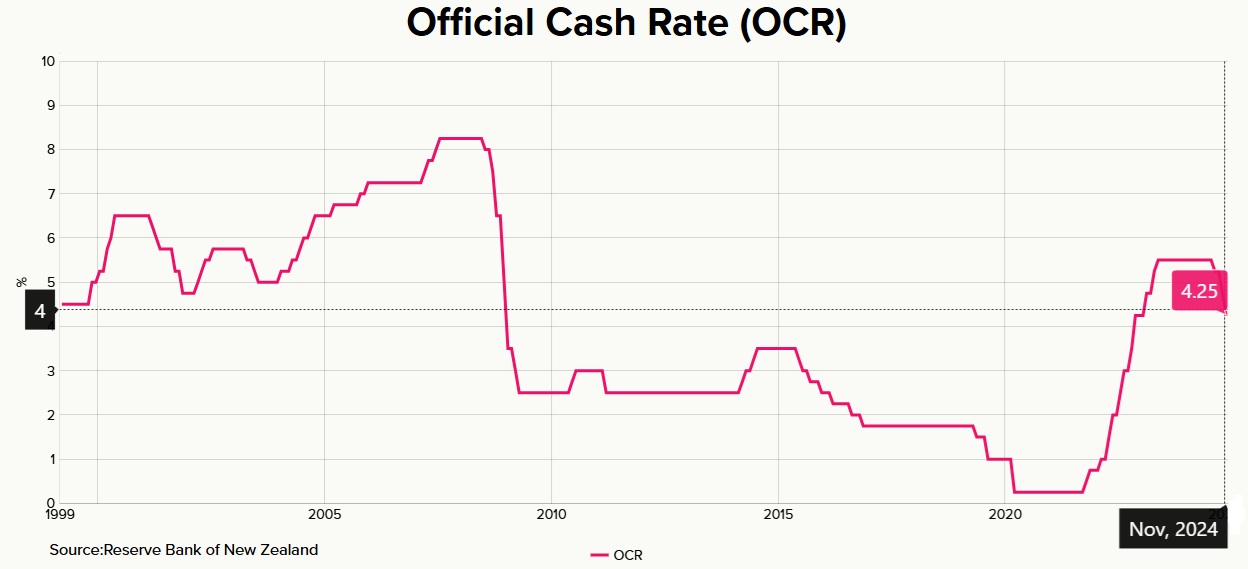
In August the RBNZ started cutting the Official Cash Rate (OCR), ending the most rapid-ever monetary policy tightening cycle, which saw the OCR& hiked from 0.25% in October 2021 to 5.50%.
The OCR will end 2024 at 4.25%. It means lower interest rate bills ahead for the roughly one-third of Kiwis (RBNZ estimate) with mortgages.
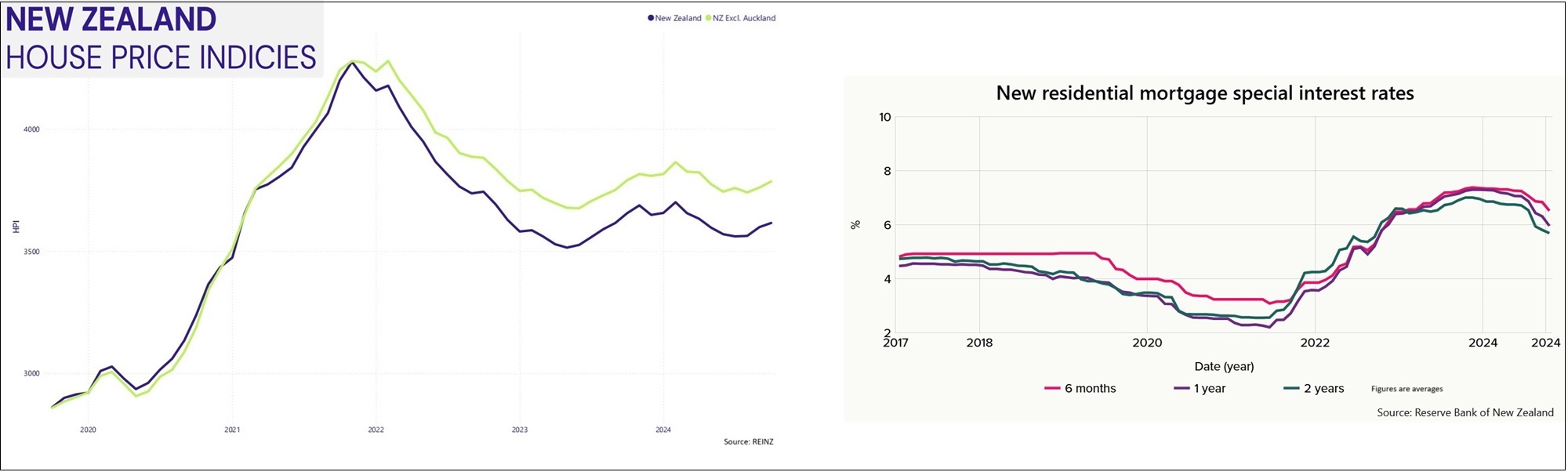
Popular one-year fixed rate mortgages (special rate) are for example already about 150 basis points lower than at the start of the year.
With most customers on fixed rates, it takes time for reductions to work through.
In its OCR announcement on November 27 the RBNZ said the average rate on outstanding mortgages had peaked at 6.4% and is expected to decline to 5.8% in the next 12 months.
So, the impact of falling interest rates is going to be a 2025 story.
There’s two sides to the interest rate coin, however. On the flip side, deposit rates are also coming down, with the six-month rate, for example about 75 bps lower since the start of the year.
Cheers and jeers
So, those who pay interest are cheering. Those who receive interest, not so much. And we should not under estimate what the impact could be of lower returns of deposit rates in the coming year.
But back on mortgages - I’ve been surprised by how well so many people have seemed to cope with what were very substantial rises in monthly interest costs. RBNZ figures show around $2 billion worth of mortgages are non-performing, which is 0.6% of the outstanding mortgage stock and around half the distressed mortgage levels seen after the Global Financial Crisis.
It is a truism though that mortgage payments will come first and other spending will be sacrificed. And that in a nutshell is the intention of OCR hikes.
So, spending dried up – and very noticeably so in the middle of the year. Hence, we see struggling businesses, closing businesses and an economy that went cold.
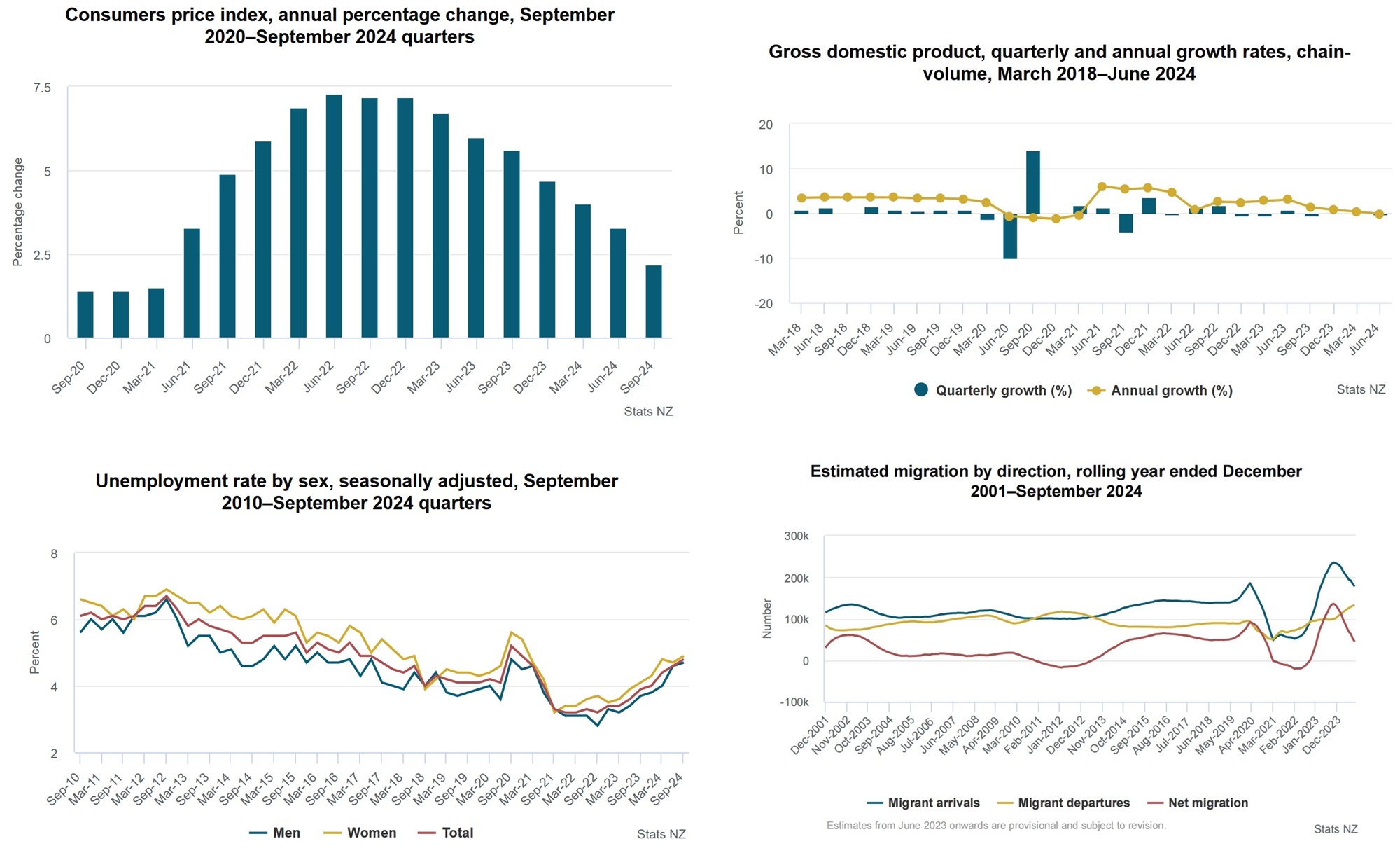
We don’t get very timely official GDP figures. We won’t even see the September quarter results till December 19. The figures up to June this year were grim, however. In the March quarter our economy eked out 0.2% of growth, but then in June we saw a 0.2% contraction. It meant that four out of the last seven quarters had produced negative figures (and there was a 0.0% and a +0.1% in those too). It is widely expected the September quarter GDP will also be negative. The RBNZ picks -0.2%, but expects 0.3% growth for the December quarter.
The per capita GDP figures as reported have been even more grim. Our economy has languished even as we added large numbers of migrants to our population. More hands have produced less. Up to June 2024 per capita GDP had fallen for seven consecutive quarters. The combined 4.6% drop in per capita GDP over that time has been worse than the collective 4.2% fall in the aftermath of the Global Financial Crisis.
(An important caveat: Stats NZ has undertaken big revisions. These will see higher GDP figures retrospectively for 2023 and 2024. The final details of this won’t be seen till the September quarter GDP figures are released, but the expectation is the revisions will make the historic GDP figures ‘less bad’ rather than particularly good.)
Employing good fortune
We are fortunate we went into the economic downturn with very low unemployment, which bottomed out at 3.2% in the September 2022 quarter. By the end of 2023 it had risen to 4.0%. And by September 2024 it stood at 4.8%, with more rises seemingly to come in the immediate future. On a seasonally-adjusted basis the unemployment level stood at 148,000 as of September - an increase of 25,000 since the start of the year.
I mentioned migration. According to Statistics NZ’s rolling 12-month figures our net gain of migrants peaked at 136,269 (235,525 in and 99,256 out) in October last year.
By September of this year (latest figures available), the 12-month running net migration figure was down to 44,907 (177,937 in and 133,030 out).
Despite rising unemployment and the flagging economy, monthly arrivals are still exceeding pre-pandemic figures. And so are the departures. Stats NZ says the long-term average for September years (2002 to 2019) before Covid was 120,200 arrivals, 91,800 departures, and a net migration gain of 28,400.
The house market looked as though it may be starting to warm up again around election time last year, but that fizzled early this year. The Real Estate Institute of New Zealand’s House Price Index for New Zealand (which takes into account changes in the composition of sales) did rise 0.5% in October, but was down 1.1% for the year. Auckland was down 3% in the year, while NZ excluding Auckland was down 0.1%.
So, that has been 2024.
It makes pretty grim reading, doesn’t it?
We can take satisfaction that inflation is back to manageable levels. That’s the big plus from the year.
But, whew, there have been a few minuses.
For me this downturn has felt very uneven in its impact – and that’s probably due to the fact that unlike a ‘normal’ recession, this one has been specifically engineered by the RBNZ and those OCR hikes.
As we get to the end of the year, we are seeing a rising tide of optimism among businesses about the prospects ahead. It does seem to me though that this is at least partly fuelled by a ‘it can’t get worse’ state of thinking, coupled with the fact that interest rate falls have come much earlier than we were led to expect. The RBNZ was suggesting rates wouldn’t come down till NEXT year - pretty much right up until it did start to cut them.
Anyway, we got through the year. And inflation’s back in its box.
What next?
I’m not big on predictions. I will, however, attempt to highlight what I see as the big issues and themes to look out for in 2025. That will be in another article coming out in a few days. Watch for that.
People will certainly be hoping for a ‘better’ year next year. But there are a lot of obstacles in front of us.
*This article was first published in our email for paying subscribers first thing Thursday morning. See here for more details and how to subscribe.
We welcome your comments below. If you are not already registered, please register to comment
Remember we welcome robust, respectful and insightful debate. We don't welcome abusive or defamatory comments and will de-register those repeatedly making such comments. Our current comment policy is here.