

The number of filled jobs in New Zealand rose by nearly 6,000 in November, on a seasonally adjusted basis - breaking a sequence of seven consecutive monthly falls, according to the latest figures from Stats NZ.
According to Stats NZ's Monthly Employment Indicators (MEI) there are still nearly 30,000 fewer jobs now in NZ than there were a year ago. (Note that the month-on-month comparisons are seasonally adjusted figures while the annual comparisons are actual figures).
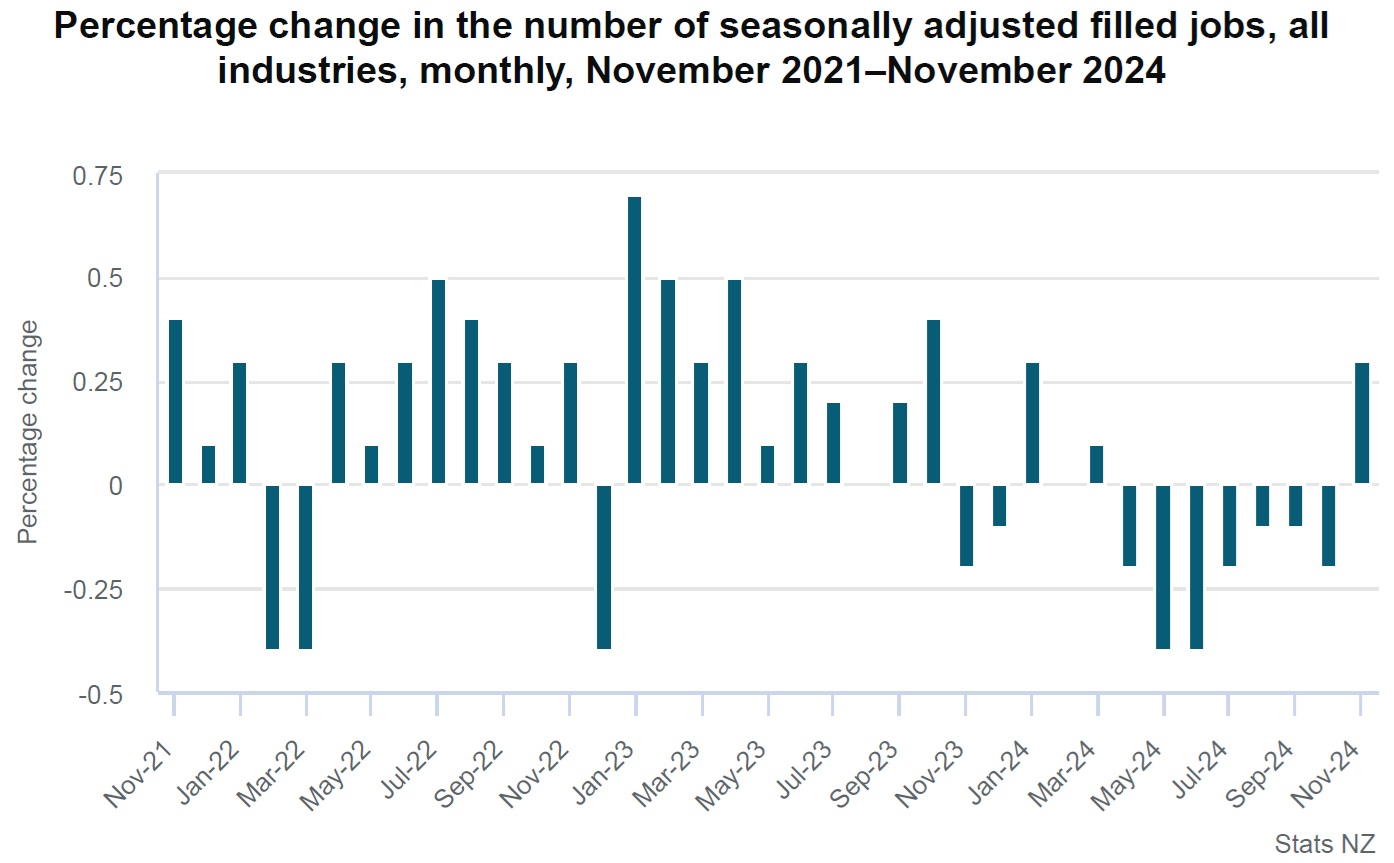
In terms of the seasonally adjusted filled jobs figures for the November 2024 month (compared with the October 2024 month), the details were:
- all industries – up 0.3% (5,980 jobs) to 2.36 million filled jobs
- primary industries – down 0.4% (436 jobs)
- goods-producing industries – down 0.2% (836 jobs)
- service industries – up 0.3% (6,230 jobs).
It's worth pointing out that this data series is normally the subject of considerable revisions subsequently - and very often the figures are subsequently revised down. However, a rise of the magnitude of 0.3%, seems unlikely to be overturned, so, it appears likely the breaking of the seven-month cycle of monthly drops seems likely to stay even after revisions.
The MEI figures come from Inland Revenue data and are therefore sourced quite differently to the quarterly unemployment figures that come from Stats NZ's Household Labour Force Survey.
According to the latest HLFS figures for the September quarter, released in early November, NZ's official unemployment rate had risen as of then to 4.8% from 4.6% as of the June quarter.
The Reserve Bank (RBNZ) is forecasting that the unemployment figures will continue to rise, peaking at 5.2% in the March quarter 2025.
But while the MEI figures are differently sourced to the HLFS figures - they often are a good indicator of the future unemployment figures.
The next HLFS unemployment figures for the December quarter are due to be released on February 5 and will be watched with keen interest.
Westpac senior economist Michael Gordon said the latest MEI figures were firmer than the "flat result" that the Westpac economists had expected "though there remains a tendency for these figures to be revised down in the months after their initial release".
The Westpac economists are still forecasting the HLFS figures to show a 0.3% decline in employment in the December quarter "that in turn would likely see the unemployment rate rise to 5% or more".
Gordon said the most notable gains in the MEI figures were seen in areas that can be broadly linked to the international tourism sector: transport, hospitality and recreational services.
"This may have reflected a gearing-up in anticipation of a better summer season than we saw in the previous year."
Stats says that in terms of the actual November MEI figures total filled jobs in the country were 2.38 million, which was down 29,895 (1.2%) on the figures for November 2023.
By industry, the largest changes in the number of filled jobs (actual figures) compared with November 2023 were in:
- construction – down 5.8% (12,137 jobs)
- health care and social assistance – up 2.9% (8,048 jobs)
- administrative and support services – down 6.6% (6,869 jobs)
- manufacturing – down 2.4% (5,823 jobs)
- retail trade – down 2.4% (5,445 jobs).
By region, the largest changes in the number of filled jobs compared with November 2023 were in:
- Auckland – down 1.6% (13,423 jobs)
- Wellington – down 1.9% (4,921 jobs)
- Waikato – down 0.7% (1,627 jobs)
- Bay of Plenty – down 0.9% (1,334 jobs)
- Hawke’s Bay – down 1.5% (1,268 jobs).
As has been the case, the younger age groups have continued to bear the brunt of the job reductions.
Stats NZ says by age group, the largest changes in the number of filled jobs compared with November 2023 were in:
- 15–19 years – down 11.2% (16,418 jobs)
- 25–29 years – down 4.8% (12,865 jobs)
- 20–24 years – down 3.5% (8,173 jobs)
- 35–39 years – up 2.9% (7,978 jobs)
- 30–34 years – down 2.1% (6,271 jobs).
We welcome your comments below. If you are not already registered, please register to comment
Remember we welcome robust, respectful and insightful debate. We don't welcome abusive or defamatory comments and will de-register those repeatedly making such comments. Our current comment policy is here.