
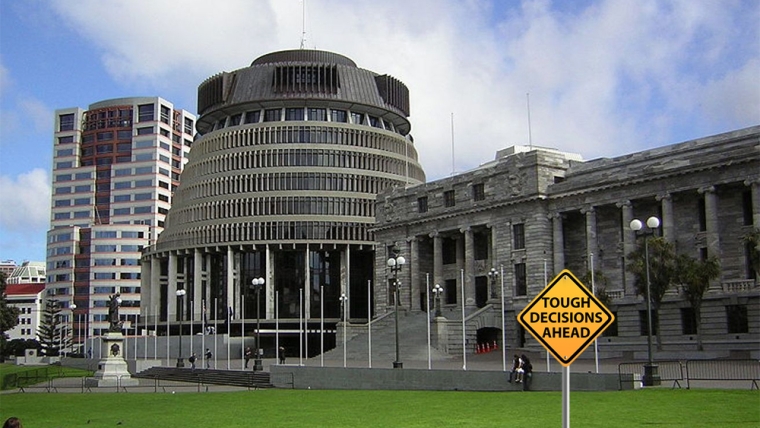
Stagflation is a situation where the economy is stagnant, inflation is out of bounds, and unemployment is high. That sums up the reality of New Zealand.
This reality runs well ahead of the statistics. For example, as I write this on 18 April, the latest quarterly data for GDP (gross domestic product) relates to quarter four (Q4) of 2025. It will be 18 June before we receive data for Q1 of 2026.
I do not criticise this apparent tardiness. It is simply the way things are. Even then, the Q1 numbers will be provisional.
The effect of the Iran-war
The Iran war will only have a modest effect on official GDP for Q1 2026. This is because of the way GDP is measured. Official GDP for Q1 measures the level of activity in the economy over the whole period of January, February and March, and only one month of those three was a ‘war month’.
This means that what we are experiencing right now, in the second half of April, will not be evident in quarterly GDP data until the second half of September when Q2 data becomes available. Note that GDP is always expressed after adjustment for inflation.
The simplest way to know what is happening to the economy right now is to ask people who work at the coal face. That includes tradespeople and those in service industries
Where I live in Christchurch, the house construction industry, unlike most other parts of New Zealand, remains buoyant. But tradespeople tell me that householders are not moving ahead with repairs and renovations. There is no doubt that restaurants and cafes are doing it tough. The real estate market has also gone quiet.
All of this tells us that one does not need to be an economist to know that, right now, the economy is going backwards!
Unemployment
The latest quarterly data for unemployment is for Q4 of 2025. Unemployment at that time was 5.4%. This is the highest figure for unemployment since September 2015.
The lowest unemployment level in recent years was 3.2% in December 2021.
Part of the unemployment problem is a mismatch between the skillsets of unemployed people compared to the skillsets demanded by the market. But some of the unemployment is not so easily explained.
For example, many nursing graduates in 2025 could not get employment in New Zealand, and of those who did get nursing jobs, many were only for part time positions, typically 0.6. I can only shake my head in wonder at the steady flow of nurses across the waters to Australia.
Another metric of slackness in the employment market is the national statistics for underutilisation. This metric takes into account the effect of people who have only part-time work, but would like additional hours.
The current underutilisation rate is 13%, marginally below the 13.1% reached in December 2020 during the global Covid epidemic. Prior to that, in December 2019, the underutilisation rate was only 10.1%.
Accordingly, the big message in relation to unemployment is that we do indeed have slack resources. The challenge to using these resources is how to do so without creating inflation.
Inflation
The latest official rate for the CPI (consumer price index) inflation is 3.1% for calendar 2025. The updated rate through to and including Q1 of 2026 will be available on 21 April, which is before some of my readers will have read this article.
This quarterly inflation for Q1 of 2026 may even create a reduction in annual inflation compared to the much quoted 3.1% for calendar 2025. But if so, it will be a short-term mirage.
There is general agreement that inflation is currently increasing in New Zealand. We all see it every time we stock up on groceries and fuel. The big question is how high will it go and for how long.
What we can be sure of is that most of the Iran-war inflation effects will not be picked up in the official inflation statistics until the Q2 data is released in July. Even then, the data will largely be confined to first-order effects.
Let there be no doubt: in regard to inflation we are in trouble. If inflation leads to compensating wage and salary increases then we will look back to the current inflation rate with fondness and longing.
Fighting stagflation
All of the above should be enough to convince readers that we already have stagflation baked in, with stagnant growth, high unemployment and exponentiating inflation.
How do we find a solution that takes us back to per capita growth, low unemployment and stable prices?
The answer is that there is no simple path.
The only tools that are available are monetary and fiscal (tax) policy.
Monetary tools lie in the realm of the Reserve Bank. Fiscal policy lies in the hands of Government through the Minister of Finance.
The only tool currently in the tool-bag for inflation is to raise the OCR (official cash rate). Essentially, this is the rate that the Reserve Bank charges commercial banks for loans, and also what it pays commercial banks for their deposits. From there, this rate works its way through the economy with commercial bank cash margins of another 2% or more added in.
This OCR is currently at 2.5% which is very low compared to historical rates over the last 26 years.
In other words, the OCR is currently set at a level which is typically regarded as stimulatory, both for inflation and economic growth. However, in our current case, we have the inflation but not the growth.
If the Reserve Bank wants to control inflation and hold it at less than 3% then there is no alternative but to raise the OCR.
This will increase interest rates across the economy and have a negative effect on GDP in the short to medium term. It will almost certainly reduce inflation, but this will come with considerable pain to the general population.
However, allowing inflation to exponentiate further will be highly destructive for the longer-term situation. We must not go there.
This is where the Government must step in with fiscal policy. The pain from controlling inflation must be balanced by reducing tax rates for those on modest incomes. Monetary and fiscal policy must work together.
Specific Monetary Policy
If I were the Governor of the Reserve Bank, I would raise the OCR forthwith to 3%, and state that the Reserve Bank hopes to maintain this rate without further increases being necessary at least for 2026.
This would be consistent with the Reserve Bank Governor’s statement on taking up her current role some five months ago, that she was going to be “laser focused” on inflation. The Governor has already stated that she expects inflation to reach 4.2% inflation in the June quarter. This not the time for pussy-footing around!
Specific fiscal policy
Now is the time to raise the band limits for income tax.
- I would raise the upper income limit for the 10.5% rate from $15,600 to $25,600.
- I would raise the upper limit for the 17.5% tax rate from $53,600 to $63,600
- I would also raise the income tax levied on incomes in excess of $250,000 from the current 39% to 45%
I would make these adjustments to come into effect as from 1 July 2026.
This would provide an extra $700 per annum in tax paid earnings for those on limited part time work and an extra $1500 of tax-paid earnings for almost all other taxpayers.
Of course nothing comes free of downsides. I estimate that this modification of tax rates would increase the Government’s operating deficit by approximately $4 billon and this would have to be covered by additional Government bonds.
In general, I am very negatively disposed to even the current level of Government deficit. But these are special times and special action is required.
I would also make the comment that these are not the time for ‘catch-up’ wage increases based on inflation. Any wage increases must be underpinned by increased productivity and increased skills.
Nor are they the time for ‘catch-up’ increases in prices by those in retail businesses.
And to those who don’t like what I have written here, what is your suggestion?
*Keith Woodford was Professor of Farm Management and Agribusiness at Lincoln University for 15 years through to 2015. He is now Principal Consultant at AgriFood Systems Ltd. You can contact him directly here.
We welcome your comments below. If you are not already registered, please register to comment
Remember we welcome robust, respectful and insightful debate. We don't welcome abusive or defamatory comments and will de-register those repeatedly making such comments. Our current comment policy is here.