

NZIER originally published this report as part of its self-funded Public Good Programme.
The New Zealand-India FTA is less about immediate trade gains and more about securing a strategic position in a fragmenting global economy.
The newly signed India-New Zealand Free Trade Agreement (FTA) represents one of the most unexpected developments in New Zealand trade policy in recent years.
For decades, India was widely regarded as one of the most difficult trading partners in the world. Initial FTA negotiations between the European Union and India were a good example of this. The talks went 15 rounds before being abandoned in 2013. Yet in a stunning turnaround, an agreement was signed between the European Union and India in 2026, following the resumption of negotiations in 2022 (European Commission 2022, 2026).
Historically, New Zealand’s negotiations with India (such as the Regional Comprehensive Economic Partnership (RCEP)) have repeatedly stalled, particularly on agriculture, market access, and the movement of people. India’s economic strategy remained heavily influenced by a history of protectionism, strategic caution, and domestic political sensitivities around trade liberalisation.
Against this backdrop, the signing of an agreement is significant in itself. But the agreement also raises an important question: what exactly has New Zealand achieved?
If the agreement is assessed purely through the lens of immediate market access gains, the answer appears mixed
There are clear commercial opportunities, but substantial limitations as well. Agriculture remains constrained, several sensitive areas have been carved out or diluted, and some provisions lack the depth associated with New Zealand’s most comprehensive trade agreements.
Yet focusing only on immediate commercial gains risks missing the larger strategic logic of the agreement.
The NZ-India FTA is best understood as part of New Zealand’s broader adaptation to a changing global economy. In an increasingly fragmented trading system characterised by geopolitical rivalry, slowing multilateralism, and growing uncertainty around global rules, New Zealand’s trade strategy continues on a path of diversification, resilience, opportunism, and strategic positioning (see Figure 2 at the end of this Insight).
This means that the agreement matters not only for what it delivers today, but also for what it may enable over time.
Trade policy in a more fragmented world
New Zealand’s trade strategy has long been shaped by its geography, small domestic market, and reliance on external demand. Since the 1980s, following major domestic economic reforms and a shift away from the inward-looking policies shaped by the Great Depression and the decline of the British economy, New Zealand has pursued increasingly proactive trade diplomacy. Over time, this helped build one of the world’s most extensive networks of free trade agreements, particularly across the Asia Pacific region.
That strategy proved highly successful.
Agreements such as the Closer Economic Relationship (CER) and the China FTA helped reposition the economy toward greater productivity, competitiveness, and export responsiveness.
At the same time, China’s emergence as a major source of external demand created an opportunity that New Zealand was well placed to exploit.
But the international environment is changing. Strategic rivalry, renewed protectionism, supply chain disruption, and weakening confidence in multilateral institutions are reshaping the global trading system. For smaller economies such as New Zealand, this creates both risks and opportunities. Slower global growth and rising uncertainty make trade-dependent growth more difficult, but fragmentation also increases the value of flexible, trusted, and politically non-threatening trading partners.
New Zealand’s comparative advantage in this environment is not scale, but nimbleness. Historically, New Zealand has often benefited from acting pragmatically and moving early when opportunities emerge, as seen with CER, the China FTA, the Comprehensive and Progressive Agreement for Trans-Pacific Partnership (CPTPP), and digital trade initiatives. The India agreement sits within this broader tradition of strategic diversification and opportunism.
Why India matters
India matters not simply because of its population size, but because of the direction in which its economy is evolving. Discussions about India have often relied on simplistic scale arguments: that selling even a tiny amount to a small proportion of India’s enormous population would generate transformative gains for New Zealand. In reality, trade relationships depend on comparative advantage, purchasing power, institutional quality, market access, and commercial capability.
Historically, many of these factors were constrained by India’s highly regulated and inward-looking economic model. However, India is gradually becoming more outward facing and increasingly engaged in global trade and investment, particularly in areas where it has a growing comparative advantage, including services, technology, pharmaceuticals, and digitally enabled industries.
For New Zealand, this means the most significant opportunities are unlikely to resemble the traditional agricultural export relationships of the past. Instead, future gains are more likely to emerge from services, technology, specialised food products, investment, education, and other higher-value economic activities.
The key strategic question is therefore not whether India delivers immediate largescale export growth, but whether New Zealand is positioning itself early enough to participate in the evolution of these emerging opportunities.
The importance of being in the room
One of the strongest themes emerging from the agreement is the value of being there. Trade agreements do more than reduce tariffs. They establish institutional relationships, create regular contact between governments and regulators, strengthen commercial familiarity, and help shape expectations about future economic cooperation.
These effects are difficult to model.
Traditional computable general equilibrium (CGE) models are well suited to estimating the static efficiency effects associated with reductions in trade barriers, including trade creation, trade diversion, and consumer welfare gains. Modelling undertaken for the India FTA National Interest Analysis provides useful estimates of these impacts (MFAT, 2026).
However, CGE models are less well equipped to capture dynamic and institutional effects, including the value of relationship-building, regulatory engagement, commercial familiarity, and long-term strategic positioning.
These dynamic effects may ultimately matter more than the initial tariff reductions themselves. New Zealand’s experience with China illustrates this point. The significance of the China FTA extended well beyond the immediate tariff outcomes. Being there as a trusted partner created commercial familiarity, institutional relationships, and long-term positioning advantages that supported broader economic engagement over time.
India is not China. The economic structures, political systems, and market dynamics are fundamentally different. But the broader strategic lesson still applies: being there can matter disproportionately when economies are evolving rapidly.
This is particularly relevant for emerging sectors. Many of India’s most promising future growth areas are relatively new and less constrained by the institutional path dependencies that characterise traditional sectors such as agriculture. This potentially creates more space for external partnerships and regulatory cooperation.
In this sense, the India agreement may be better understood as creating a platform for future engagement rather than delivering a completed economic outcome.
A good agreement or simply the best achievable agreement
The agreement also highlights an important distinction in trade policy analysis between ideal outcomes and achievable outcomes. By the standards of New Zealand’s most ambitious trade agreements, the India FTA contains significant limitations.
New Zealand’s trade policy history includes examples of how it has successfully negotiated difficult situations in which only partial access has been granted. The British Accession into the European Economic
Community (the forerunner to the European Community) is one notable example (see Nixon and Yeabsley, 2002). Over time, we have had more access, and further agreements have been signed, increasing trade and official connections, benefiting all.
Agriculture remains highly sensitive, and the negotiators deserve credit (and the industry supporting them) for achieving any market access improvements for kiwifruit, apples and honey. Not for the first time, New Zealand’s ability to work with industry on a package of sector-specific development resulted in a comparative advantage in market access.
Despite this, the agreement is unlikely to be viewed as a ‘gold-standard’ FTA because several outcomes are less comprehensive than those achieved in some of New Zealand’s recent trade agreements. In particular, the lack of dispute settlement coverage in SPS (sanitary and phytosanitary), TBT (technical barriers to trade), and investment chapters, and a lack of interest in more comprehensive elements (such as Māori trade provisions, trade and gender, or broader environment provisions). This comes alongside some risky fishhooks, such as the still-to-be determined Kiwifruit, Apples and Honey Action Plans, and potentially burdensome implementation requirements on investment that could otherwise risk market access outcomes.
Under normal circumstances, such limitations would attract significant criticism. However, trade agreements do not occur in a vacuum. Negotiations reflect political realities, institutional constraints, bargaining power, and the timing of both parties. In the context of New Zealand’s usual low bargaining power, we also eroded our position for the first time with a self imposed ultimatum to deliver the agreement during this term of government.
While a political deliverable, given general support for FTAs in New Zealand, the agreement was likely never time constrained on our end. Despite this, the fact that an agreement with India was reached at all is, in many respects, a notable achievement. This matters because trade policy is ultimately an exercise in second best outcomes.
Governments do not negotiate under ideal conditions. They negotiate within constraints:
- limited political capital
- domestic interest group pressures
- negotiating resource limitations
- geopolitical considerations
- shifting external conditions.
Viewed through this lens, the India agreement may be less than perfect, but strategically valuable, secured during a rare political opening in India. Windows for trade negotiations do not remain open indefinitely with international partners. If an agreement had not been reached during the current period, it is entirely plausible that negotiations could have stalled for another decade or longer. This reinforces a broader feature of New Zealand trade policy: opportunism matters.
For smaller economies, the ability to move quickly when conditions align can yield advantages unavailable to larger, more rigid systems.
Strategic options and resilience
The agreement also reflects New Zealand’s ongoing efforts to broaden its economic options in an uncertain world. Historically, New Zealand’s trade strategy was shaped by the search for market access, reflecting both agricultural protectionism in industrialised economies and New Zealand’s reliance on a narrow export base. This reinforced the importance of diversification and outward-looking trade relationships.
That logic still matters, but trade policy is now also about resilience and strategic flexibility. Concentration in a small number of export markets creates long-term vulnerabilities, particularly in a more fragmented global economy.
India contributes to this diversification strategy. This does not mean replacing existing relationships. Australia remains New Zealand’s closest economic partner, China remains critical, and ASEAN countries continue to offer major opportunities. Rather, India becomes part of a broader portfolio of relationships that collectively strengthen resilience and expand future options.
In an increasingly uncertain global trading environment, maintaining strategic flexibility is increasingly valuable.
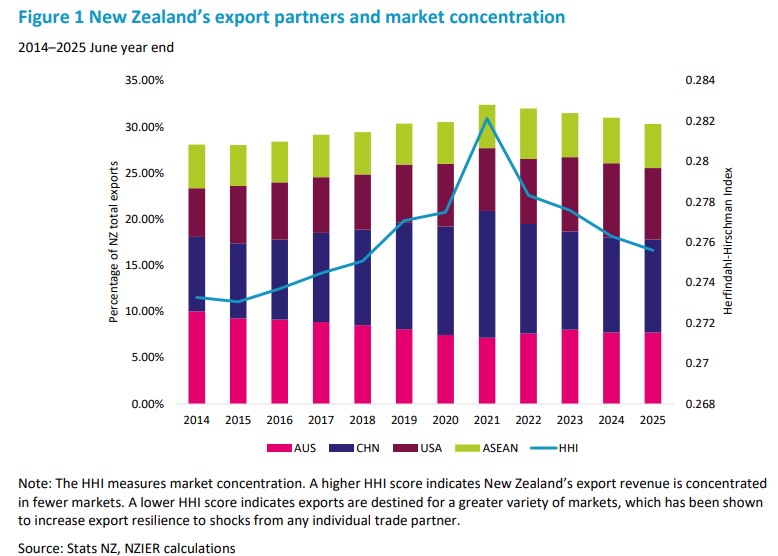
Particularly during the COVID period, New Zealand’s concentration (and exposure to risk) with export partners increased dramatically – see the blue HerfindahlHirschman Index (HHI) in Figure 1, which peaked in 2021. New Zealand’s export concentration had been increasing before and during the COVID period, particularly towards China. However, since then, New Zealand exports have broadened again, with a greater share coming from the US. While New Zealand’s export trade is significantly more diversified than it was in the 70s, it is important to understand that over 20 percent of our total exports are still destined for China, the USA and Australia – an important reality as international trade policy uncertainty and geopolitical rivalries heighten.
Beyond trade flows alone
The significance of the India relationship may also extend beyond direct trade flows.
India is becoming increasingly influential within global economic governance and multilateral negotiations. Its role in institutions such as the World Trade Organization (WTO) has steadily expanded.
Indeed, India has often played a pivotal role in shaping, delaying, or blocking major trade initiatives. Other countries frequently align with India’s negotiating stance, giving it influence that extends beyond its formal economic weight. This has important implications.
For New Zealand, deeper engagement with India is not solely about exports. It is also about maintaining relationships with an increasingly influential actor in the evolving global system.
This does not imply that New Zealand will fundamentally reshape India’s approach to global trade governance. But regular engagement, institutional familiarity, and stronger bilateral relationships may improve New Zealand’s ability to navigate future negotiations and understand emerging policy directions.
The potential benefits of the agreement are also likely to extend beyond trade and investment flows alone. The movement of highly skilled labour can generate wider economic and social gains through productivity, innovation, entrepreneurship, and capability development. New Zealand has historically benefited from skilled migrants from India across a range of sectors, including technology, engineering, academia, health, and professional services.
These contributions often create broader spillover effects through business formation, knowledge transfer, international networks, and stronger commercial links between countries. In this sense, deeper engagement with India may strengthen not only trade relationships but also New Zealand’s longterm economic capability and resilience.
Trade agreements often create ongoing channels of communication that matter well beyond the immediate terms of the agreement.
Risks of overselling the agreement
At the same time, there are risks in overstating the agreement’s likely effects.
Public discussion about trade agreements often gravitates toward large headline numbers, particularly around investment or projected export gains. These claims may be politically attractive, but they can create unrealistic expectations.
This appears particularly relevant in relation to investment. Much of the investment-related discussion surrounding the agreement appears to involve facilitation, encouragement, and ‘best endeavours’ commitments rather than guaranteed capital flows. In practice, investment outcomes will continue to depend primarily on commercial incentives and business decisions.
Furthermore, investment is inherently a long term endeavour; it does not materialise overnight. While China is now New Zealand’s largest trading partner, it remains only our third largest source of investment (New Zealand China Council, 2025). Building investment relationships requires confidence and trust, and those foundations take time to develop.
Trade agreements can reduce barriers and create opportunities. They cannot compel commercially irrational investment. Overstating likely gains creates problems:
- It risks undermining public confidence if large projected outcomes fail to materialise.
- It distracts attention from the more realistic and strategically important aspects of the agreement.
The strongest case for the India FTA is not that it will immediately transform the New Zealand economy. Rather, the agreement’s value lies in:
- securing an institutional foothold
- expanding strategic options
- creating future commercial pathways
- strengthening diversification
- deepening engagement with an increasingly important economy.
These are meaningful benefits, even if they are harder to quantify.
The deeper policy question
Ultimately, the India FTA raises a deeper question about the future direction of New Zealand trade policy.
In a world characterised by slower global growth, geopolitical fragmentation, and constrained negotiating resources, what should trade policy prioritise? Here are two options:
- A focus on agreements with the largest measurable short-term commercial returns.
- Place greater emphasis on strategic positioning, resilience, and future optionality.
The India agreement suggests that New Zealand is increasingly moving toward the second approach. This does not mean abandoning commercial pragmatism. Trade policy still needs to deliver real economic outcomes. But it does suggest a broader conception of what trade agreements are intended to achieve.
Trade agreements are increasingly becoming tools of strategic economic positioning rather than simply mechanisms for tariff reduction. That shift reflects the realities of the current global environment.
In summary
The New Zealand-India FTA is unlikely to transform the economy overnight, and its immediate gains are likely to be modest rather than revolutionary. But the agreement’s significance lies less in short-term trade flows than in strategic positioning.
As the global trading environment becomes more fragmented and uncertain, New
Zealand’s trade policy is increasingly focused on diversification, resilience, and maintaining options. In that context, the India agreement represents an effort to engage early with an economy and geopolitical actor of growing long-term importance.
The central question is therefore not simply whether the agreement maximises immediate commercial gains, but whether it strengthens New Zealand’s position in a changing global economy. That is ultimately a question of strategy as much as trade liberalisation.
References
European Commission (2022) EU and India kick start ambitious trade agenda https://policy.trade.ec.europa.eu/news/euand-india-kick-start-ambitious…
European Commission (2026) EU and India concluded landmark Free Trade Agreement https://ec.europa.eu/commission/presscorner /detail/en/ip_26_184
MFAT (2026) National Interest Analysis: New Zealand – India Free Trade Agreement https://www.mfat.govt.nz/assets/Tradeagreements/NZ-India-FTA/NZ-India-F…
New Zealand China Council and NZIER (2025)
Invested Interests: An Update on the New Zealand-China investment relationships in 2025. https://nzchinacouncil.org.nz/wpcontent/uploads/2025/08/NZ-ChinaInvestm…
Nixon C and Yeabsley J (2002) New Zealand’s Trade Policy Odyssey. NZIER Research Monograph No. 68.
Chris Nixon is Principal Economist at NZIER.
NZIER originally published this report as part of its self-funded Public Good Programme.
We welcome your comments below. If you are not already registered, please register to comment
Remember we welcome robust, respectful and insightful debate. We don't welcome abusive or defamatory comments and will de-register those repeatedly making such comments. Our current comment policy is here.