

The latest Westpac-McDermott Miller Employment Confidence Index shows employment confidence has plummeted to the lowest point in the survey's history.
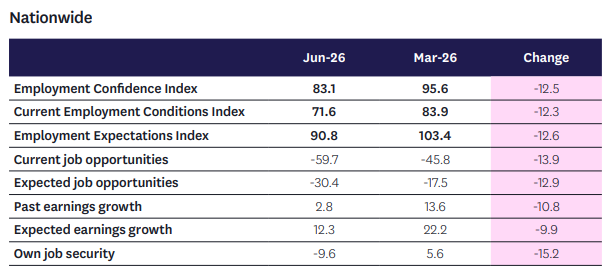
The index fell by 12.5 points to 83.1 in the June quarter. This is the lowest reading for the survey in its almost 22 year history. The survey began in September 2004.
The loss of confidence was shared across all of the survey questions, Westpac senior economist Michael Gordon said, and was “fairly consistent” across regions, ages and income groups.
“We note though that – as with our consumer confidence survey – the results here are very much a product of timing. [...] the latest survey was held in early June, just before the US-Iran peace deal and the largest of the recent declines in fuel prices,” Gordon said.
“So while the survey certainly highlights the downside risks to the labour market outlook for the months ahead, we’ll also be keeping a close eye on higher-frequency indicators such as vacancies and filled jobs, to see how they progress in light of the latest developments,” Gordon said.
Westpac surveyed households between 1st June and 12th June, with a sample size of 1,550.
Renewed job market softness
A net 60% of respondents told Westpac they were experiencing job hunting difficulty.
“The latest reading is consistent with our forecast of renewed softness in the jobs market in the coming months, with the unemployment rate expected to reach a cyclical peak of 5.6% by the end of the year,” Gordon said.
Households in the employment confidence survey were also downbeat about the medium-term outlook, with expected job opportunities in a year falling to a net -30%, close to the record lows seen during the 2008 Global Financial Crisis (GFC).
Gordon said a broader range of indicators also suggest that the Middle East conflict has left employers more wary. But in contrast with the weakness in confidence surveys, job advertisements have been steady over the last few months, though they remain well below pre-Covid-19 levels.
Workers’ perceptions of their own job security fell sharply, reaching their lowest level since the Covid lockdown. The fall in confidence was greatest among young workers, Gordon said, who in turn had seen the greatest improvement in previous quarters.
Only a net 3% of households reported a rise in their earnings over the last year, from a net 14% in the March quarter survey, Westpac found.
“This was close to the record low that we saw during the Covid lockdown, and the more recent cycle lows in early 2025,” Gordon said.
A net 12% of households expect a lift in their earnings in the year ahead, which is the lowest reading in the history of the survey.
“These earnings growth measures have remained at historically low levels in recent years, even through the sharp lift in wage inflation in the years following Covid. We suspect that respondents are viewing this in ‘real’ terms – that is, whether their earnings are keeping pace with, or falling behind, the cost of living,” Gordon said.
Sharp falls regionally
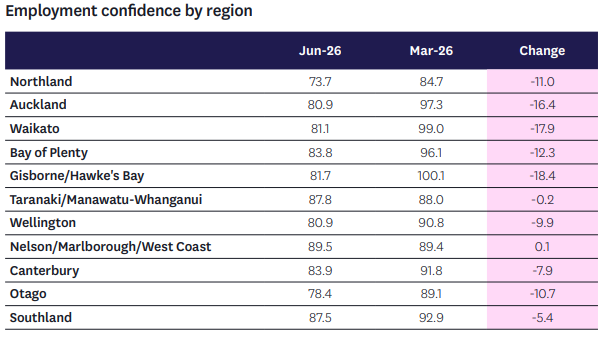
According to Gordon, most regions reported sharp falls in employment confidence in the June quarter, with the North Island tending to see larger falls than in the South Island.
“This corresponds with the general tone of the economic data in recent months, with stronger conditions in the South Island providing more of a buffer against external shocks,” he said.
The largest falls in employment confidence were in the Auckland, Waikato and Gisborne/Hawke’s Bay regions.
“As with our consumer confidence survey, there was a relatively large drop in employment confidence in Otago compared to the rest of the South Island. While strong export commodity prices are still helping to support economic conditions in the region, the outlook for international tourism and hospitality exports has darkened in recent months,” Gordon said.
The two areas that bucked the national trend, with overall employment confidence broadly unchanged for the June quarter, were the Taranaki/Manawatu regions, and the top and west of the South Island.
Consumer confidence
The release of the Westpac-McDermott Miller Consumer Confidence Index painted just as grim a picture last week, with Westpac reporting the index fell by 14.3 points in the June quarter to just 80.4, the lowest level since 2023.
Westpac classifies a level below 100 as indicating that more households are pessimistic about economic conditions than optimistic.
Westpac senior economist Satish Ranchhod described it as the weakest result since 1991. A net 38% of households told Westpac in the consumer confidence survey that they had cut back their spending on dining out and other entertainment activities.
We welcome your comments below. If you are not already registered, please register to comment
Remember we welcome robust, respectful and insightful debate. We don't welcome abusive or defamatory comments and will de-register those repeatedly making such comments. Our current comment policy is here.