
Petrol and diesel prices dropped slightly in May, following two months of rises.
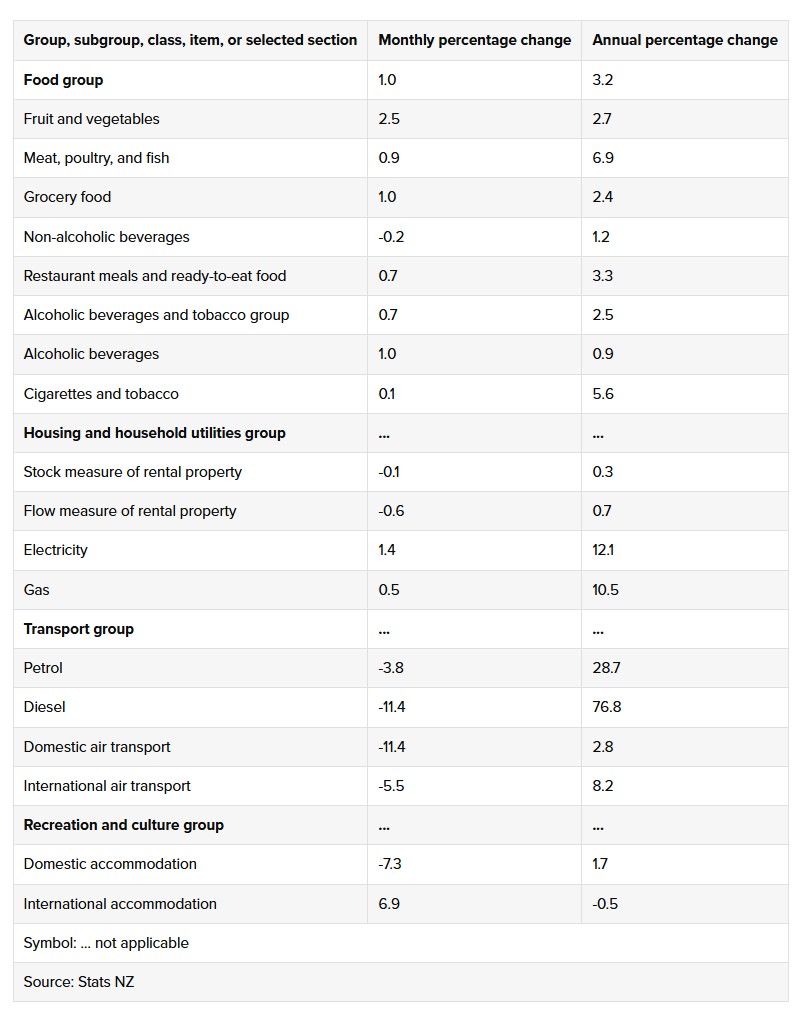
Statistics New Zealand's latest Selected Price Indexes (SPI) figures, released on Tuesday, showed from April to May, petrol prices decreased 3.8% while diesel prices dipped 11.4%.
This follows petrol prices rising 33.6% and diesel a massive 94.9% over the two months from February. In the year to May, prices for these two fuel types increased - petrol was up 28.7% and diesel was up 76.8% - driven by conflict in the Middle East.
The SPI is a monthly series featuring about 47% of the contributors to the quarterly Consumers Price Index (CPI) - New Zealand's official measure of inflation. The SPI also includes monthly data on things like food, alcoholic beverages and tobacco, rental housing, utilities, transport and accommodation services.
Domestic and international airfares
Domestics airfares increased 11.4% monthly, while international airfares jumped 5.5%.
Meanwhile, in the 12 months to May, domestic airfares increased 2.8%, and international airfares jumped 8.2%.
Stats NZ prices and deflators spokesperson Nicola Growden said: "Decreases in airfares were recorded in May 2026, in line with historical trends for the month.”
“Airfares are based on prices set up to 12 months earlier and reflect a range of factors.”
Monthly food prices up 1.0%
Food prices increased 1.0% between April to May. This is a jump as food prices were flat overall between March and April.
The grocery food group contributed the most to the monthly increase, up 1.0% followed by fruit and vegetables which was up 2.5%.
Higher prices for standard 2-litre milk was the largest contributor to the monthly increase as global milk prices rose in May. The weighted average retail price of milk per 2 litres was $5.06 in May, up from $4.86 in April.
Legs of lamb, capsicums and butter were recorded as having price increases while price decreases were recorded for mandarins, boxed chocolates, and frozen desserts.
Food groups continue to see yearly increase
Food prices rose 3.2% in the year to May - this followed a 2.6% rise in the year to April.
All food groups recorded price increases between May 2025 and May 2026.
Prices for the meat, poultry, and fish group rose 6.9% and was the largest contributor to the annual increase in food prices. This was followed by restaurant meals and ready-to-eat food, up 3.3% annually.
Price increases were recorded for milk, blocks of chocolate, white bread, and takeaway coffee while price decreases were recorded for tomatoes and olive oil.
CPI and the Official Cash Rate
The Official Cash Rate (OCR) was held at 2.25% in the Reserve Bank’s May Monetary Policy Statement (MPS). There was a split vote 3-3 between the three senior Reserve Bank (RBNZ) staff on the Monetary Policy Committee, who voted for a hold, and the three external members who voted for a 25-basis point increase.
RBNZ Governor Anna Breman, as chairperson, had the casting vote which meant the OCR was held.
In the March quarter, annual inflation, as measured by the Consumer Price Index (CPI), came in at 3.1%, slightly above the RBNZ’s projections of 3%.
The RBNZ is tasked with maintaining inflation between 1% and 3% based on the CPI, specifically targeting 2%. For the June quarter, the RBNZ is projecting inflation to reach 4.2%.
The OCR will next be reviewed on July 8. The June quarter CPI is due out on July 21.
Although the OCR was left unchanged in May, the RBNZ signalled the holding period may be coming to an end with hikes potentially on the horizon. But speaking to interest.co.nz, RBNZ Assistant Governor Karen Silk couldn’t rule out that the OCR could also be held.
Asked if the conflict in the Middle East ended tomorrow there was a chance the OCR could be held in the future, Silk said: “That’s a possibility. Our forward guidance, which is the OCR track, is at a point in time based on what we know at that point in time.”
With ongoing conflict in the Middle East, who knows what would happen or when it could end, she said, but in the lead up to the next Monetary Policy Review in July, the Reserve Bank should hopefully get a better view.
Silk said: "Even before this happened, we were forecasting a gradual drift up ... The thing we would love to see is to see that more positive change happen and this economy get back into a recovery."
"We were clearly [seeing] in the first quarter of this year - the economy was recovering. It would be fantastic if this just ended up as something which was transitory, and the economy got back on track again."
Food prices index
Select chart tabs
Here is the detailed SPI information for May as supplied by Statistics New Zealand:
We welcome your comments below. If you are not already registered, please register to comment
Remember we welcome robust, respectful and insightful debate. We don't welcome abusive or defamatory comments and will de-register those repeatedly making such comments. Our current comment policy is here.