
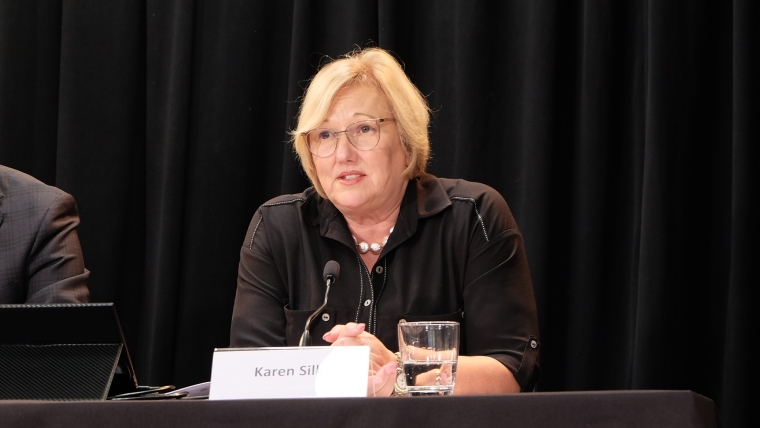
Reserve Bank Assistant Governor Karen Silk isn’t a shy person and she’s more than comfortable standing her ground.
That’s why she doesn’t have any issues with the Reserve Bank’s new approach of making the votes of Monetary Policy Committee members public when consensus hasn't been reached between them over Official Cash Rate (OCR) decisions.
“I don’t have a problem with it at all,” Silk told interest.co.nz. “Everybody’s very comfortable with it.”
On Wednesday, the OCR was left unchanged at 2.25% in the Reserve Bank's May Monetary Policy Statement (MPS). But there was a split vote of 3-3 between the three senior RBNZ staff on the committee, who voted for a hold, and the three external members who voted for a 25-basis point increase.
RBNZ Governor Anna Breman, as chairperson, had the casting vote which meant the OCR was held.
For people on the outside looking in, the split vote was a hot topic. But speaking to interest.co.nz on Friday, Silk said May's meeting wasn't really any different to other meetings they've had.
"Attributing views hasn’t changed the dynamics in the meeting at all.”
'The vibe in the meeting was really good'
And in terms of openness, it was a really good committee, Silk said.
“The process that we follow around sharing our views, information, [and] challenging each other. It’s all really courteous. It’s respectful. But we certainly have very open conversations and nobody’s concerned about holding back in terms of expressing their views.”
Silk said committee members feel comfortable with each other.
“We’re talking about a series of issues. We’re not challenging individuals. We’re challenging and discussing some really deep and complex matters so the vibe in the meeting was really good.”
She said May’s meeting was good, open and respectful.
“It shows a lot of respect when you can actually come to a point where all of us can go, ‘actually we’re really comfortable with saying we have a difference of opinion around some of these things’.”
Asked when it became apparent that a casting vote was needed, Silk said you don’t get to that point until the end.
“The process is set up for us to try and reach a consensus outcome and it’s only when you get towards the end that you are going ‘actually no, I feel very strongly about my position and I don’t think that any argument against it is going to make me change my view or that I’d feel comfortable with a slightly different perspective’, and we don’t formally vote until the morning of the meeting.”
Still a lot of consensus
Despite the split vote, Silk said there was still a lot of consensus as well. There was consensus on the economic forecasts and on the forward guidance through the OCR track.
What people had differences over was the timing, she said.
"That came down to what were people’s judgments around whether we were seeing early signals of more embedding of inflation versus ‘actually I just want to prevent that and so the earlier you go, then maybe you could do that’ versus ‘we’re already seeing a weak economy and a tightening in financial conditions, and maybe that's enough to say we don't need to go just yet.’”
What all committee members agreed on though, she said, was that if they were going to see more inflation coming, they’d have to lean into it.
“And that’s why you do see an upward sloping OCR track.”
'Fantastic if this just ended up as something which was transitory'
Asked if the conflict in the Middle East ended tomorrow there was a chance the OCR could be held in the future, Silk told interest.co.nz: “That’s a possibility. Our forward guidance, which is the OCR track, is at a point in time based on what we know at that point in time.”
But there was another six weeks until the next meeting.
With ongoing conflict in the Middle East, who knows what would happen or when it could end, she said, but over the six-week period, the Reserve Bank should hopefully get a better view.
“We’ve got another six weeks until the next meeting. We’ll have more data,” she said.
"It's uncertain and we're trying to make sense of it on the way through."
Silk said: "Even before this happened, we were forecasting a gradual drift up ... The thing we would love to see is to see that more positive change happen and this economy get back into a recovery."
"We were clearly [seeing] in the first quarter of this year - the economy was recovering. It would be fantastic if this just ended up as something which was transitory, and the economy got back on track again."
We welcome your comments below. If you are not already registered, please register to comment
Remember we welcome robust, respectful and insightful debate. We don't welcome abusive or defamatory comments and will de-register those repeatedly making such comments. Our current comment policy is here.