
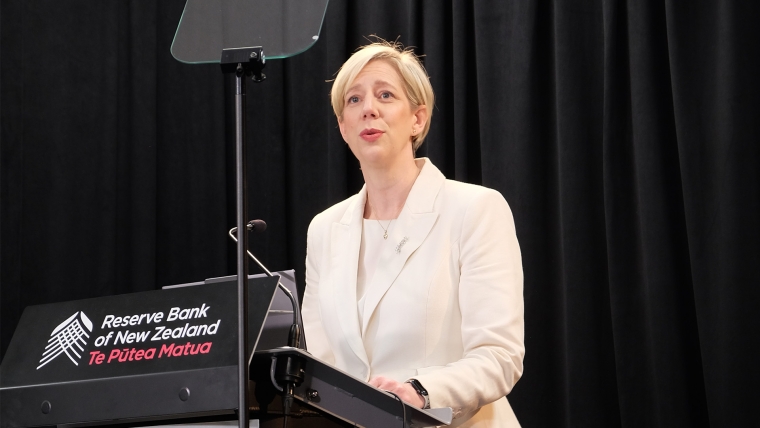
Reserve Bank Governor Anna Breman says her casting Monetary Policy Committee vote was based on an assessment of the upside risk to inflation and outlook for economic growth.
“I made an assessment on how I see these two forces,” Breman told reporters at a press conference on Wednesday.
Her comments follow the May Monetary Policy Statement (MPS) where the Official Cash Rate (OCR) was held at 2.25%.
It's the first time the RBNZ has made the votes of Monetary Policy Committee members public when consensus hasn't been reached between them. This shows a vote split 3-3 between the three senior RBNZ staff on the committee, who voted for a hold, and the three external members, who voted for a 25 basis points increase. Breman, as chairperson, had the casting vote which meant the OCR was held.
Speaking at the post-MPS press conference, Breman said: “Members in favour of raising the OCR were more concerned with the risk of cost pressures leading to stronger second round effects on inflation.”
On the other hand, members in favour of the hold also saw inflationary pressures, Breman said, but emphasised low core inflation, which strips out volatile goods and services such as food and energy prices, subdued wage growth and well anchored medium and long-term inflation expectations.
“These members also put more weight on weak demand and tighter financial conditions as likely to dampen second round price increases.”
Asked what made her certain that holding the OCR was the right move, Breman said: “We all recognise that we have an uncertain global environment currently … I looked at the upside risk to inflation and our main forecast. I also looked at growth and I made an assessment on how I see these two forces.”
On the attributed votes, Breman said the committee welcomed the increased transparency.
Following the OCR announcement, Finance Minister Nicola Willis said the split sent "a really clear message that this is an accountable, transparent Monetary Policy Committee that is judging what are very finely balanced issues in the current global economic environment.”
"That it is judging those factors with all of the data it has to hand, and that even with all of that data, these things are finely balanced, and views may differ."
RBNZ expects to see rising mortgage rates over the coming months
In its MPS, the committee noted New Zealand financial conditions had tightened through higher wholesale interest rates. These were passing through to higher fixed-term mortgage rates and term deposit rates (but to a lesser extent).
“The average interest rate on outstanding mortgages declined to 4.9% in March but is expected to increase to 5.3% over the next 12 months,” the MPS said.
At the press conference, RBNZ Assistant Governor Karen Silk said: “Globally, most central banks are taking a bit more of a wait and see approach. Many economists share that view. At this point in time, markets are looking ahead from that, and looking at future inflationary pressures, and have therefore priced that in already.”
Silk said this fed into near-term wholesale rates and wholesale rates were a key driver to what happens with retail rates.
“We’ve seen mortgage rates increase off the back of that rise in wholesale rates and that’s been informed by what market expectations are.”
Breman said the RBNZ’s forecast suggests average mortgage rates would rise.
“Now that we've seen wholesale interest rates and mortgage rates starting to increase, that will also flow through to the average in the stock, so we do expect to see that over coming months.”
Unemployment seen holding above 5%
The May MPS projects the unemployment rate to be over 5% for the rest of the year and 2027. As of the March quarter, the jobless rate was 5.3%.
Breman said NZ had experienced three years of weak economic growth, but there were some early stages of recovery at the end of last year and at the beginning of 2026.
“This year we actually saw employment growth as well, and now with the global events, this is again hurting and slowing down the economy. So it is a really tough situation, in particular for younger people who have a weaker connection to the labour market.”
The RBNZ projects inflation to peak in the September quarter at 4.3% and to return to its 2% target midpoint in mid-2027. The RBNZ still expects annual inflation to reach 4.2% in the June quarter, unchanged from the April monetary policy review.
The central bank’s target inflation range is 1% to 3%, with a midpoint of 2%.
In the March quarter, annual inflation, as measured by the Consumer Price Index (CPI), came in at 3.1% for the second consecutive quarter.
Breman said: “It’s really important from our perspective that if we don’t get inflation down - we will get inflation down - but if we saw persistence in inflation, that would mean that purchasing power would be weak for a long time.”
“It would weaken the labour market so bringing inflation back to target will mean that we will get purchasing power back, we will get better growth, and we will get a better labour market going forward.”
We welcome your comments below. If you are not already registered, please register to comment
Remember we welcome robust, respectful and insightful debate. We don't welcome abusive or defamatory comments and will de-register those repeatedly making such comments. Our current comment policy is here.