

Westpac says consumer confidence fell sharply in the June quarter as the war in the Middle East “rippled across the global economy” through to New Zealanders' wallets.
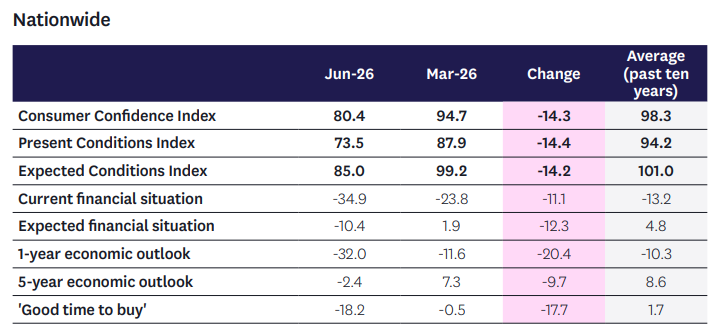
The Westpac-McDermott Miller Consumer Confidence Index fell by 14.3 points in the June quarter to just 80.4, the lowest level since 2023. Westpac classifies a level below 100 as indicating that more households are pessimistic about economic conditions than optimistic.
“In the wake of the Middle East conflict, fuel and other living costs have been pushing higher,” Westpac senior economist Satish Ranchhod said.
“There has also been related upward pressure on borrowing costs and growing concerns about the outlook for economic activity. All of that has been a drag on household spending in recent months.”
Westpac surveyed consumers between 1st June and 12th June, with a sample size of 1,550.
Ranchhod noted that since the survey was completed, US President Donald Trump has announced an agreement has been reached to extend the ceasefire with Iran and open the Strait of Hormuz.
“Assuming the agreement holds, disruptions to oil markets, global shipping and supply chains will take time to ease,” Ranchhod said.
“However, oil prices have already started to drop back and, if this continues, it could pave the way for a recovery in confidence and firming in economic activity through the back part of the year.”
'Weakest result since 1991'
Ranchhod said a net 38% of households told Westpac in the survey that they have cut back their spending on dining out and other entertainment activities.
“That’s the weakest result since 1991, and echoes the reports of tough trading conditions from many hospitality operators in recent months,” he said.
“However, spending on dining out and hospitality is strongly influenced by changes in the cost of essentials like fuel. And with petrol prices dropping back again recently, we could see hospitality spending picking up again over the coming months.”
The latest Selected Price Indexes (SPI) out of Statistics New Zealand show that from April to May, petrol prices decreased 3.8% while diesel prices fell 11.4%. However, in the year to May, prices for these two fuel types increased - petrol up 28.7% and diesel up 76.8% - driven by conflict in the Middle East.
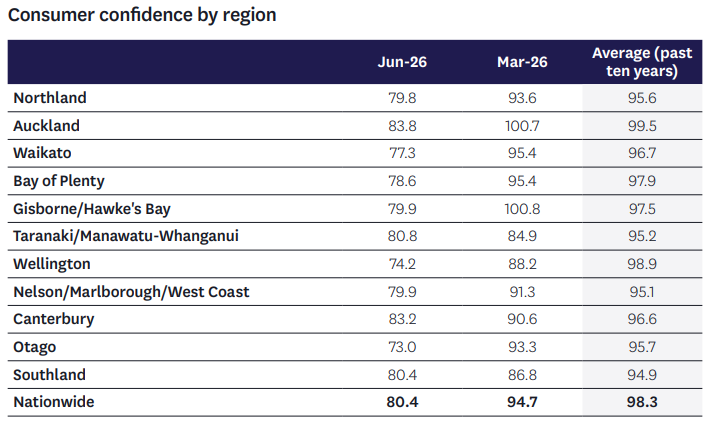
Ranchhod said Wellington remains the “most pessimistic part of the country” due to rising living costs and continued softness in the job market, but noted that consumer confidence is down across New Zealand.
“Confidence has fallen especially sharply in Otago,” he said.
“While strong export commodity prices are still helping to support economic conditions in the region, the outlook for international tourism and hospitality exports has darkened in recent months. That’s a particular concern for those in Queenstown, with a number of operators reporting a drop in bookings.”
Consumer confidence was better in Canterbury, thanks to the continued strength in the dairying sector, according to Ranchhod, which was helping to insulate the region from the financial headwinds that have been slamming into the economy.
“However, even here confidence has taken a sizeable knock,” he said.
We welcome your comments below. If you are not already registered, please register to comment
Remember we welcome robust, respectful and insightful debate. We don't welcome abusive or defamatory comments and will de-register those repeatedly making such comments. Our current comment policy is here.