sign up log in
Want to go ad-free? Find out how, here.

A review of things you need to know before you sign off on Monday; surging exports & imports, lackluster property market, $60 mln carbon tax subsidy, food-for-fuel deal in force, swaps up, NZX on hold, NZD firms, & more

Economy / news
A review of things you need to know before you sign off on Monday; surging exports & imports, lackluster property market, $60 mln carbon tax subsidy, food-for-fuel deal in force, swaps up, NZX on hold, NZD firms, & more
[updated]

Here are the key things you need to know before you leave work today (or if you work from home, before you shutdown your laptop).

MORTGAGE RATE CHANGES
Update: Heartland Bank raised its reverse mortgage rate by +24 bps today to 7.99%. All current mortgage rates are here. And note, you can compare mortgage offers with our unique calculator that takes into account other costs and cashback incentives, here.

TERM DEPOSIT/SAVINGS RATE CHANGES
No changes here either. All updated term deposit rates less than 1 year are here, for 1-5 years, they are here.

SURGING EXPORTS, NO PROGRESS
June was a strong export month with values rising 24.8% from the same month a year ago. Unfortunately most of this was spent on imports, especially electric vehicles which drove imports up +27.6% from year-ago levels. That meant only a +$29 mln trade surplus in June, less than the +$158 mln a year ago, and the +577 mln two years ago.

MORE DETAIL ON EXPORTS & IMPORTS
Export growth to our usual top five destinations were all strong; China (+24%), Australia +(18%), the USA (+43%), Japan (+19%) and Korea (+38%). But very strong growth to Indonesia (+105%), Taiwan (+41%) and Malaysia (+43%) are also worth a mention. Import activity was more mixed and focused on car-buying from countries strong in EVs. But this was largely overshadowed by oil purchases with price rather than volume playing the dominant role. Of note though is the -7% retreat in buying from the USA.

PROPERTY MARKET UPDATE
June's housing market suggested many vendors are becoming more realistic on price which could help get their property sold. The housing market pendulum swung further in buyers' favour in June. See the report here.

SUBSIDING INDUSTRY TO OFFSET CARBON COST
The Government has stumped up $60 mln to support Golden Bay Cement domestic cement manufacturing in Whangarei after owner Fletcher Building threatened to close it and import its requirements. By the way, Holcim had closed its Westport facility in 2016 and has since imported all its NZ requirements, giving it a cost saving that pressured the Fletcher operation. This decision throws into the spotlight that local manufacturing includes the cost of carbon, but imports do not. International cement production seeks out jurisdictions that don't apply carbon costs.

NZX50 LITTLE CHANGED
As at 3pm, the overall NZX50 index is down -0.1% so far today, with a -0.3% weekly retreat. It is up +0.8% from six months ago. From a year ago it is now up +5.5%. Market heavyweight F&P Healthcare is down -0.6% so far today. Fletcher Building, SkyCity casino, Spark and Chorus gain as the NZX50 slips; Investore Property, Oceania, Vulcan Steel and Ryman lead the decliners.

FOOD-FOR-FUEL DEAL NOW IN FORCE
The deal between New Zealand and Singapore on essential supplies is now in force following a ceremony in Auckland on Saturday, 18 July 2026. The Agreement on Trade in Essential Supplies (AOTES) was signed earlier in Singapore. Under this deal Singapore guarantees to supply New Zealand with fuel, medicines, and chemicals. In return, New Zealand guarantees to supply Singapore with food.

RATES ON HOLD IN CHINA
The People’s Bank of China kept its key lending rates at record lows for a 14th straight month in July, as widely expected. The one-year loan prime rate (LPR), the benchmark for most corporate and household borrowing, was held at 3.0%, while the five-year LPR, a reference rate for mortgages, remained at 3.5%.

HOUSING MARKET CORRECTION
In Australia, the latest weekend's residential auction activity was low, possibly back to levels they had in 2018. They are finally having the housing market correction necessary to address their affordability problems.

SWAP RATES FIRM
Wholesale swap rates will likely have resumed theur upward track today. Keep an eye on our chart below which will record the final positions closer to 5pm. The 90 day bank bill rate was up +1 bp at 2.88% on Friday. Today, the Australian 10 year bond yield is up +6 bps from this morning at 4.97%. The China 10 year bond rate up +1 bp at 1.74%. The Japanese 10 year bond is unchanged at 2.71% today. The NZ Government 10 year bond rate is now at 4.73%, up +5 bps from yesterday. (The RBNZ data is now 'prior day' with the Friday rate unchanged at 4.65%.) The UST 10yr yield is up +2 bps at 4.57%.

EQUITIES MIXED
The local equity market has dipped to start the week, now up down -0.2% so far. But the ASX200 is up +0.2%. Tokyo has opened down another -4.0%. Hong Kong is up +1.8% and Shanghai is up +1.6% at its open today on 'home team' buying. Singapore is down -0.1% at its open. Wall Street futures suggest the S&P500 will open up +0.6%.

OIL PRICES RISE AGAIN
American oil prices are up +US$1.50 from this morning with the WTI benchmark now just on US$84/bbl, while the international Brent price is just under US$90/bbl..

CARBON PRICE HOLD
There have been few trades so far today but the price has moved very slightly to $54/NZU. See our daily chart tracker of the NZU price for carbon, courtesy of emsTradepoint.

GOLD ON HOLD
In early Asian trade, gold is up +US$4/oz from this morning, now at US$4021/oz. Silver is up +US$1 at just over US$57/oz but still near its lowest since November 2025.

NZD FIRMER
The Kiwi dollar is up +10 bps against the USD from this morning, now just on 58.5 USc. Against the Aussie we are unchanged at 83.7 AUc. Against the euro we are up +10 bps at 51.2 euro cents. This all means the TWI-5 is now just over 62.4 and up +20 bps from this where we started this morning, aided by an outsized rise again the struggling yen.

BITCOIN LITTLE-CHANGED
The bitcoin price is now at US$64,729 and up +0.3% from this morning. Volatility has been low at just under +/- 0.6%.

Daily exchange rates

Select chart tabs

Source: RBNZ
Source: RBNZ
Source: RBNZ
Source: RBNZ
Source: RBNZ
Source: RBNZ
Source: RBNZ
Source: CoinDesk

Daily swap rates

Select chart tabs

Source: NZFMA
Source: NZFMA
Source: NZFMA
Source: NZFMA
Source: NZFMA
Source: NZFMA
Source: NZFMA

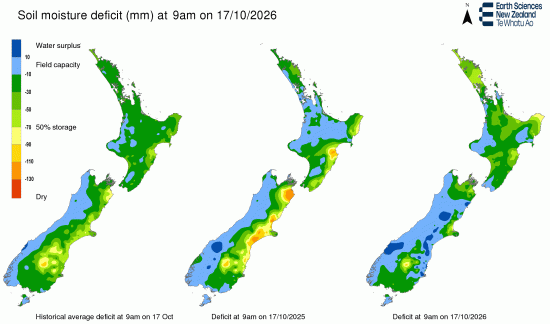
This soil moisture chart is animated here.

Keep abreast of upcoming events by following our Economic Calendar here ».

We welcome your comments below. If you are not already registered, please register to comment

Remember we welcome robust, respectful and insightful debate. We don't welcome abusive or defamatory comments and will de-register those repeatedly making such comments. Our current comment policy is here.

19 Comments

South Korea's KOSPI Index down 4% today. So down 30% in a month. Volatility is worse than in the GFC. SK hynix down 36% in a month, but still up 566% over past 12 months.

http://tradingview.com/chart/i8P2jvrM/?symbol=KRX%3AKOSPI

Imagine that happening in any of the Anglosphere markets. 

Up
1

Space X not really reaching new heights and the new Kimchi ai model is scaring the horses and children.


Up
2

Patrick Boyle was all over it yesterday with one of his entertaining videos:

How to Be Right and Lose Everything

Up
0

Patrick Boyle was all over it yesterday with one of his entertaining videos:

Personally I don't like Boyle. Refuses to make an effort to understand the ol' rat poison.

Boyle is hooked up with Scott Galloway - who hates crypto with a passion but sits on the board of crypto cold storage company Ledger. Hypocrite. 

Up
0

So it sounds like I should listen to Patrick Boyle Phoenix.

Up
1

"Of note though is the -7% retreat in buying from the USA."

Great news. Why finance MAGA? It's like shooting yourself in the foot, using light arms bought from MAGAland by our MAGAlite government. Seems all the coalition butt kissing isn't going to prevent Trump tanking our lamb exports though. 

"United States’ move to initiate a safeguards investigation into lamb imports from New Zealand and Australia. 

US President Donald Trump’s Trade Representative, Jamieson Greer, formally asked for the investigation on Wednesday NZT."

"Any decision to restrict imports, which could include tariffs or quota limits, sits with the US president.  NZ lamb currently faces a 10% tariff in the US."

https://www.farmersweekly.co.nz/markets/sheep-and-beef-markets/us-light…

Up
1

President Clinton did that. The revenue went to the USA sheep farmers and provided for them to increase production of their lamb. Large, fatty lamb somewhere like a NZ ML2 grade mutton carcass but about a third heavier.That combined with high cost inefficient processing serves to accelerate the decline of lamb consumption in the USA. A very good example of the counterproductivity and futility of subsidies of any nature. Much of the product ends up in the food assistance programs anyway.

Up
1

Every EU country now runs a trade deficit with China, and the bloc’s annual deficit exceeds €300 billion.

All the shrieks of protest are about China’s undervalued currency, subsidies and industrial overcapacity shifting the cost onto European industry.

The West is hypocritical. And at least the Orange Swan has been direct about it early, unlike the EU who want to "civilize" the Chinese (woke Green energy ideas when the Chinese are already more advanced in that space). I can't see how the West will impose some kind of Plaza Accord on China. Simply cannot happen.  

https://www.euractiv.com/news/eu-vows-to-maintain-anti-china-trade-tool…

Up
0

The US advantage has suddenly shrunk

The momentum that has powered the AI trade for months has stalled, and the arrival of Kimi K3 now threatens to blow up the most crowded trade in the world.

To be clear, Moonshot AI concedes Kimi K3 still trails Anthropic’s Claude Fable 5 and OpenAI’s GPT-5.6 Sol models on overall performance. But that’s like saying an Olympic champion is still ahead of a come-from-nowhere teenage athlete.

Fable and GPT-5.6 are Anthropic and OpenAI’s bleeding edge, frontier models that were thought to be at least 12 months ahead of any Chinese competitors. But now the gap between the very best frontier models out there and some Chinese upstart might be a matter of months.

Up
3

"Singapore guarantees to supply New Zealand with fuel, medicines, and chemicals. In return, New Zealand guarantees to supply Singapore with food."

Guarantees is a strong commitment. Does it mean Singapore gets first pick should our own production crash for any reason?

Up
1

Trust us

We Muppets have your best interests at heart. 

We are purloining them on behalf of someone else. 

Up
1

I wonder how strong that guarantee would be if say the US threatened to sanction Singapore if they upheld it?

Up
0

If the petrochemical supply stops coming to Singapore, it will be 'producing' diddly-squat. 

Up
0

Theres also that

Up
0

'June was a strong export month with values rising 24.8% from the same month a year ago. Unfortunately most of this was spent on imports, especially electric vehicles which drove imports up +27.6% from year-ago levels. That meant only a +$29 mln trade surplus in June, less than the +$158 mln a year ago, and the +577 mln two years ago...'

Google Gemini has a few words to write on the tradeoff...

To calculate how many years it will take to break even on the reduced fuel imports, we need to compare the national upfront cost of importing these vehicles against the annual fuel import savings they generate for New Zealand.

The exact payback period varies depending on whether we look strictly at pure electric vehicles (BEVs) or the broader category of reduced-emission vehicles (which includes plug-in and standard hybrids).

1. Pure Electric Vehicles (BEVs)

According to data from Stats NZ, New Zealand imported $810 million NZD worth of pure electric vehicles in the year ending June 2026.

  • The Math: The average Kiwi driver saves roughly $2,000 to $2,500 per year on petrol by switching to an EV. However, from a national trade perspective, we only care about the imported cost of that fuel (excluding domestic fuel taxes, retail margins, and local electricity costs). The avoided import cost of fuel is roughly $1,000 to $1,300 per vehicle annually.

  • The Break-Even: When looking at total upfront import costs against national fuel savings, pure EVs reach a macroeconomic break-even point in about 6 to 8 years.

2. The Broader "Reduced-Emission" Category

If we look at the entire subset of low-emission vehicles that drove up the import surge—totaling $2.9 billion NZD (comprising $810m pure EVs, $413m plug-in hybrids, and $1.69 billion standard hybrids):

  • The Break-Even: Because standard hybrids carry a lower premium but yield smaller overall fuel reductions per vehicle compared to pure EVs, the aggregated break-even timeline for the entire $2.9 billion asset class stretches to roughly 8 to 11 years to completely offset their import value via reduced fossil fuel imports.

Summary

While these vehicle imports heavily constrained the June trade surplus down to just +$29 million, they function as a long-term macroeconomic trade-off. New Zealand accepts a temporary, sharp deficit in manufactured imports to permanently shave down its ongoing fossil fuel import bill, paying itself back in 6 to 11 years depending on the specific vehicle mix.

Up
1

It doesn't 'pay back'. 

It merely 'costs less' per time (and indeed your quoted numbers assume 'all else being equal' - which is obviously not the case. 

Put simply, EVs are the right answer to the wrong question. if you ask: Can modernity be maintained? The answer is: NO. 

Ask the obvious supplementary question: Are EVs about modernity? Do they have a place beyond it? And the answers are yes, and no, respectively. 

Then ask how long exponential growth has to go from here - and the answer is: less than the lifetime of any vehicle bought now. By some margin. 

So I'd argue that running existing vehicles out, is the lesser-impact action. 

Up
1

In many cases the owner would have bought a new car regardless. So really it's the difference between the cost of ICE and EV that matters. And these days the difference isn't much. 

Up
0

Cement production support. 

I reckon cement manufacturing is a strategically important capability to retain within NZ.

I note that between 2020 and 2024, NZ production of other strategically important compounds was lost with the closure of Marsden Point: bitumen dropped from 70% locally produced to 0%; and CO² dropped from 100% to less than 10%.

I suspect cost of carbon emissions in NZ, against countries from which these products are imported was a critical element in the closure of Marsden Point. 

Virtue signalling has very real $ costs to NZ and long term vulnerability to import supply risks.

But we have abundant hard gravel supplies building up in many of our rivers, increasing risk of flood protection systems failure. Perhaps our roading network should revert to gravel roads, meaningfully adding to flood risk mitigation and making rail more attractive in the process.

Last bit tongue in cheek. 

Up
1

"Last bit" should improve driving skills stds - eventually.

Up
2